


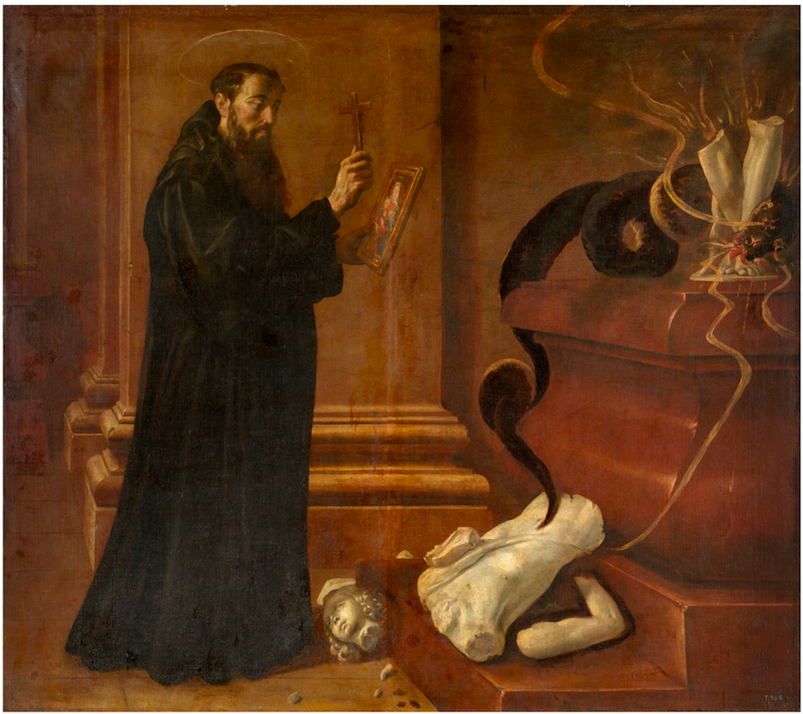
The Patriarch of Western Monks, Saint Benedict Abbot (480-547) (Figure 1), was the founder of one of the longest-lasting religious orders in the entire history of Christianity, the Benedictine Order. This order emerged from reflection on monastic life within the context of the Church.

The lives of saints can be divided into three stages, according to the ideals and circumstances that encompassed the development of Christian religion and the consciousness of Catholic believers. The first stage is associated with martyrs and ascetics during the full struggle against paganism. The second period begins with the activity of Saint Benedict, a time when paganism had not disappeared but there was a common interest in combining study with prayer. Finally, the period that begins with Saint Francis, when Christian Europe has eradicated paganism (Gandía, 1942: 83).
Who was Saint Benedict?
Saint Benedict was born in Nursia (Italy) in 480, during a period of decline in the ancient world, coinciding with the fall of the last Roman emperor of the West. Sources about his life are scarce and mainly rely on the writings of Saint Gregory. He came from an affluent family that sent him to study philosophy and literature in Rome. The Eternal City was inhabited by fervent Christians, pagans, atheists, etc., where people of various beliefs coexisted. Added to this was the youthful atmosphere and corruption evident on its streets. All of this produced a strong rejection and opposition to the saint, leading him to decide to leave Rome and become religious.
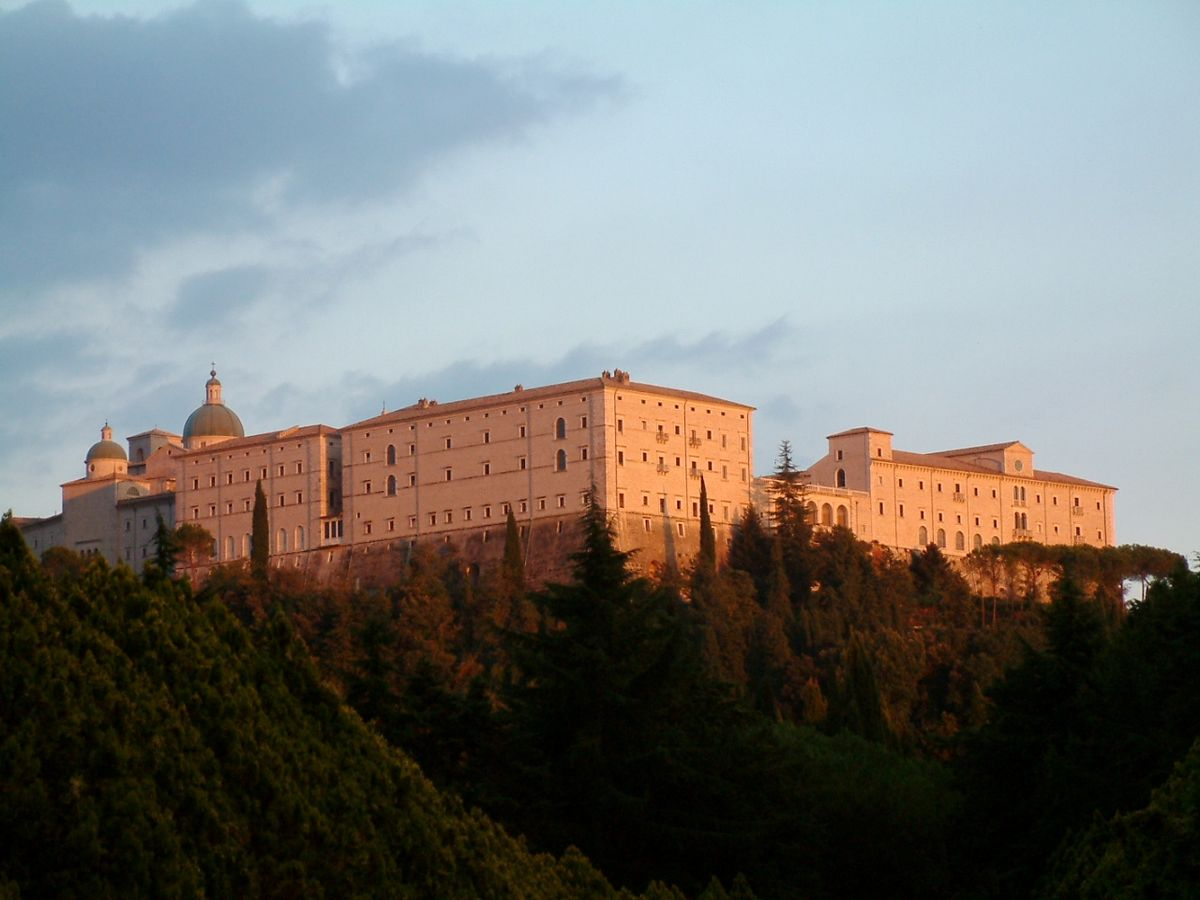
From this point onward, he lived as an hermit for years in a rocky region near Subiaco. Due to his accounts, many people were drawn to him, leading to his move to Monte Cassino. In this area, on the ruins of the temple of Apollo – which the inhabitants of this place had worshipped before his arrival – (Figure 3) he built two chapels and the Abbey of Monte Cassino around the year 530. From here emerged the influence that would play such an important role in the Christianization and civilization of post-Roman Europe.
However, Saint Benedict was not the founder of monasticism. A century earlier, figures such as St. Anthony Abbot and St. Martin of Tours had begun this work. But, why did he stand out in a time when there was such a strong vocation with great precedents?
BENEDICTINE RULE
Saint Benedict stood out for the wisdom of his writings and the organization of the Order, adapting to the social and personal context of monks and community. In the pre-medieval period in which he lived, monastic life lacked uniform legislation. Each community followed its own rule or the orders of a superior (Gandía, 1942: 86-). Thus, The Rule was born.
This writing was based on discretion, balance, and wisdom. It did not distinguish itself for its innovations but rather for the codification of essential norms, at the same time basic for communal life. In it reflects the high biblical-Christian spirituality of the monk and his excellent formation in the Classical Greek-Roman tradition.
For Saint Benedict, The Bible is the primary source from which monastic life springs forth. It collects doctrinal and spiritual principles, that is, the way of life of the community. In The Rule, the figure of the Abbot stands out as a spiritual father and shepherd of monks whose duty is the «charismatic mission», that is, defending the values of monastic tradition in accordance with the personal situations of cenobites (monks in community), making it respected and observed.
How were the first years of the Congregation?
Saint Benedict had the support of his sister Scholastica, who became one of the main propagators of the Order. She was the founder of Benedictine monasteries for women. The Order spread throughout France during its first century since its foundation and over time became one of the most powerful orders in Europe. Roman culture was carried through Benedictine monks to areas of England, Germany, among others, achieving a spiritual and cultural unity that broke with the Discovery of America and Luther's work (Gandía, 1942: 97-98).
How did Benedictine monks live?
The religious life of the Benedictines was based on personal prayer and liturgy, obedience, humility, fraternal charity, abbatial authority, and the practice of good works in search of spiritual purification and God. For spiritual enrichment, they perform the Opus Dei (divine office) and the Lectio Divina (meditative reading of sacred scriptures) (Colombás, 2004: 713).
The traditional motto of the Order was and is Ora et labora, that is, pray and work (the two main occupations of Benedictine monks). In Saint Benedict's time, manual labor was associated with slaves; it was not a task proper to a «decent man». The Abbot dignified it and gave it meaning as collaboration in God's work («theology of work»). The atmosphere that prevailed in the monastery was one of solitude and silence but also community fraternity.
The monks dedicated themselves to constant labor, prayer, and contemplation. Of the twenty-four hours a day, they devoted three and a half hours to prayer, half an hour to meditation, four hours to reading and study, six and a half hours to work, eight and a half hours to sleep, and one hour to meals. In winter, work and reading decreased while sleep and meditation increased.
CONCLUSIONS
To conclude, the internal and external organization of the Order was a social instrument of the Church during the Early Middle Ages, turning the convent into a small state and a kind of democratic center where everyone was heard. Wherever a convent was built, many houses soon gathered around it, and this group of houses became a city. Its Rule is presented in human history as the first monument of legislative art.
BIBLIOGRAPHY
Gandía, Enrique de (1942): San Benito de Nursia. Universidad II. Universidad Nacional del Litoral, 83-98.
García M. Colombás (2004): The Primitive Monasticism. Biblioteca de autores critianos. Madrid.
Giottho, Eduardo (1981): ‘San Benito y la Teología de la Vida Religiosa’, Revista de la Facultad de Teología de la Pontificia Universidad Católica Argentina. 37, 135-148.


Comments