
The phenomenon known as spolia (spoilation) played a key role, not only in the physical construction of the first Christian churches but also in the development of their symbolic and religious meaning (Caballero y Sánchez, 1990). The term spolia is used to refer to the reuse of ancient construction or decorative materials such as sarcophagi, architectural pieces, and liturgical elements in new constructions, etc. The question is: what was its purpose? To answer this question we will focus on the reutilization of paleochristian material in a Romanesque church in Val d’Aran: the Church of Saint Thomas (or Saint Martin) of Casarilh. It should be noted that there are other reused architectural elements from the paleochristian period in Val d’Aran (Coll Pla et al., 2019), such as the stele of Bagergue, the sarcophagus of Betrén, among others. However, we will focus on the sarcophagus of Casarilh (Figure 2) due to its characteristics that we will see later.
But first, let's analyze the purpose of spolia. Fundamentally, there are two purposes when reusing construction materials: an ideological one and a practical one (Esch, 2011, p.23). For example, we find in Tarragona Cathedral a Bethesda-type sarcophagus embedded in its facade in the thirteenth century (Claveria, 1998, p.245). According to Claveria (1998), its function is ornamental and iconographic; however, for Esch (2011) it is ideological, as the sarcophagus goes beyond having a constructive intention. It represents episodes from the life of Jesus, as if in a graphic novel, so that anyone who contemplates the sarcophagus can receive the message. As for the second purpose, this responds to a construction need such as a lack of material with the aim of reducing work time or costs (Esch, 2011, p.23). Some elements from St. Peter's Basilica would fall into this category, as mentioned by Brandenburg (2011):
The warehoused pieces were available on a large scale to the imperial benefactors; they could meet a large demand in a short period of time; and in the luxury of color of
the shafts and the rich designs of the capitals, they could give the basilica a
decoration appropriate to a great public building. There is no room here for
an ideological explanation of their use (p.61)
As we can see, spolia was a strategy used by medieval Christian communities to resignify materials and elements from the Roman or paleochristian world. This strategy played a fundamental role in religious legitimization and the construction of foundational memory, as well as the sacralization of new places of worship. Let's see in more detail what this ideological functionality consisted of:
- Religious legitimacy and foundational memory
The reuse of sarcophagi and columns from Roman or paleochristian times allowed Christian communities to reinforce their legitimacy through the connection of the place of worship with antiquity or the venerable apostolic past.
- Sacralization of spaces
Pagan spaces were converted into places of Christian worship through sarcophagi or biblical reliefs. This all sacralized the building and established a continuity between tradition and the new cult. We find this same phenomenon in recently Christianized rural areas like Val d’Aran, where embedding a sarcophagus in the facade of a church reinforced the Christianization of the place of worship.
- Development of an educational and catechetical function
In some cases, symbolic reliefs found on recycled objects also serve an educational purpose. Biblical passages were represented as seen in the Bethesda sarcophagus at Tarragona Cathedral.
Once we have seen the general characteristics of spolia, let's look at a specific example found in the Church of Saint Thomas of Casarilh, in Val d’Aran (Figure 1) to illustrate what has been discussed.

At the base of the bell tower of the Romanesque church, built around the twelfth century, there is an embedded marble front (Figure 2) that probably comes from a paleochristian sarcophagus (Pladevall i Font, 1994: 426).
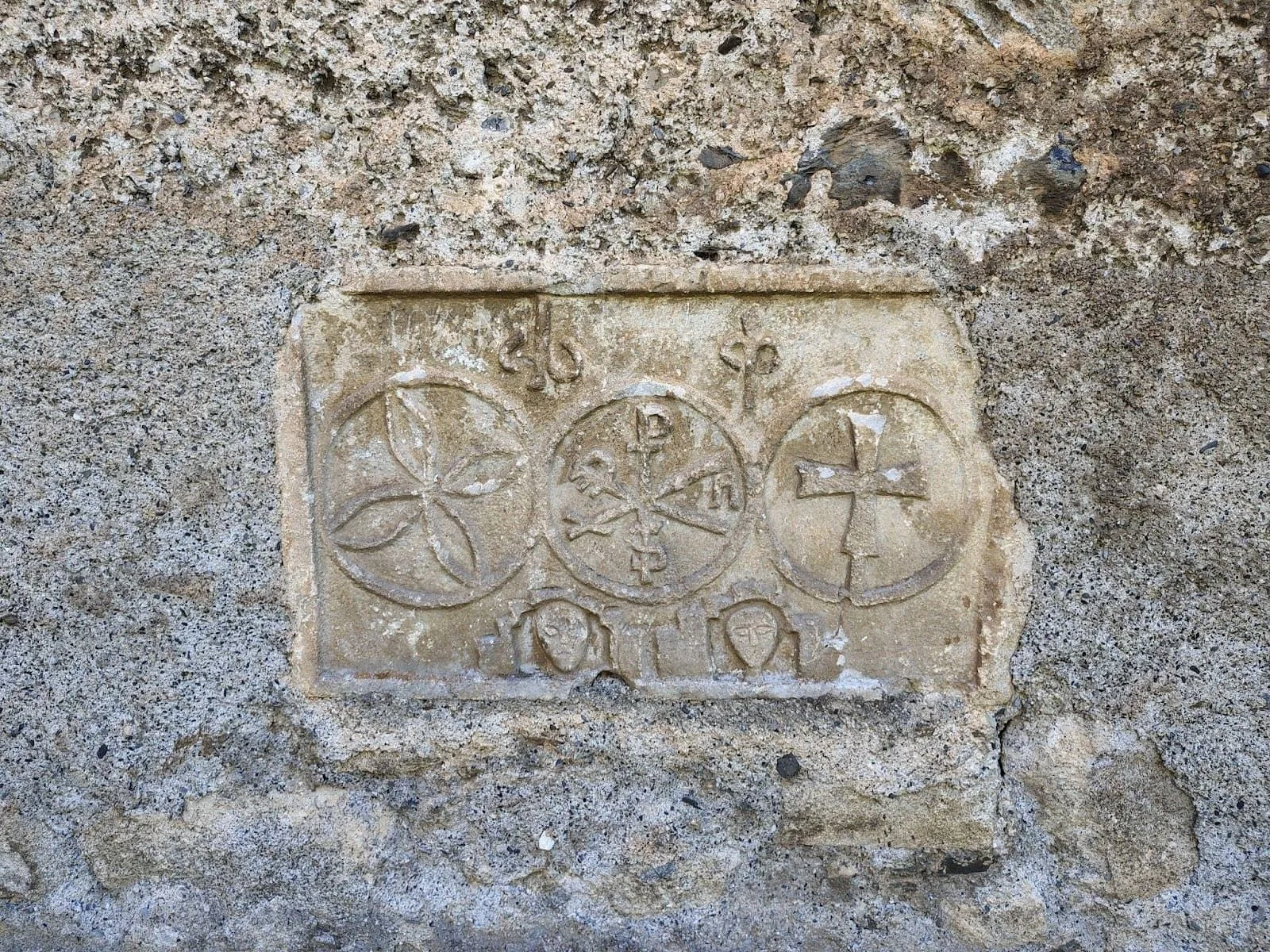
This sarcophagus measures 92 x 54 cm and features three circles contained within each other and tangent to one another. In them, a four-petal flower, a crismón, and a Greek cross are carved respectively. At the bottom, two human faces framed by two stepped arches can be observed, while at the top there are two fleur-de-lis flowers, one of which is pointing downwards.
The crismón represents Christ's monogram. It consists of the first two Greek letters of "Christ," ji (X) and rho (P), usually within a circle. The term comes from medieval Latin “chrismon,” which is an acronym for “Christi monogramma.” Crismons in the Pyrenees are found in several buildings as reused material (Camps, 2019). It is common to see them accompanied by the letters alpha (A) and omega (Ω). However, in the case of the Casarilh crismón, it seems that the letter omega (Ω) was not reproduced correctly from the model, hence why it is at least curious to observe. Olañeta (2017), regarding this, comments:
The reading as pax vobis could justify the presence of the letters i and v in certain crismons in the Aran Valley and Pallars Sobirà valleys. This provides an explanation for the peculiar closed form that omega takes in all these pieces (except Casarilh and Alós d’Isil, where the strange omega is a result, rather, of incorrect reproduction of the model) (p.110)
The four-petal flower could be a solar symbol used already in Iberian times (Pladevall i Font, 1994). It represents the immortality of the soul and also appears during paleochristian, Visigothic, and pre-Roman periods.
Lastly, the two faces at the bottom of the slab could be Adam and Eve in Paradise (Pladevall i Font, 1994), where the person who lay in the tomb expected to reach after death.
In the churches of Sant Feliu de Vilac and Sant Pèir d’Escunhau, also in Val d’Aran, we find a crismón accompanied by two stars. Both the crismón and the Greek cross are motifs found on paleochristian sarcophagi. The embedded sarcophagus in Casarilh's bell tower is another example of reusing a paleochristian funerary piece placed in an altomedieval church (Caballero y Sánchez, 1990).
The phenomenon of spolia in Val d’Aran is an example of how the practical relates to the symbolic. The Casarilh sarcophagus not only served constructive purposes but also
played a role in sacralizing space and religious legitimization. The ideological and educational load was clearly manifested. This, in turn, allowed for a connection with the sacred past and apostolic tradition, reinforcing its memory as a Christian community. The Casarilh sarcophagus, like other reused elements from paleochristianism in Val d’Aran, are examples of how an element acquires different symbolic meanings throughout its life. Spolia implies resignification: To adapt or perish.
Bibliography
Brandenburg, H. (2011). The Use of older elements in the architecture of fourth and fifth-century Rome: a contribution to the evaluation of spolia. In R. Briliant and D. Kinney (Eds.), Reuse value: Spolia and appropriation in art and architecture from Constantine to Sherrie Levine (pp.53-73). Ashgate Publishing.
Caballero Zoreda, L., & Sánchez Santos, J. C. (1990). Reutilizations of Roman material in Christian worship buildings. In Cristianismo y aculturación en tiempos del Imperio Romano, Antigüedad y Cristianismo (Murcia), 7, 431-462. Universidad de Murcia, Museo Arqueológico Nacional.
Camps i Sòria, J. (2018). Romanesque sculpture in the Aran Valley. In Conselh Generau d’Aran (Ed.), Aran me fecit: Des mèstres constructors ara recèrca deth patrimòni sacre (pp. 224-226). Conselh Generau d’Aran.
Claveria, M. (1998). The reuse of Roman sarcophagi in Catalonia. AnMurcia, 13-14, 241-250.
Coll Pla, S., Puche Fontanilles, J. M., Solà Morales, P. de, & Toldrà, J. M. (2019). Persistence of late antiquity in the architecture of Val d’Aran. In Tarraco Biennal: Actes 4t Congrés Internacional d’Arqueologia i Món Antic (pp. 235-250).
Institut Català d’Arqueologia Clàssica / Escola d’Arquitectura de Reus, Universitat Rovira i Virgili.
Conselh Generau d’Aran. (2018). Aran me fecit: Des mèstres constructors ara recèrca deth patrimòni sacre. Conselh Generau d’Aran. https://productes.conselharan.org/producto/aran-me-fecit/
Esch, A. (2011). On the reuse of antiquity: The perspective of the archaeologist and of the historian. In R. Briliant and D. Kinney (Eds.), Reuse value: Spolia and appropriation in art and architecture from Constantine to Sherrie Levine (pp. 13-32). Ashgate Publishing.
Olañeta Molina, J. A. (2017). From Rome to the Pyrenees. Genesis, evolution, and reading of the crismón. In D. J. Buesa (Coord.), Enciclopedia del Románico en la provincia de Huesca (pp. 97-130). Fundación Santa María la Real del Patrimonio Histórico.
Pladevall i Font, A. (Director). (1994). Catalunya romànica XIII: Solsonès, Val d’Aran. Enciclopèdia Catalana.


Comments