
Death is defined as a passage, a transition. The funeral ritual is a rite of passage between two opposite spaces, that of life and that of death. The deceased undergoes a process of transition through successive transformations to make the spirit pass from an inferior plane to a superior one, from the subterranean realm to the celestial, from human to divine.
Thomas (1983: 473)
Introduction
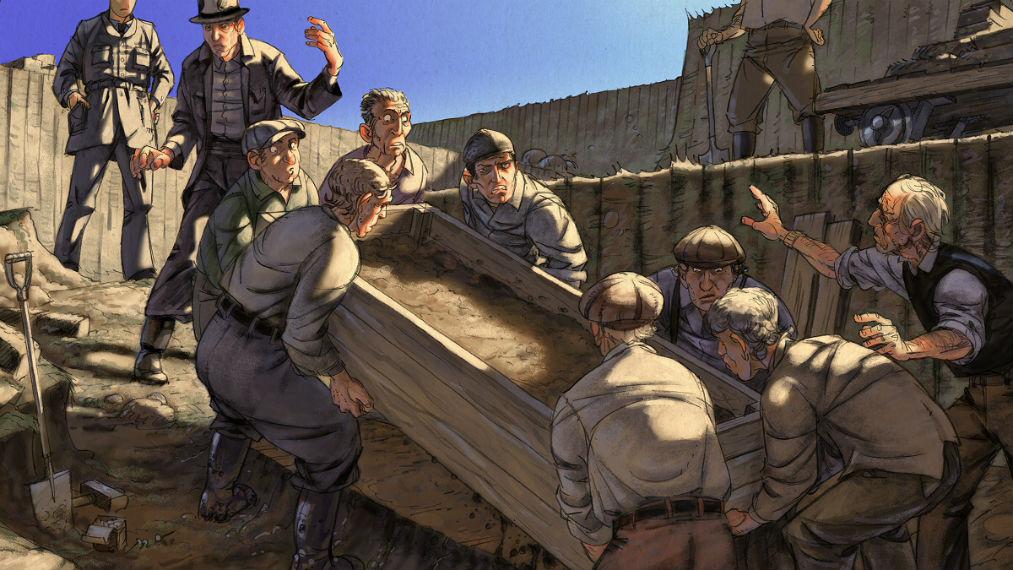
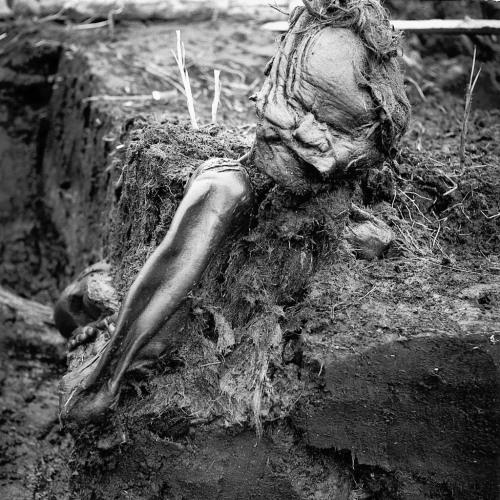
A calm day of work was expected in the peat bog of Silkeborg (Denmark) that morning in May 1950. Nothing suggested that what they were about to extract would be far from ordinary turf: a lifeless body of a man. Alarmed by what seemed like a recent crime, the workers called the police. To their surprise, it was sent not to the homicide department but to the National Museum of Denmark (fig. 1). Thus came to light the Tollund Man, one of more than 2,000 well-preserved mummies found since the nineteenth century in peat bogs and swamps across wet Europe.
This could be the beginning of a novel, but we are faced with the story of how one of the most important and well-preserved mummies to date was discovered. Observed, admired, and studied, the Tollund Man is a gateway to knowledge about past populations, their way of life, their belief systems, and their relationship with death.
Death produces terror, fascination, curiosity, and interest in equal measure in humans. Concern with death is inherent to human nature, and every society has faced it with the tools at its disposal, resulting in each culture having a unique funerary ritual that sets it apart (Martínez Blanco and Pérez Guzmán, 2017: 75).
Under the term "Archaeology of Death," coined in the eighties of the last century (Chapman et al., 1981), scientific studies are carried out on funerary archaeological remains that have reached us (Thompson, 2015). Several disciplines come together in multidisciplinary works to piece together the puzzle of the past. History, Archaeology, Forensic Anthropology, Paleopathology, Paleodemography, Genetics, Palynology, Anthracology, Linguistics, Nutrition and a long etcetera complement each other in Death Archaeology.
It will be precisely through these disciplines that we approach the study and understanding of European peat bog and swamp mummies. How, when, why, and under what circumstances they died, and which phenomena have allowed them to still appear today will be questions to which we aim to provide clear answers. To do so, we will look at the types of mummies found in archaeological records and their processes of mummification. We will pay special attention to mummies from European swamps and why they have been preserved in such an extraordinary way before studying the causes of their deaths and why these occurred under those circumstances.
Types of Mummies
A mummy is a corpse, either human or animal. Here we will focus on the former. The human body is mostly made up of water and upon death undergoes liquefaction, the decomposition of cells into liquids and gases. This is what we call the process of postmortem decay (Peña, J. A., Bustos Saldaña, R., Verdín G., O., 2019: 26-29). The bacteria responsible for decomposing corpses need two things to live: water and oxygen. When either is lacking, the process slows down and can come to a complete halt. Thus, a mummy is a corpse that has dried out without undergoing this process and retains an easily recognizable physical appearance (Parra Ortiz, 2015: 62-64).
Depending on how the postmortem decay process was halted, we can find natural mummies or artificial ones. We speak of natural mummies when a body has been preserved thanks to certain environmental conditions in an spontaneous manner without human intervention (Peña, J. A., Bustos Saldaña, R., Verdín G., O., 2019: 30). We say that a mummy is artificial if the corpse was mummified due to human intervention, carrying out specific embalming processes (Trancho, 2012: 249).
Within the category of natural mummies, we can distinguish three groups according to the factor that has intervened in the mummification:
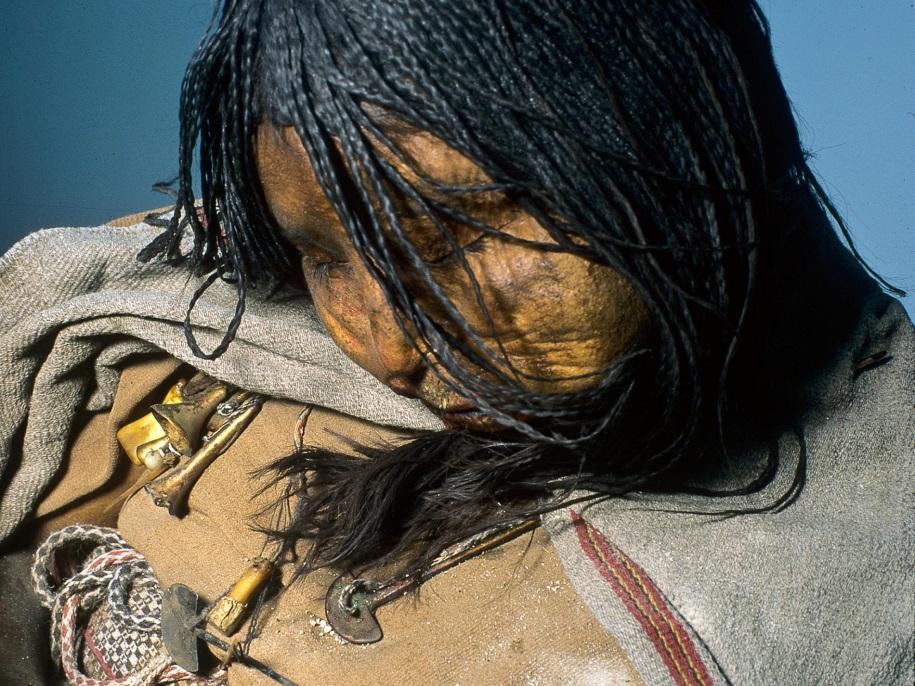
- Dry Mummies: This occurs in arid zones where water loss from the body is very rapid and in areas where temperature creates unique environmental conditions. Zones such as deserts or volcanic caves are perfect for this type of mummification to occur. Examples of both include the first mummies of the Nile Valley, where the dryness and high temperatures of the desert allowed bodies buried in the sand to be preserved; or the Andean mummies of Llullaillaco (Argentina) (Santa Cruz Javier, 2017: 12), where at the summit of the volcano and an altitude of 6,700 meters, they froze and dehydrated (Ceruti, 2018: 126s). In this last case it is a "naturally intentional mummy," as they were deposited there intentionally and, being seated, favored that liquids from the abdominal cavity migrated out of the body (Ceruti, 2012: 90s) (fig. 2).
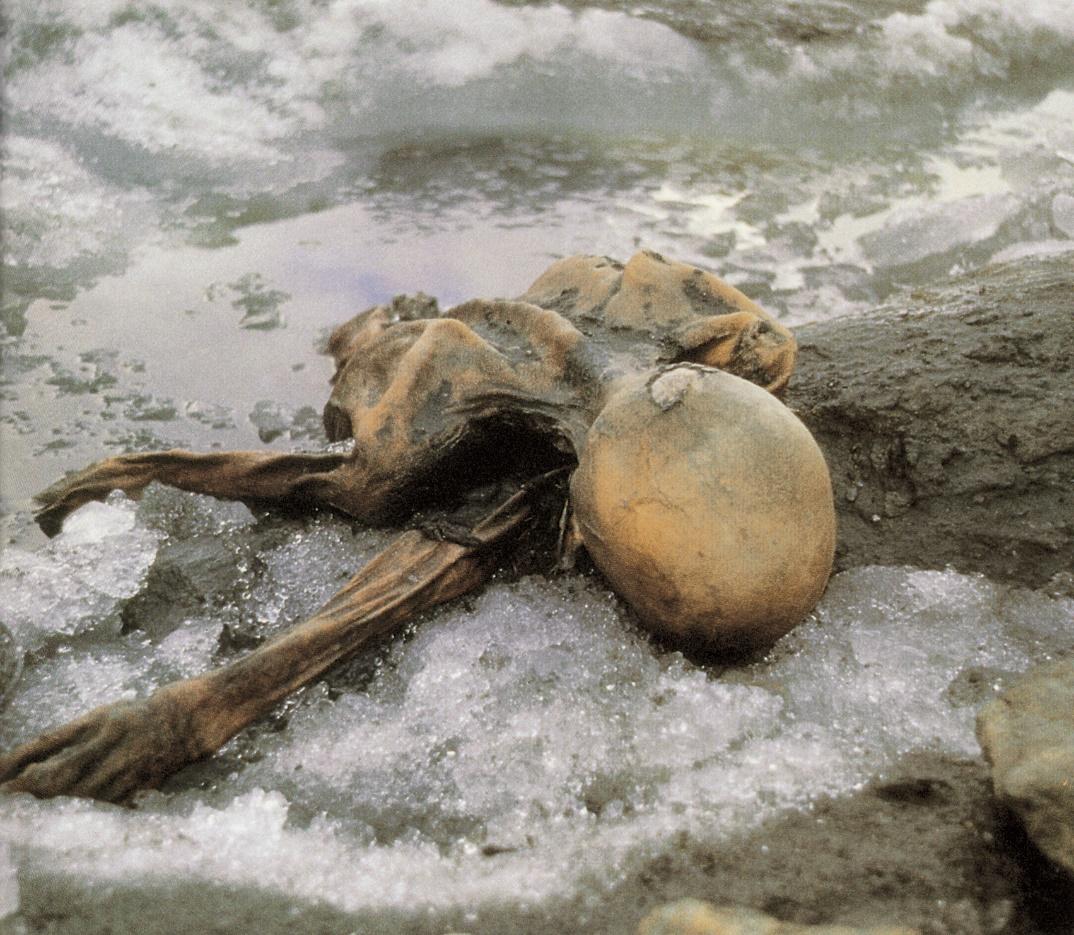
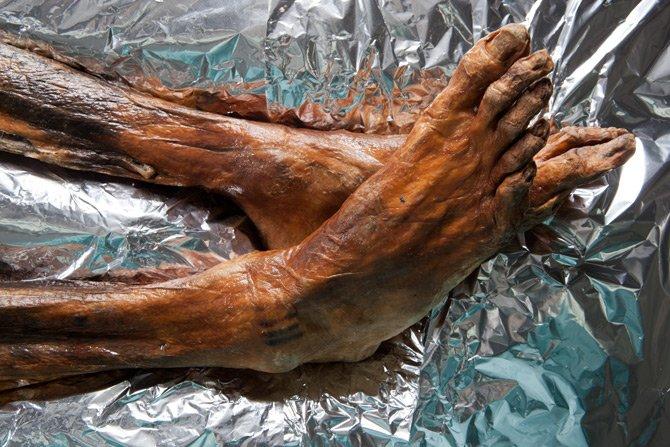
- Cold Mummies: This process would act like our home freezer. Low temperatures minimize bacterial action, preventing decomposition. These conditions are found in mountain peaks with perpetual snow or permafrost zones where dehydration by sublimation is also possible. This type of mummy only remains preserved in this state while environmental conditions remain stable; if they thaw, the decomposition process will begin (known as "living" mummies) (Trancho, 2012: 250). In this category we include the so-called Iceman, Ötzi, found in the Alps in 1991, and whose death has been dated to 3350-3100 cal BP (VVAA, 2009: 59) (fig. 3 and 4).
- Muddy Mummies: Their preservation has been possible thanks to the acidity and lack of oxygen in the peat bogs where they were thrown (fig. 5). In them we will focus on the next point.

If we talk about artificial mummies (those in which humans have intervened intentionally), the first example that comes to mind is the Egyptian mummies (fig. 6). The Egyptians, for millennia, worked on perfecting the art of embalming. Although there were many variants carried out, we will detail the type of mummification that was performed during the New Kingdom (1539-1075 BC), a period in which we can speak of the golden age of Egyptian mummification (Parra Ortiz 2015, 71–74). Generally speaking, a typical embalming process lasted about 70 days and involved a total of 14 steps:
- 1. Transporting the deceased to a temporary structure, a kind of tent, where the body was stripped and washed (seh-netjer or "divine cabin" when it involved royalty; ibu en hab or "purification tent" for common people).
- 2. Transporting the clean body to the embalmers' workshop, known as wabet wat ("pure place") or per nefer ("beautiful place").
- 3. On the operating table, extracting the brain through a hole made in the ethmoid bone of the nose. Sometimes access was via the foramen magnum or the eye socket.
- 4. Eviscerating the corpse through an incision on the left side of the abdomen. The heart was left in place because it was considered by Egyptians to be the seat of reason.
- 5. Cleaning and disinfecting the cavity with water and palm wine.
- 6. Drying out the extracted organs separately before being placed inside canopic jars.
- 7. Introducing material for stuffing the body so that it did not lose its shape while also drying from within: packets of natron to dry, linen to absorb liquids, resin to disinfect and myrrh to give a pleasant scent.
- 8. General desiccation of the body by covering it with solid natron, for 40 days.
- 9. Removing the body from the natron, cleaning it, and emptying its stuffing.
- 10. Restoring the corpse's natural appearance: filling the cranial cavity with resin, and the body with packets of natron, sand, and onions.
- 11. Plugging the head orifices and placing a cloth with drawn eyes over the deceased’s eyes, along with makeup on the face.
- 12. Anointing the body with aromatic oils to give it an appealing appearance and scent.
- 13. Sealing the body with liquid resin.
- 14. Wrapping.

Not everyone could afford this process, so depending on the individual's financial status, all or only part of these steps would be carried out (fig. 7).

Mummies from Swamps and Peat Bogs
Few swamps have the conditions necessary for a body to be preserved (Renfrew and Bahn, 2007: 60s). These conditions are: low temperatures that minimize bacterial action preventing decomposition; absence of oxygen which slows or halts postmortem bacterial activity; humic acid, a substance derived from sphagnum moss in swamps after chemical processes, which prevents bacteria from acting and rotting the skin, giving these mummies their characteristic dark color as if they were tanned leather (Pringle, 2002: 103s). (Fig. 8) The conjunction of these factors allows for such extraordinary preservation that we can even know what was the last meal ingested before death. Thus it is no surprise that workers in that Danish peat bog mistook an ancient mummy for a recent crime scene. This was not an isolated case, as there are records of churches where funerals have been documented for other bodies found under similar circumstances (Grilletto, 1989: 102).
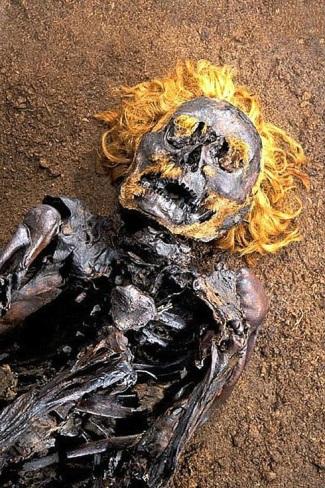
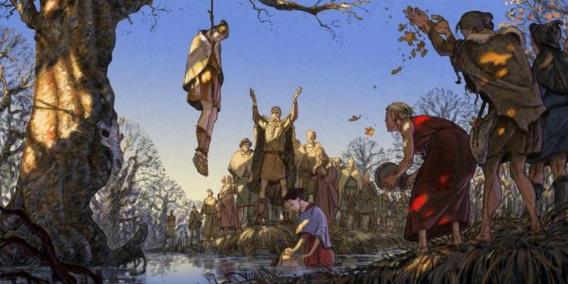
But why have more than 2,000 mummified bodies been found in swamps and peat bogs? Men, women, and sometimes children have been found there. Anthropological and paleopathological analyses of these bodies have determined that they suffered violent deaths. From the study of perimortem and postmortem injuries we know that many were hanged, bled to death, or drowned. Others also had their limbs broken or their heads crushed. The Tollund Man, the Grauballe Man, the Windeby Girl (41 cal BP-118 cal AD) (Gebühr, 2002: 47), and the Neu Versen Man (known as "Red Franz") (135-385 cal AD) (van der Plicht et al., 2004: 483s) are some named examples of these violent deaths (fig. 9).

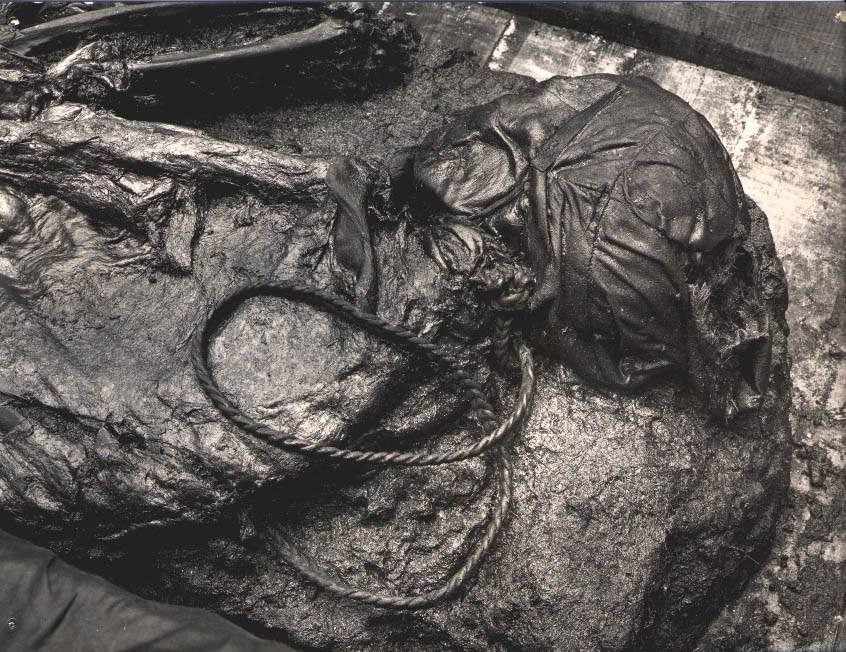
Thus, we know that the Tollund Man (405–380 cal BC) (Nielsen et al., 2018) was strangled by being hanged from a tree but his neck was not broken (fig. 10). He is surrounded by a braided cord of two strands with which he was hanged. Care was taken when depositing him in the swamp after death, closing his eyes and mouth, and placing him as if sleeping (fig. 11). Even today he continues to sleep peacefully in his eternal slumber (fig. 12). The Grauballe Man (400-200 cal BC.) had a deep cut across his neck from ear to ear that reached the vertebrae. He also has skull fractures and a left tibia fracture, caused by blows with a blunt object (Grilletto 1989, 105). We can also observe bone decalcification due to sphagnan, humic acid, and transient compounds between them, which causes human bones to soften, deforming under the weight of peat (Pringle, 2002: 103s). This is most noticeable in his skull, deformed by the weight of the ground covering it (fig. 13) (Haywood, 2016).
Why they died and how they ended up in these swamps and peat bogs will be questions answered in future publications.

Bibliography
Ceruti, M.C.:
- (2012). “The children of Llullaillaco and other Andean mummies: health, folklore, identity”. Scripta Ethnologica 34, 89–104.
- (2018). “Of mummies and child sacrifices: considerations for a South American archaeology of childhood.” Revista de Arqueología Espacial: Archaeology of Childhood, Brazilian Archaeological Society 31, 118-133.
Chapman, I. Kinnes, K. Randsborg (Eds.). (1981). The archaeology of Death, Cambridge, Cambridge University Press.
Grilletto, R. (1989). Mummies: from the pyramids to the crypts, from Danish peat bogs to scientists' offices, a fascinating journey through time and space. EDAF, Madrid.
Haywood, J. (2016). The men of the north: the viking saga. Ariel, Barcelona.
Martínez Blanco, C., Pérez Guzmán, I. (2017). “Analysis of cremated remains: to exclude or not to exclude? Can we find representative fragments?” in Times change, from stone to keyboard, X Young Researchers Archaeology Conference, Association of History and Archaeology of Burgos, 74-83.
Nielsen, N.H., Philippsen, B., Kanstrup, M., Olsen, J. (2018). “Diet and Radiocarbon Dating of Tollund Man: New Analyses of an Iron Age Bog Body from Denmark”. Radiocarbon 60, 1533–1545. https://doi.org/10.1017/RDC.2018.127
Parra Ortiz, J.M. (2015). Mummies: the defeat of death in ancient Egypt. Crítica, Barcelona.
Peña, J. A., Bustos Saldaña, R., Verdín G., O. (2019). “Cadaveric phenomena and forensic diagnosis,” International Journal of Forensic Sciences 31, 10-37.
Pringle, H. (2002), The mystery of the mummies: science and the ancient obsession with conquering death, Grijalbo, Barcelona.
Renfrew, C., Bahn, P.G. (2007). Archaeology: theory, methods, and practice, 3rd ed. Akal, Madrid.
Santa Cruz Javier, M.R. (2017). Childhood and Gender Archaeology. The case of the Llullaillaco Children (Argentina). Autonomous University of Madrid. Faculty of Philosophy and Letters.
Thompson, T. (Ed.). (2015). The archaeology of cremation. Burned Human Remains in Funerary Studies. Studies in Funerary Archaeology. Volume 8. Oxford/Philadelphia: Oxbow Books.
Trancho, G.J. (2012). “The bodies of the past: natural and artificial mummification.” Jornadas sobre Antropología de la muerte. Identidad, creencias y ritual, 247-274.
van der Plicht, J., van der Sanden, W.A.B., Aerts, A.T., Streurman, H.J. (2004), «Dating bog bodies by means of 14C-AMS», Journal of Archaeological Science 31, 471–491. VVAA. (2009). Archaeology: the most important archaeological sites and cultural treasures in the world. Blume, Barcelona.


Comments