


In a previous article, we discussed Cesarión, the eldest son of Cleopatra and, had circumstances been different, also the eldest son of Caesar. However, Cleopatra's lineage will not end with her death, as she will have three more children from her union with Mark Antony, whom we will discuss in this article.
What happened after Caesar's death?
After the assassination of Caesar on March 15, 44 BC, Cleopatra returned to Egypt fearing for her son's life since in the dictator’s will, his adopted son Octavian was named heir, better known by the title Augustus.
Meanwhile, political chaos reigned in Rome as the Senate lacked the strength to restore its regime. Real power fell into the hands of Caesar's lieutenants, Mark Antony and Marcus Aemilius Lepidus. The former took control of the situation attempting to embody a new dictator following his predecessor’s footsteps. However, his ambitions were thwarted by the arrival of Octavian. Initially siding with the Senate, Octavian would later ally himself with Mark Antony, sponsored by Lepidus, forming what was known as the Second Triumvirate (43 BC), which was essentially a hybrid between triumvirate and dictatorship (Roldán et al., 1989: 13-16).
One of the first actions taken by this new triumvirate was to confront Caesar's assassins, Marcus Junius Brutus and Gaius Cassius Longinus, who were defeated in the Battle of Philippi (42 BC). Following their victory, there was a division of territories, with Mark Antony being put in charge of the East (Barceló and Ferrer Maestro, 2007: 231).

Mark Antony and Cleopatra
The first meeting between the triumvirate leader and the Egyptian queen took place in Tarsus, southern Turkey, in 41 BC. There they laid the groundwork for a joint project for the eastern Mediterranean, where both satisfied their personal interests: Mark Antony needed Egypt's wealth and strategic location to manage his territories as well as initiate war against the Parthians. On the other hand, Cleopatra sought to strengthen her position and that of her son now that she no longer had Caesar’s protection, in addition to expanding her territory (Domínguez Arranz and Puyadas Rupérez, 2014: 820).

As with Caesar, Mark Antony decided to stay in Alexandria for a while with the queen, with whom he also had an amorous relationship. From this encounter were born twins Alexander Helios and Cleopatra Selene (Roldán et al., 1989:27). However, this stay was interrupted in the spring of 40 BC when his presence was required in Italy. He would not return to the East until late 37 BC, when he resumed his relationship with Cleopatra and had their third child, Ptolemy Philadelphus.

This relationship was not without conditions on the part of the Ptolemaic monarch, which were accepted in full by the Roman general. Thus, in 34 BC, they proclaimed the Donations of Alexandria, which claimed Caesarion as the legitimate heir to Caesar, distributed the East among Cleopatra's children and requested a divorce from Mark Antony with Octavia, Augustus' sister, thus definitively breaking ties with Rome (Novillo López, 2013:121).
War was declared against Cleopatra, accused of wanting to dominate the East, as her husband's provinces had passed into her hands and those of her children. The decisive moment of this confrontation would be the Battle of Actium in 31 BC, where the eastern side was defeated (Cid López, 2000: 138). We all know how history ended, as it has inspired countless literary works about the tragic fate of the couple.

But what happened to their children?
We already know the tragedy of Caesarion, who was assassinated in Alexandria at 17 years old. As for his siblings, they were taken to Rome and paraded as prisoners during Octavian's triumphal procession. According to Dio Cassius (LI, 21,8), they were later given to Octavia to raise alongside the other children she had with Mark Antony. Of the two boys, nothing is mentioned again in Greco-Roman sources. In contrast, we know more about Cleopatra Selene.
In 25 BC, she was married to Juba II of Numidia. Shortly after, they were given the newly created Kingdom of Mauretania, which would be under Roman influence. Thus, Cleopatra Selene —to whom in the Donations of Alexandria had been granted sovereignty over Cyrenaica and Libya— became queen once again. The couple ruled these territories for almost two decades until her premature death (Puyadas Rupérez, 2017: 711). During this time, it is evident that Cleopatra's daughter had a significant influence on her husband, as seen in the name given to their son, Ptolemy. This honored Cleopatra’s Egyptian ancestors and linked the Lagid dynasty to the newly created Mauritanian dynasty (Puyadas Rupérez, 2013: 195).

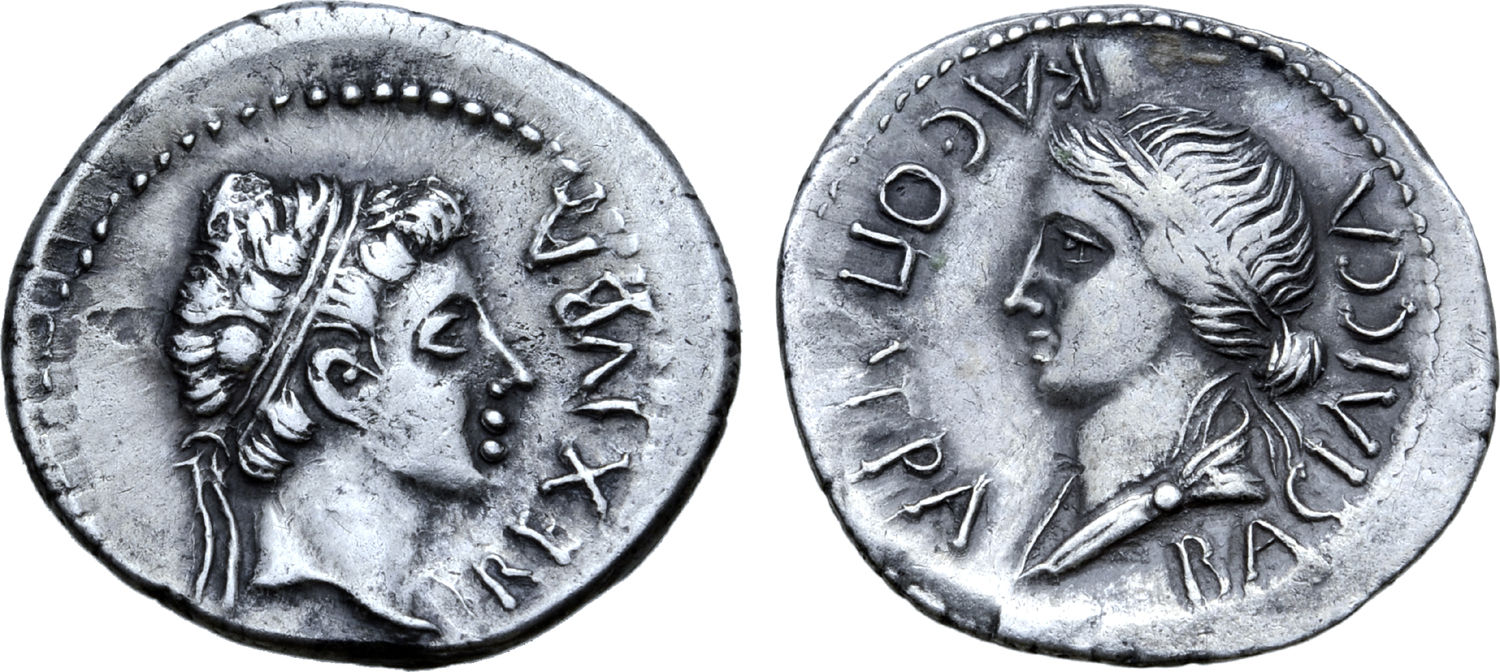
This is best reflected in the coinage of the time. While most show both monarchs, there are also issues solely featuring Cleopatra Selene, which reflects her power and the significant influence of her Greco-Egyptian heritage on her reign, as the representation of women on coins was a custom of her ancestors but not of Rome. Additionally, many elements present in her mother's coinage are adopted, reasserting her pride in being her descendant (Puyadas Rupérez, 2013: 199).
Finally, Cleopatra Selene died around 5 BC, possibly coinciding with a lunar eclipse as Crinágoras of Mytilene relates in one of his commemorative epigrams (Galán Vioque, 2016: 293).
«Even the moon darkened when it rose at sunset, hiding its sorrow in darkness, when it saw its namesake, the enchanting Selene, descending lifeless to the gloomy Hades; sharing her beauty with her light and mourning her death with its own darkness».
Crinágoras of Mytilene.
Conclusions
The relationship between Mark Antony and Cleopatra VII is always known for its romantic aspect, but if we delve into the context surrounding their worlds at that time, we can see that the main basis of their union was essentially political and military. Both wanted something the other had, although it's true that the Roman general seemed to need her more. And Cleopatra, thanks to her abilities, knew how to take advantage of this, regardless of whether or not there was a real romantic relationship between them.
As for their children, if we already had little information about the young Caesarion's life, even less is known about his siblings. Some have suggested that Alexander Helios and Ptolemy Philadelphus died prematurely, which could explain why there are no records of them. If this were true, it would be worth asking whether their deaths were natural or intentional, and why Selene survived. Again, more questions than answers.
On the other hand, it's important to highlight the significance of Cleopatra Selene’s pride in her dynasty and mother. Remember that she was raised in Rome during her youth, where she would have been exposed to negative propaganda about Cleopatra even after her death, making it normal for her to have disowned her. However, once out of Octavian's direct control, we see that her reign was a tribute to the Egyptian queen in many ways, with Egypt’s spirit living on through her.
Bibliography
Barceló, P., & Ferrer Maestro, J. J. (2007). Historia de la Hispania romana. Alianza Editorial.
Cid López, R. M. (2000). Cleopatra: mitos literarios e historiográficos en torno a una reina. Studia Historica: Historia Antigua, 18.
Dión Casio (2004). Historia de Roma. Traducción de Domingo Plácido. Madrid.
Domínguez Arranz, A. & Puyadas Rupérez, V. (2014). De la investigación al discurso sobre la moneda: la legitimación de los reyes y reinas lágidas a través de las acuñaciones. En Patrimonio numismático y museos: actas XV Congreso Nacional de Numismática. Madrid, 28-30 de octubre de 2014 (pp. 811-824). Museo Casa de la Moneda.
Galán Vioque, G. (2016). Antología palatina II. La guirnalda de Filipo. RBA Libros.
Novillo López, M.A. (2013). Breve historia de Cleopatra. Nowtilus.
Puyadas Rupérez, V. (2013). Cleopatra Selene, reina de Mauritania: la herencia de un mito. En Política y género en la propaganda en la antigüedad: Antecedentes y legado (pp. 191-204). Ediciones Trea.
Puyadas Rupérez, V. (2017). Cleopatra madre. La faceta olvidada de la reina de Egipto. En IX Congreso Virtual sobre Historia de las Mujeres (15 al 31 de octubre de 2017): comunicaciones (pp. 699-712). Archivo Histórico Diocesano de Jaén.
Roldán, J.M., Blázquez, J.M., & Castillo, A. D. (1989). Historia de Roma: Tomo II-El Imperio Romano. Madrid: Cátedra.


Comments