


If we were to ask around, everyone would certainly recognize the name of Julius Caesar, one of the most famous figures in the history of Rome. The same would be true for Cleopatra in Egypt. Both are representative figures of a period of change for their respective cultures. Another participant during these times will be their son, Cesarión, whom we will introduce in this article.

A bit of context
Between 49 and 45 BC, the Second Civil War of the Roman Republic takes place, with its main protagonists and adversaries being Julius Caesar and Pompey the Great. Around them, two factions will form, and we can anticipate that Pompey's side will not be victorious.
The conflict does not remain centered in Rome but extends to all territories under control of the Republic, affecting both our Hispania and more eastern regions, including Egypt, which is the stage for many of the episodes we are going to discuss in this article.
Remember that the last dynasty of Egypt at that time was the Ptolemaic, whose palace intrigues made it lose more and more influence in the Mediterranean world since the 2nd century BC. As a result, Rome became interested in the land of the pharaohs, especially with the intention of preventing new powers from emerging to challenge it. Thus, during an initial phase, Rome and Egypt become different territories but allies, which explains why this last one becomes involved in the conflict between Caesar and Pompey.
At this point enter the two ruling brothers of Egypt: Ptolemy XIII and Cleopatra VII, who were embroiled in a fratricidal war due to their aspirations to rule alone. After the Battle of Pharsalus, in 48 BC, Pompey flees to Egypt, where he is assassinated by Ptolemy XIII, who had seen him as an opportunity to gain Caesar's favor for his cause (Plutarch, Life of Pompey, 79). However, the Roman consul ends up supporting Cleopatra, and Ptolemy XIII, after refusing an offer to rule over Cyprus and rising in arms, is defeated at the Battle of Alexandria in 47 BC.
Finally, Caesar allows Cleopatra to continue as queen but alongside her younger brother, Ptolemy XIV, who actually had little power or influence.
The relationship between Cleopatra and Caesar
Once the conflict was resolved, the dictator could have returned to his homeland but decided instead to stay in Egypt with the queen for a while, having an amorous relationship. Was it truly love or were there other reasons for this prolonged stay? These are questions we may never know the answers to. What is known is that Caesar, guided by Cleopatra, toured and got to know Egypt firsthand, learning about its customs, culture, and seeing the potential of this land (Muñoz Santos, 2013:154).
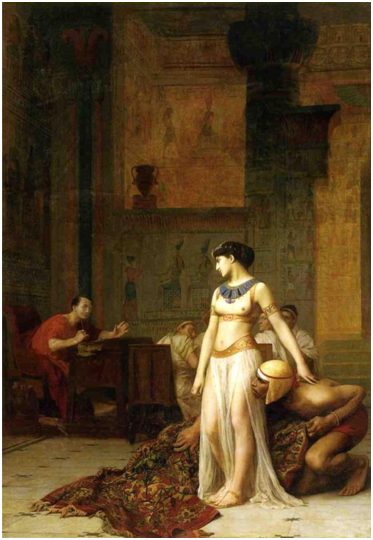
As a result of the time they spent together, Cleopatra gave birth to a child, Ptolemy XV, commonly known by the name of Cesarión (meaning "little Caesar"). The sources are unclear about whether this son was acknowledged or not by the dictator but do indicate that his mother repeatedly claimed him as the father (Puyadas Rupérez, 2017:703).
Possibly, the desire to legitimize Cesarión was one of the reasons that led Cleopatra to accept an invitation to travel to Rome, where she stayed with her brother and son in a private villa belonging to Caesar from 46 to 44 BC (Novillo López, 2013:58).
On March 15 of the year 44 BC, Cleopatra's aspirations for her son were cut short by the assassination of his lover. In his will, Caesar named Octavian, his adopted son, as heir, forcing Cleopatra to return to Egypt out of fear for Cesarión's life.
Cesarión
From his birth, Cleopatra began preparing the way for her son towards the throne. Unable to make him Caesar’s successor, she focused on a propaganda campaign in Egypt. Evidence of this can be seen in temples such as Dendera, Edfu, or Hermontis among others. The latter was unfortunately victim of a long process of looting that has left us with nothing more than the drawings and studies made by Richard Lepsius, which reflect how Cesarión is shown as the son of two gods: Isis-Cleopatra and Caesar-Amun, thereby justifying his appointment as future pharaoh (Cid López, 2000:131).
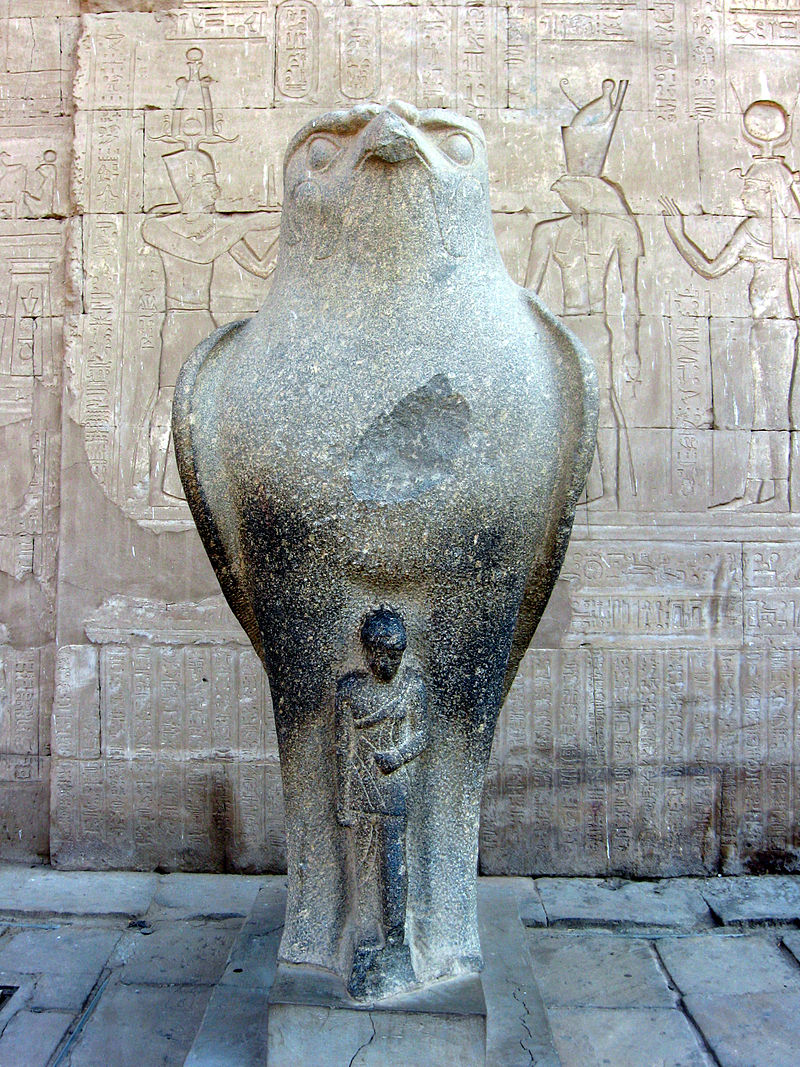
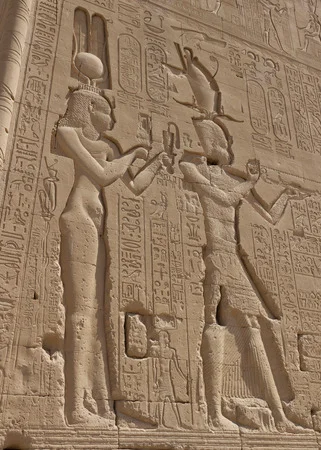
In the temple of Dendera, on the other hand, Cleopatra (who at that time ruled alone since her brother Ptolemy XIV had died suddenly) appears alongside a Cesarión dressed in the attire of pharaohs, to whom she cedes the spotlight, remaining herself behind. Yet another evidence of the propaganda carried out to ensure the future of the young man (Puyadas Rupérez, 2017:705-6).
In 34 BC, this is consolidated with the so-called Donations of Alexandria, where Mark Antony names Cleopatra queen of Egypt, Cyprus, Libya and southern Syria, while Cesarión is designated co-ruler and publicly declared as Caesar's legitimate heir (Plutarch, Life of Antony, 4-6). Additionally, he distributed the rest of territories to his children with the Egyptian queen, thus completely dissolving relations with Octavian and Rome (Novillo López, 2013:75).
As a response, the emperor invaded Egypt in 30 BC, and Cleopatra tried to protect her eldest son by sending him to the port of Berenice with the intention that he would sail on the Red Sea towards India. However, shortly after his mother's death, the young pharaoh, advised by his tutor, returned to Alexandria where he was assassinated at 17 years old, marking the end of Egypt’s last recognized pharaoh (Dion Cassius, LI, 15, 5).
CONCLUSIONS
There is scarce information that has reached our days about the life of Caesar and Cleopatra's son. There are many more questions than answers, and sometimes the answers themselves are mere theories. Nonetheless, there is no doubt that young Cesarión was an important piece in a chessboard where his mother’s political skills are well reflected, allowing us to see beyond the "femme fatale" image fostered by literature, cinema, and Octavian himself.
BIBLIOGRAPHY
- Cid López, R. M. (2000). Cleopatra: literary and historiographical myths around a queen. Studia Historica: Historia Antigua, 18.
- Dion Cassius (2004). History of Rome. Translation by Domingo Plácido. Madrid.
- Muñoz Santos, M. E. (2013). The cruise on the Nile of Caesar and Cleopatra; reflections. Boletín de la Asociación Española de Egiptología, (22), 151-160.
- Novillo López, M.A. (2013). A brief history of Cleopatra. Nowtilus.
- Plutarch (2007) Parallel Lives. Translation by Jorge Bergua Cavero, Salvador Bueno Morillo and Juan Manuel Guzmán Hermida. Madrid.
- Puyadas Rupérez, V. (2017). Cleopatra as a mother: the forgotten side of the queen of Egypt. In IX Virtual Congress on Women's History (October 15-31, 2017): communications (pp. 699-712). Archivo Histórico Diocesano de Jaén.


Comments