
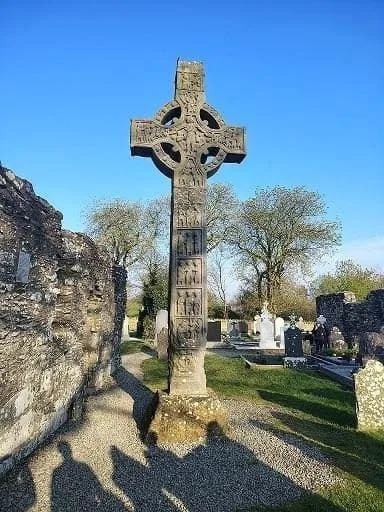
The Celtic crosses found in the Irish paleochristian monasteries represent the fusion between primitive Christianity and Celtic cosmology. Monastic centers like Clonmacnoise, Monasterboice, and Glendalough served as spiritual hubs and conservatories of artistic and religious memory on the island. Specifically, we will focus on the high cross monastery of Muiredach in Monasterboice. This monastery is located in County Louth, founded by Saint Buite (520), and houses a cemetery, two churches, three high crosses, a sundial, and a tower that stands 35 meters tall.
The paleochristian period in Ireland begins in the fourth century, progresses through the consolidation of monasticism in the seventh century until the peak of its art in the ninth century. The Emerald Isle or Hibernia was never occupied by Rome, though it was invaded by Vikings in the eighth century. During the early days of Christianity in Ireland, monasteries were founded thanks to Saint Patrick and Saint Ciarán. For example, a community dedicated to prayer, manuscript copying, and preservation arose in Clonmacnoise. There is some debate as to whether St. Patrick established Celtic monasticism or if it was already present when he arrived on the island in 432 according to the Annals of Ulster (Colombás, 1974, p.297). It is believed that the monastic movement had already been installed on the island coming from Gaul and Spain, without ruling out a direct contact with Egypt and the East (Colombás, 1974, p.300; Roberts, 2016, p.16).
One of the artistic characteristics of Irish monasticism is syncretism, which mixed Christian and Celtic symbols as occurred in other parts of the world where Christianity came into contact with other religions. This hybridization on the island resulted in the spread of Irish crosses throughout its territory.
These crosses or high crosses emerged from primitive Christianity, where monasteries represented centers of spiritual, educational, and social life. The crosses, erected between the 7th and 10th centuries, after St. Patrick's arrival, are adorned with biblical reliefs mixed with Celtic motifs. Christian elements fuse with Celtic ones. Initially, the first crosses were made of wood or metal. However, from the 7th century onwards, stone crosses were carved, and a circle was integrated at the intersection of the cross. This circle would serve to stabilize the structure and symbolize the synthesis between Christianity and pagan solar beliefs (Scantlebury, 1929, p. 295).
On these crosses, we can find biblical scenes sculpted in relief and spiral decorations that have their origins in the Bronze Age in ancient Crete (Scantlebury, 1929, p. 296). We also find a series of interlaced patterns on the crosses, many of which end with representations of animal heads, all following a symmetrical scheme providing harmony and balance to the entire relief (Scantlebury, 1929, p. 296).
It is worth noting that there are representations of animals, some of which acquire symbolic meaning and are not merely products of the sculptor's imagination. At times, the interlacing mentioned earlier represents the limbs of the animals. It should be added that spiritual lessons were drawn from animal customs. For example, the pelican that sprinkles its blood on its chicks to give them life would be a symbol of Christ’s salvific sacrifice or the Agnus Dei, which is found in the cross of St. Patrick and St. Columba in Kells (Scantlebury, 1929, p. 297).
The origin of this type of crosses likely lies in the menhirs that Saint Patrick marked with a cross along with other monks to Christianize them (Scantlebury, 1929, p. 293). There are crosses that would show an intermediate step in their evolution revealing some characteristics of a cross. This is exemplified by Fahan Mura from the seventh century (Scantlebury, 1929, p. 294), which is a standing stone slab on which Celtic knots and hints of the arms of the cross are carved.
An example of a more complex cross can be found in the Monasterboice monastery, which houses the Muiredach Cross (Figure 1) at 5.5 meters (tenth century), named after Abbot Muiredach mac Domhnall (who died in 923). On it are carved biblical scenes from both the Old and New Testaments, serving to instruct pilgrims and believers.
Synthesis of Christian and Pagan Elements
It is a fact that the Irish Christian community adapted and reinterpreted Celtic elements, considered pagan, to promote Christianity on the island. This synthesis can be observed in the high crosses of Ireland, particularly in the adoption and reinterpretation of Celtic elements: “ «In Ireland, the continuity of menhir worship is especially evident, from The Uninscribed Stone to inscribed stones with Ogham or Latin inscriptions accompanied by Christian symbols» (Guirand, 1971, p. 307).
In Ireland, Celtic deities were mixed with those of Christianity. An example can be found in Saint Brigid of Kildare, an ancient Celtic deity with the same name (Brigid, which in Irish means "the exalted" and patron saint of Ireland (Dundalk, 452- Kildare, p. 525). The deity Brigid was the goddess of poets, protector of lands, source of life and rebirth in spring. Saint Brigid's mother, a Pictish slave, was baptized by St. Patrick, who had a good friendship with Saint Brigid, who founded the first women’s monastery. In this monastery there was previously an oak tree considered sacred by druids and dedicated to the goddess Brigid. We can see here how Christian elements intertwine with Celtic ones, like the interlaced patterns carved on Celtic crosses. Let's look at an example.
The Muiredach Cross
The Muiredach cross (Figure 1) at 5.5 meters (tenth century) has two sides: the west side and the east side. On the west side, starting from the top of the cross, we find carved in relief, somewhat worn by time, Moses and Aaron.
Right at the center of the cross, where the arms meet, the Crucifixion scene comes to life. To its right, Roman soldiers guard Christ's tomb, while on its left, a group of people contemplate the dramatic moment (Figure 2).
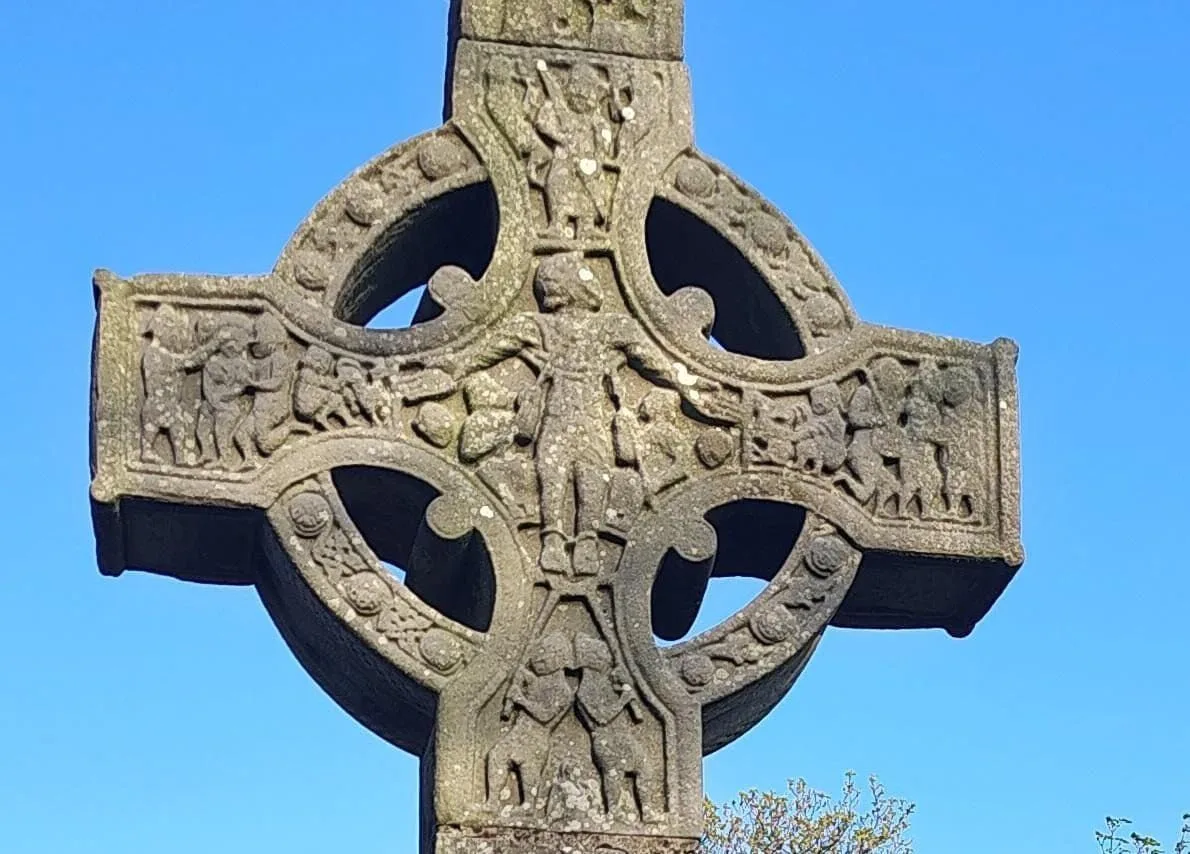
Descending along the shaft below the ring marking the intersection, the narrative presents the apostles' mission, Thomas's unbelief, and finally, Jesus' arrest. The story ends with a dedication inscription to Abbot Muiredach: OR DO MUIREDACH LASNDERNAD IN CHROS.
The east side presents an impactful scene: the Last Judgment. Contrasting with the crucified Christ on the west side, there is a majestic Christ flanked by angels. To his right are the saved while to his left are the damned. In other words, the destiny of humanity.
The Emerald Isle contains many more examples of syncretism between Celtic and Christian elements. The Muiredach Cross is just one example of numerous crosses that result from the coexistence of two worldviews, intertwining and fusing over centuries. It seems Saint Patrick's strategy of adapting or modifying island customs to Christianize them was successful: a Celtic Christianity emerged.
Bibliography
Colombás, G. M. (1974). The Primitive Monasticism, 2 vols., BAC.
Guirand, F. (1971). General Mythology, Labor.
Scantlebury, C. (1925). “The High Crosses of Ireland”. The Irish Monthly, 53(624), 293-298.Roberts, J. (2016). The Sacred Mythological Centers of Ireland. Bandia Publishing.


Comments