

The study of colonization in the Mediterranean during the 9th century BC often encounters a paradox: the presence of foreign objects does not imply that their makers settled there permanently. This distinction is key to understanding the nature of two iconic Iron Age sites: Kommos, on the southern coast of Crete, and Al-Mina, in the North Levant (Figure 1). Based on archaeological data and recent postcolonial interpretations, we examine how architectural structures and religious contexts reveal two distinct models of cultural contact that new theories help to rethink, transcending the binary view of "colonizer" and "colonized." On one hand, Kommos illustrates an integrated Phoenician commercial district where worship and warehouses demonstrate physical coexistence and hybridization with the Cretan world. On the other, Al-Mina raises the question of whether the abundance of Greek pottery reflects a colony or a middle-ground, which would be a physical space of interaction between cultures (Hodos, 2009, p. 222) based on local foundations, where Greeks were one more actor within a Phoenician commercial network.
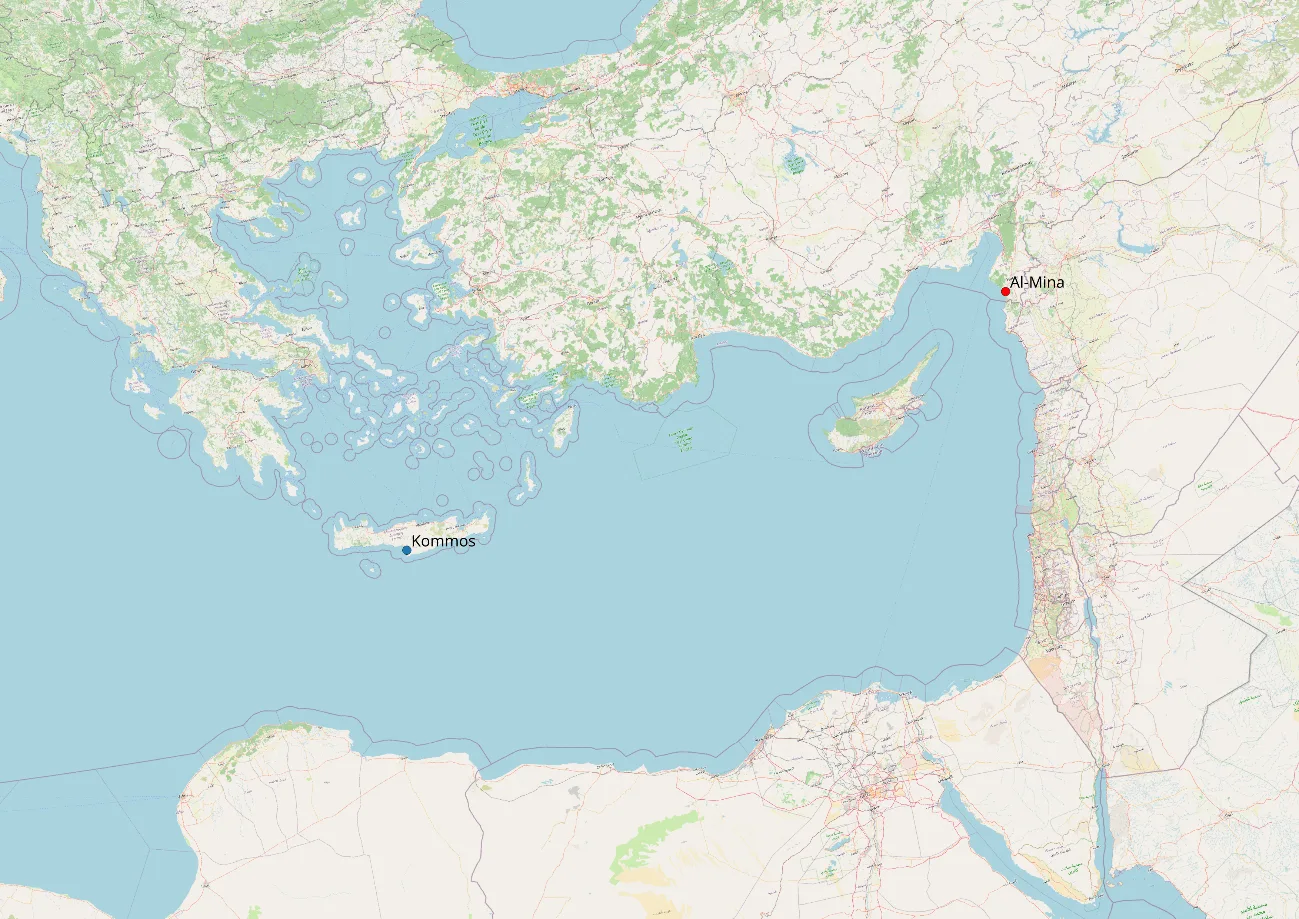
Figure 1. Location of Kommos and Al-Mina in the Eastern Mediterranean. Source: the author.
Situated south of Creta, Kommos begins in the Bronze Age and continues through the Iron Age. The site is divided into three sectors: the north and central, dating from the Minoan period, and the south, which includes a Minoan phase and an early Iron Age occupation. This last phase is concentrated in two structures: elongated rooms and a temple. The elongated rooms, near the coast, are interpreted as warehouses due to their layout, similar to the port and ship repair spaces of the Phoenician colony of Kition.
The evolution of the temple is divided into three phases: A (1200-800 BC), B (800-600 BC), and C (375-160 BC) (Muñoz, 2022, p. 24). Phase A contains Minoan materials and, towards the end, foreign elements such as an Egyptian faience bowl and Phoenician amphorae (Muñoz, 2022, p. 25). Phase B arises from the reconstruction of the building, incorporating lateral benches that define an easternizing layout similar to the temple of Sarepta. Its material record includes Egyptian faience products, terracotta zoomorphic figures, Cypriot pottery, and eastern cups and amphorae (Muñoz, 2022, pp. 25-33). Additionally, an altar has been linked to a Phoenician-influenced triad of Nefertum, Sekhmet, and Ptah, based on the discovery of faience figurines of the first two deities (Muñoz, 2022, p. 28). This cult, widespread in Egypt during the first millennium BC, aligns with the Phoenician expansion of the 9th century BC, a period of strong cultural imprint and dispersion of Nile goods throughout the Mediterranean.
Consequently, the various elements found at Kommos, particularly in the temple of Phase B, can be considered clear evidence of Phoenician expansion eastward (Muñoz, 2022, p. 33). In this sense, the function of the settlement would have been primarily economic, interpreted as a Phoenician commercial district (Muñoz, 2022, 44). These enclaves are characterized by a small size and are composed of high-status Phoenician merchants (Aubet, 2006, p. 39). This merchant community would have used the temple both for religious functions—demonstrated by the presence of the aforementioned Egyptian deities of Sekhmet and Nefertum—as well for commercial purposes. Parallel to this, the structures interpreted as warehouses could have served to concentrate goods for subsequent redistribution, similar to how Aubet interprets the warehouses of Toscanos (Aubet, 2006, pp. 40-41). Ultimately, from the case of Kommos the intense commercial contacts that connected the Aegean, Anatolian, and Oriental worlds become evident (Aubet, 2012, p. 230).
The Al-Mina jaciment is located on the Orontes River, in the North Levant. At this site, a large quantity of Greek pottery, mainly Euboean, is found, with an initial chronology dating back to the 9th century BC (Graham, 1986, p. 53; Coldstream, 2000, p. 29). In fact, the imported Hellenic material corresponds to nearly 50% of the total pottery recovered during excavations (Hodos, 2008, 61). Based on these data, authors such as Boardman or Coldstream argue that the settlement would have been under Greek agency. One of the main arguments supporting this theory is the presence of locally produced skyphoi pottery, as Boardman argues that its manufacture in situ would demonstrate the existence of Greeks living permanently in this territory (Graham, 1986, p. 56). However, the author Graham nuances that this presence does not necessarily establish a Greek population, as skyphoi pottery was also locally produced in Cyprus without necessarily implying colonization (Graham, 1986, p. 56).
Against the thesis of Greek control, the absence of Greek burials, religious spaces, or domestic architecture stands out (Coldstream, 2000, p. 30). Instead, the archaeological record shows storage structures (Aubet, 2006, p. 40) whose construction technique follows a clearly Phoenician pattern (Graham, 1986, p. 54). Thus, despite the abundance of imported pottery, it is difficult to defend a dominant Greek presence; the evidence points to the site functioning as a prominent commercial node.
Both sites share a chronology, as the Temple B of Kommos and the initial levels of Al-Mina are dated to mid-9th century BC (Graham, 1986, p. 53; Coldstream, 2000, p. 29; Muñoz, 2022, p. 24). This period marks the beginning of Phoenician colonization towards the central and western Mediterranean, which would last until the 8th century BC (Aubet, 2006, p. 36). Thus, the establishment of Phoenicians at Kommos directly responds to this dynamic of global expansion.
The difficulty lies in considering whether there was a stable Greek presence at Al-Mina during these chronologies, as indicated by material finds. It is known that there was contact between Phoenicians and Aegean populations, including Euboeans. An example is the finds of faience and bronze objects of orientalizing style in the necropolis of Leftkandi, although it is a point of contact (Muñoz, 2022, pp. 187-188). However, Greek expansion begins in the 7th century BC, so Al-Mina would be an exceptional case if considered a colony. Unfortunately, with the limited information available about Al-Mina, it cannot be confirmed.
A common element of the two sites is the presence of structures related to storage and commerce. The difference lies in the function these commercial points develop. In the case of Kommos, this settlement would be fully integrated as a point of commerce within the Phoenician commercial network of the Mediterranean. Thus, Kommos could play an important role in the storage and distribution of goods, not only Phoenician, but also local and foreign. The characteristic element of the settlement is the temple. This temple shows the presence of an exogenous community settled in the territory. The building is interpreted as having a quadruple function: religious, communal dining, cultural interaction (Muñoz, 2022, pp. 42-44), and important economic, as the temple is the gateway for eastern products into the Cretan world. Another function that cannot be ruled out is the administrative function. This hypothesis arises from the functions of the temple of Kition, which, in addition to the mentioned and detected in the temple of Kommos, includes the administrative function of this commercial port. In the case of Al-Mina, it cannot be confirmed that it is part of a Greek commercial network prior to expansion, but rather an exceptional case. While there is a large amount of eastern elements around Kommos, in the case of Al-Mina there are settlements like Tell Sulkas, Tell Bassit, Tabbat al Hammam, or Ras Ibn Hani that have little Greek pottery (Coldstream, 2000, 28-29). Thus, there is no such significant incidence as in Kommos.
Another very different comparative element is the residential spaces of the two sites. In the case of Kommos, temporary residence zones have been interpreted, such as Building Z (Muñoz, 2022, 45). Although the existence of this temporary residence at Kommos cannot be confirmed (Muñoz, 2022, p. 45), the island of Creta shows Phoenician presence in the territory, as the cippi of Knossos demonstrate (Muñoz, 2022, p. 52). In the case of Al-Mina, no Greek structures or burials have been detected (Coldstream, 2000, p. 30). Thus, it is difficult to determine a permanent or temporary Greek Euboean occupation in the context of the 9th century BC.
Another difference is that at Kommos, the material and construction evidence shows the physical presence of Phoenicians in the form of an orientalized commercial quarter oriented towards exchange with Cretan communities. This contact generated visible cultural hybridization in the archaeological record. Similarly, the eastern-planned temple and its functions corroborate this stable settlement, supported by well-documented contemporary parallels such as Kition. Conversely, at Al-Mina, the supposed Greek agency is limited exclusively to pottery.
Consequently, while Kommos can be interpreted as a Phoenician commercial quarter defined by hybridization, the case of Al-Mina fits better with the concept of middle-ground. Despite the importance of Greek pottery, the discovery of Phoenician Red Slip pottery (Hodos, 2008, pp. 60-61; Graham, 1986, pp. 57-58) demonstrates that local communities provided a space of exchange where both Greeks and Phoenicians participated. This scenario of commercial cohabitation shares parallels with the material hybridization of Pithekoussai, although at Al-Mina the control of the structures remains in indigenous hands.
Finally, the use of postcolonial theories helps us achieve a more accurate understanding of the relationships between diverse populations. The contrast between Kommos and Al-Mina highlights a great diversity of contacts that challenge traditional colonial theory, which is based on an active "colonizer" and a passive "colonized."
Bibliography
Aubet, M. E. (2012). “The Phoenician commercial quarter as a colonial strategy”, Rivista di studi fenici, XL: 221-236.
Aubet, M. E. (2006). “The Phoenician commercial system”, Mainake, XXVIII: 35-47.
Coldstream, J. (2000). “Exchanges between Phoenicians and Early Greeks”, National Museum News, 11: 15-32.
Graham, J. (1986). “The historical interpretation of Al Mina”, Dialogues d’histoire ancienne, 12: 51-65.
Hodos, T. (2009). “Colonial Engagements in the Global Mediterranean Iron Age”, Cambridge Archaeological Journal, 19: 221-241
Hodos, T. (2008). “Relative ceramic densities in the north-eastern Mediterranean Iron Age”. Olbia, 16: 57-72.
Muñoz, J. (2022). Thirsty seafarers at Temple B of Kommos. Commercial Districts and the role of Crete in Phoenician Trading networks in the Aegean. PhD thesis. Universitat Pompeu Fabra.


Comments