
Spices are usually recognized primarily for their use in cooking and specifically, in the preparation of food, but they were not used solely for this purpose; they were also employed in medicine and perfumes.
Apparently, they also played a role in the funerary context during Ancient Egypt, specifically used in the mummification process of the deceased, but as foreign spices, they also suggest a fluid trade with Asia.
Spices in Ancient Egypt
It is understood that «spices are parts of the plant that have a more concentrated flavor and are used in cooking to aromatize dishes» (Farrimond, 2020, p.10).
In Ancient Egypt certain spices were used such as parsley, celery, mint, cumin, coriander, fenugreek, sesame, dill, thyme, marjoram, fennel, mustard, anise, cinnamon and pepper; the latter clearly brought from other places (Tallet, 2006; Reixach Coll, Cervera Ral and Salas-Salvado, 2005; Ikram, 2001) (figure 1).
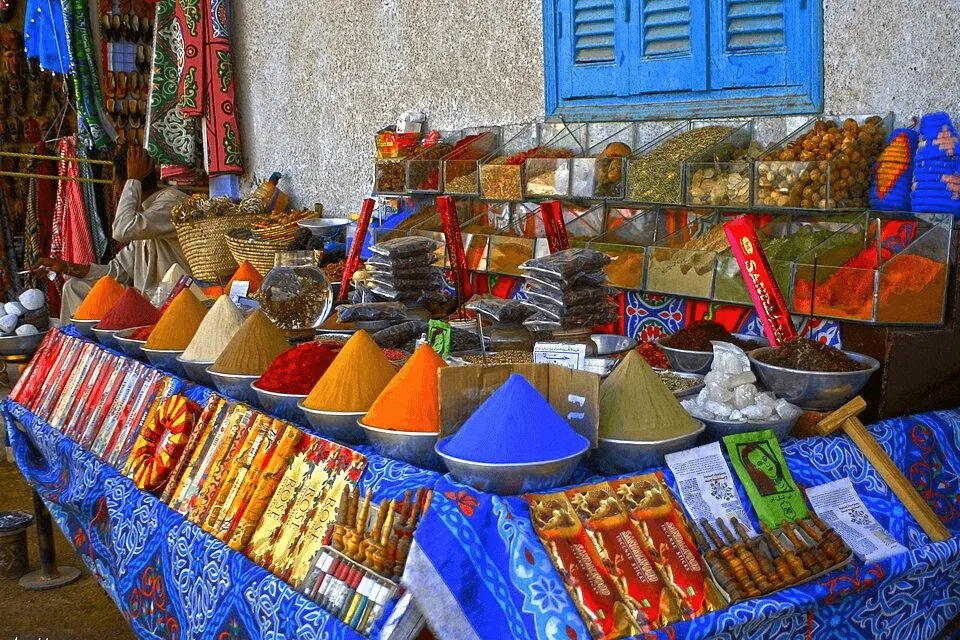
Many of them were found in tombs from the New Kingdom such as those of Kha's TT 8 in the Theban necropolis where garlic, onions, juniper, cumin, tarragon and coriander were found that are preserved in Turin’s Egyptian Museum collection. In this way, they provide us with information on how herbs and grains were used as spices to season food.
Some of them were native to the Egyptian land such as cumin, while others due to their foreign origin, like cinnamon and pepper, demonstrate contact with other lands and fluid trade between different regions, more specifically with South Asia.
While it was not necessarily a direct trade but rather operated through the Near East, for example: «Babylon obtained spices and vegetable dyes … from Magan (Oman), Tilmun (Bahrain) and Melukhkha (western India) through long-distance exchange» (Gestoso Singer, 2008, p. 199).
During the Roman period, ports in Egypt such as Berenice were used to reach India for obtaining spices, specifically pepper.
Mummification and Spices
Mummification was a complex process to preserve the body of the deceased for their next life in the afterlife, an important matter for ancient Egyptians due to religious beliefs; it was necessary to preserve the body so that the Ka (vital force) of the deceased could return to the tomb and recognize themselves. This way they could benefit from food offerings placed in the tombs.
The mummification process initially began conditioned by climate and environment, which allowed bodies to be preserved in sand; at first, the dead were buried in pits and later tombs were constructed (David, 2001), but over time, the body preservation process varied and improved.
In History (Book II Euterpe), written in the 5th century BC, Herodotus describes three types of mummification used in Ancient Egypt, whose choice depended on economic resources. In one of them, internal organs were removed through a cut on the left side, leaving only the heart -considered the seat of intelligence and strength-, while the brain was extracted and discarded (David, 2001).
Then, the body was cleaned and covered with natron, the main substance used for embalming, composed of sodium carbonate and baking soda obtained from Wadi el-Natrun. Its function was to absorb bodily fluids, drying it out. Subsequently, the mummy was filled and wrapped in linen bandages.
During this process, Herodotus tells us that «afterwards they fill the abdominal cavity with ground pure myrrh, cinnamon and other aromatic substances except frankincense, and sew up the incision» (Herodotus, 1992, p. 374).
There were other less expensive mummification procedures involving preparing the body by draining organs through the anus or more economical ones without eviscerating the body.
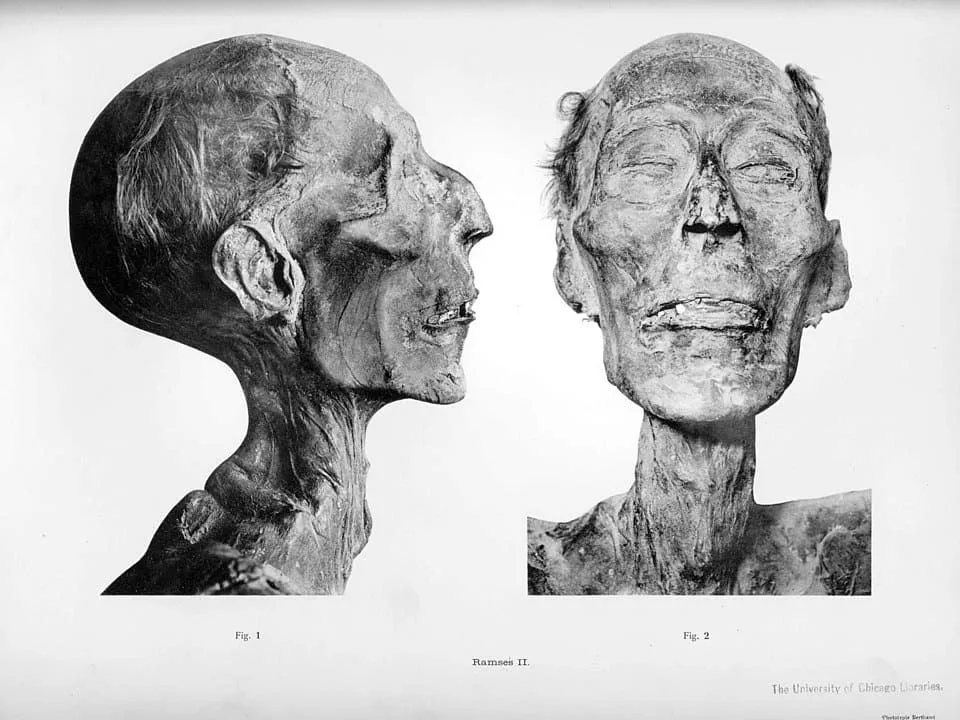
On the other hand, black pepper was found in the nose of Ramses II's mummy (1279-1212 BC), pharaoh of the 19th Dynasty of the New Kingdom (1570-1070 BC). The pharaoh’s mummy was taken to France in 1976 because it was affected by fungi causing its deterioration. To carry out its treatment, many studies were conducted to cure it.
Among these studies, a series of radiographs revealed that his nasal cavities had been filled with granular material ranging from 1.5 to 3 millimeters in size. Finally, «after several days of repeating the tests multiple times to acquire greater certainty and reject those not producing the desired image, we concluded that the filling of august nose was made up of black pepper (Piper nigrum)» (Llagostera, 2010, p.76) (figure 2). It was even suggested that mustard seeds might have been mixed with the pepper, although alone or with mustard, this may have happened due to knowledge of its preservative and anti-putrefaction properties contained in these spices (Llagostera, 2010).
Black pepper is a spice native to India that has been cultivated and traded for more than 3,500 years. It had great relevance in antiquity, becoming a source of wealth during the Roman era.
Initially, it was believed that black pepper did not exist in Egypt during the pharaonic period, but its discovery in Ramses II's mummy (Tallet, 2006) contradicts this assumption. This also had to do with the fact that pepper was an expensive spice, so it might have been used for more than just cooking.
Meanwhile, cinnamon (Cinnamomum verum) is native to Sri Lanka, formerly Ceylon (figure 3). Although there is a translation discrepancy, it's unclear whether it refers to Ceylon cinnamon or cassia (Cinnamomum cassia), which is native to southern China. The latter has existed since 2700 BC and was used in Chinese medicine; Egyptians could have employed it for food preparation and medicine.
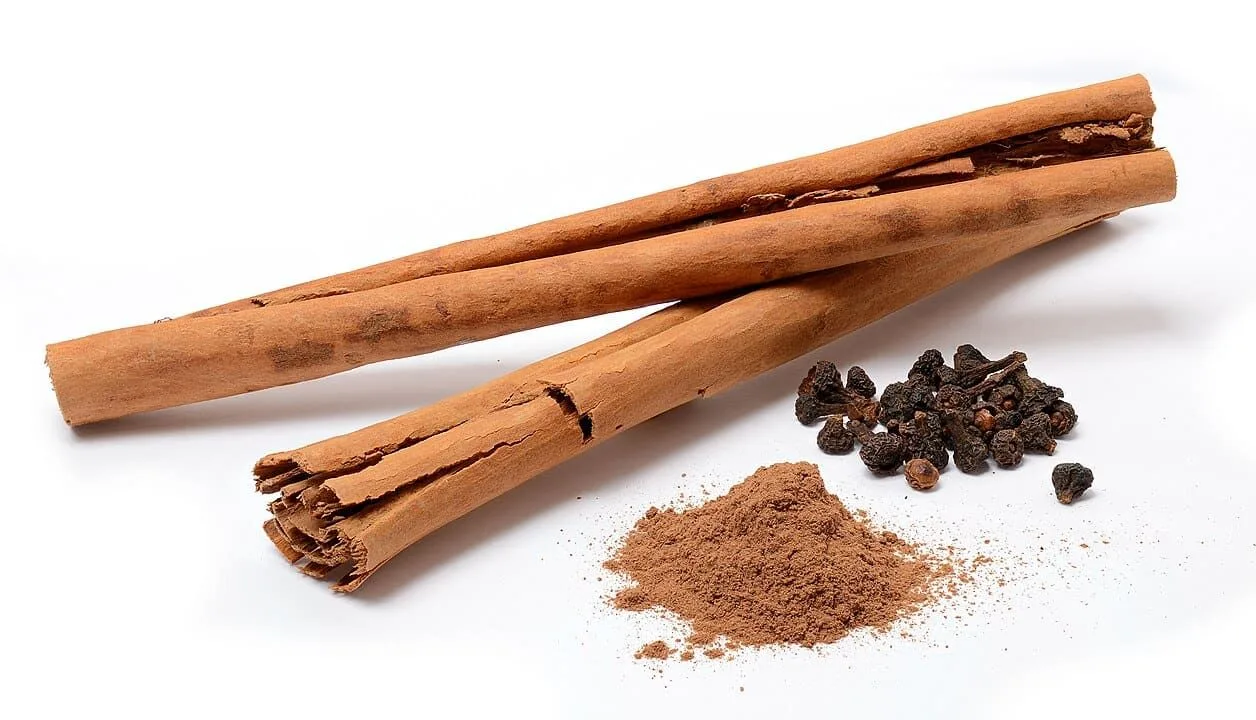
Cinnamon was used as incense and for embalming. It was imported through African merchants, but it is unknown whether it was cinnamon or cassia (Farrimond, 2020).
Conclusion
Evidence of the use of spices appears in different eras; while they are known for their use in the preparation of food, medicine, cosmetics, they also played a role in the mummification process.
This allows us to observe that through the trade of spices places were indirectly connected over long distances, providing information on their use and movement from one place to another. Additionally, it provides knowledge about the properties they could offer for the preservation and scent of mummies in tombs.
Bibliography
Collezione Museo Egizio. (21 August 2025). Cup with seeds. https://collezioni.museoegizio.it/en-GB/material/S_8252
David, A. R. (2001). Mummification. In D.B. Redford (Ed.). The Oxford encyclopedia of ancient Egypt Vol. II. Oxford University Press.
Farrimond, S. (2020). The science of spices. Origins of spices and basic principles for mixing and combining them in the kitchen. Dorling Kindersley.
Gestoso Singer, G. (2008). Goods exchange between Egypt and Western Asia from Thutmose III's reign to Akhenaton. Centro de Estudios de Historia del Antiguo Oriente, UCA.
Herodotus (1992). History II Euterpe. Editorial Gredos.
Herodotus (2009). The nine books of history. Edaf.
Ikram, S. (2001). Food. In D.B. Redford (Ed.). The Oxford encyclopedia of ancient Egypt Vol. I. Oxford University Press.
Llagostera, E. (2010). Posthumous journey to Paris of Pharaoh Ramses II. In Espacio, Tiempo y Forma, Serie II, Historia Antigua, t. 23, 61-89.
Parra, J. M. (2011). History begins in Egypt. Critica.
Reixach Coll, M., Cervera Ral, P., and Salas-Salvado, J. (2005). Food culture in ancient Egypt. In J. Salas-Salvado, P García-Cerda and J. Sánchez Ridalles (Eds.). Food and nutrition through history (pp. 35-61). Editorial Glosa.
Tallet, P. (2006). Cooking in ancient Egypt. Ediciones Folio.


Comments