
In a previous article (Martínez Blanco, 2021), we delved into the world of mummies discovered in European bogs and peatlands. In this new installment, we will explore why these deaths occurred.
The answer to this question lies in the ritual known as "triple death" or "threefold death."
- The Ritual of the «Triple Death» or «Threefold Death»
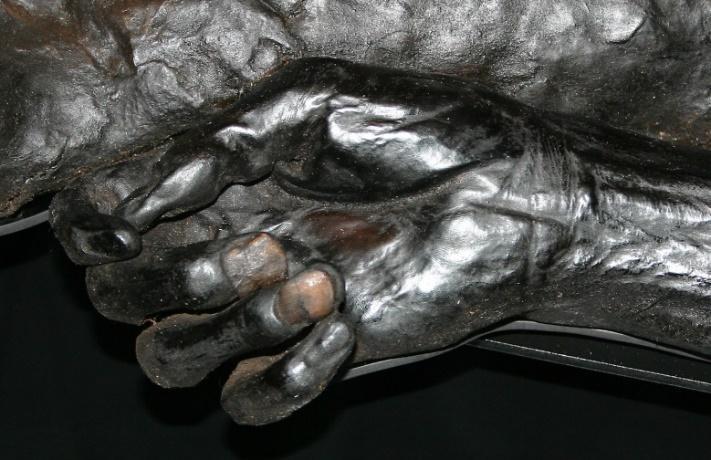
Anthropological and paleopathological results (Krenzer, 2006) (Ubelaker, 1999) of these bog and peatland mummies lead us to think that they were probably criminals executed with methods appropriate for their crimes. However, there are two data points that do not align with this theory: their nails and their stomachs. If we observe the nails of, for example, the Man of Grauballe (fig. 14), we see that these are very well cared-for hands that show no signs of having performed hard manual labor (Velasco, 2005). This leads us to think that it could be a person from an upper class, exempt from manual labor (even remnants of nail polish have been preserved on some of these mummies) (fig. 15).

Regarding the study of stomach contents, both the men of Tollund and Grauballe as well as that of Borremose (840 cal BC) (Jeremiah, 2014: 20s.) consumed different types of scorched wheat, barley, and oats, plants that could be preserved from one harvest to another (Renfrew and Bahn, 2007: 276s.). In some bodies, wild seeds were also observed, and in rare cases, remnants of meat. These are not foods associated with an annual diet, so it has been thought they may have been ritually sacrificed, making this their last meal, and thus having a special character (Velasco, 2005). In some cases, their deaths were determined to be near the winter solstice, suggesting that these could be propitiatory sacrifices to ensure the fertility of the fields (Grilletto, 1989: 106). This theory is supported by remnants of a cake made from various cereals and mistletoe fruit, a sacred plant for the Celts (Palao Pons, 2001: 185) as Pliny tells us in his Natural History, confirming their ritual sacrifice of Celtic tradition:
One must not pass over, in this matter, the admiration felt by the Gauls for mistletoe. The druids—this is what they call their magicians—hold nothing more sacred than mistletoe and a tree on which it grows, especially if that tree be an oak. […] A priest, dressed in a white robe, climbs the tree and with a golden sickle cuts the mistletoe, which is caught in a white cloak. […]. They believe that mistletoe, taken as a potion, confers fertility on any barren animal and serves as a remedy against all poisons.
Plin. Nat. XVI, 95
Trans. Francisco Manzanero Cano, I. Garcia Arribas and María Luisa Arribas Hernáez
Also found were ergot fungi (Claviceps purpurea), a hallucinogenic plant. This, along with the position in which Tollund Man was found, leads us to think that it was a voluntary sacrifice, as he had been drugged before dying. These sacrifices have been attributed to the rites of Nertho, the Earth Mother, described by Tacitus in his Germania.
Nothing remarkable about each one of them except that they worship a common goddess called Nerthus, or Mother Earth. They believe she intervenes in human affairs and visits different tribes. On an island in the Ocean there is a sacred grove and in it a cart consecrated to her covered with a veil. Only a priest may touch this vehicle. He feels the presence of the goddess in the sanctuary and accompanies her, with great reverence, as she travels from place to place. No wars are started then; no weapons are taken up. All arms remain locked away. Only then is there peace and quiet, and they are valued until the same priest returns the goddess to her temple, having had enough of her contact with mortals. Immediately after that he washes in a secluded lake the vehicle, the veil, and if one wishes to believe it, the goddess herself. Some slaves help him; these are swallowed up by the very lake. Hence the ancient terror and sacred ignorance about what is seen only by those who are about to die.
Tac. Ger. 40, 5
Trans. José María Requejo Prieto
We would be in the presence of a ritual to ensure good harvests and the fertility of herds. A festival in honor of the goddess Nertho where these northern tribes would lay aside their weapons and come together to observe the priest charged with transporting the goddess in her chariot from the sanctuary. After days of celebration, and now sated by her contact with mortals, the goddess decides to return to her sanctuary. But first they perform a ritual cleansing at the lake, whereupon the priest sacrifices those slaves gathered there. However, Tacitus does not go into detail about how these sacrifices were carried out. We must keep in mind that Tacitus speaks of a character foreign to the society he describes, and therefore his information is biased (Olmos, 1992: 13s.)
The ritual fitting these bog mummies is not that described by Tacitus but rather the rite of "triple death" or "threefold death" (Haywood, 2016) (Almagro-Gorbea, 2012: 7–39). The first to speak of this ritual was Lucan in his Farsalia in the 1st century AD:
«[…] those who appease with terrible sacrifices the cruel Teutates and Eso, grim on their savage altars, and Taranis, whose altar is no less cruel than that of Diana Scythica».
Luc. I, 444-447
Trans. Antonio Holgado Redondo
He refers to a series of bloody sacrifices carried out in honor of these three divinities (Teutates, Esus and Taranis) with the aim that they be favorable.
Three centuries later, "triple death" would be much more explicitly described by the Bern commentators in their Commenta Bernensia or Bern scholia (César, 1986) (Caes. Gal. VI, 16), speaking of an Indo-European origin ritual consisting of drowning a victim, hanging them and burning them. In this text it is specified to which gods these sacrifices were dedicated and the type of sacrifice for each god. Three were the gods honored and three the rituals carried out: for Teutates, tribal unity deity, a man was drowned by submerging him in an amphora; for Esus, nature divinity, the victim was hanged from a tree and bled to death; and for Taranis, god of thunder, light and sky, the victim was burned alive, enclosed in a structure resembling a scarecrow (Ward, 1970: 134s.).
The whole Gallic nation is extremely superstitious; and for this reason those who are afflicted with serious diseases, or are in battle and danger, either sacrifice men, or vow to sacrifice them, using the services of druids as ministers for such sacrifices, being persuaded that the immortal gods cannot be appeased for the preservation of one man's life unless another's is offered up; and by public law they have arranged certain kinds of these same sacrifices. Others form images of wickerwork, huge colossi, whose interiors are filled with living men, whom they burn along with the straw-work when it catches fire. In their estimation the sacrifices of robbers, brigands, and other criminals are most acceptable to the gods; but if there is a lack of these, they do not hesitate to sacrifice innocent people.
Caes. Gal. VI, 16
Trans. José Goya y Muniain and Manuel Balbuena
"Triple death" is considered a characteristic ritual of the Celtic world, but it has also been documented both literarily and archaeologically among Germanic peoples in northern Europe, Slavs, Greeks, Anatolians, and Persians (though sometimes with variations) (Almagro-Gorbea, 2012: 7–39) (Evans, 1979). It was practiced from the Iron Age to the Middle Ages, during which time it left its mark on popular imagination and narratives such as The Chronicle of Henry of Livonia, The Chronicle of Nestor, Procopius' De Bello Gothico, the legend of Santa Marina de Aguas Santas, Aeschylus' Agamemnon, or the Book of Good Love by the Archpriest of Hita.
In Slavic tradition we find several examples of "triple death" (Fisher, 1970: 157s). In The Chronicle of Henry of Livonia it is proposed to murder Bishop Berthold by burning him in his church, killing him with a weapon or drowning him. The Chronicle of Nestor narrates Olga's revenge on the Drevlians for the assassination of her husband Igor. It tells that she buried the first contingent of Drevlians alive; invited the second to a bathhouse, locked them in and set it on fire; and passed the third contingent by sword during a banquet (Evans, 1979: 157).
In Germanic tradition we find an example of "triple death" in Hávamál, "Sayings of Hár" or "Speech of the High One", where Odin speaks of his own sacrifice (Ward, 1970: 124) (Evans, 1979: 157), hanging himself from a tree, probably the Yggdrasil or "Cosmic Tree of Life," while pierced by his spear, for nine days and nights before submerging in mead. He thus suffers a triple death to be reborn with the wisdom of a poet, the secrets of magical divination, and runic script (Almagro-Gorbea, 2013: 391).
In all these narratives we find two common points:
- There is always a prophecy of death that is never believed.
- The Indo-European belief in the inevitability of fate is evident.
Next, we present fragments from Agamemnon and the Book of Good Love, where the prophecy and ritual are detailed:
1125 CASSANDRA. Ah, ah! Look, look! Move the bull away from the
cattle. Grabbing it with his clothes and using its black horns he strikes it and falls into a bath full of water. I am telling you about a murderer under treacherous circumstances.
1140 CHORUS LEADER. You are mad, possessed, and by yourself
sing an off-key song, like the golden nightingale, uncatchable in song,
with a mind that moves to compassion, chirping «Itis, Itis» lamenting a flourishing life in misfortunes.
CLYTEMNESTRA. I will not be ashamed to say things
opposite to the many good agreements before circumstances changed. For how could someone who prepares enemy traps against enemies that seem like friends, could set nets of destruction at a higher altitude than the leap? This contest, not forgotten †from ancient times† of an old victory has come, if only after time.
I stand where I have struck, on accomplished deeds. Thus did I act and this I will not deny, neither fleeing nor avoiding death. Around him I cast a net without escape, like for fish, the perfidious wealth of a garment. I strike twice and with two groans he loosens his limbs. And, already fallen, I give him a third, grace due to Zeus Subterranean, savior of corpses. Thus does he let out his life †falling†, and, exhaling violent bloodshed, reaches me with dark dewy rain of blood, while I rejoice no less than the harvest
with the rain given by Zeus in the pains of childbirth from the sheath. And if it were possible, as to pour libations over a corpse,
this would be juster than justice. He, having filled his house with such a large crater of abominable evils, he himself, upon returning, has drained it. Thus are things, elders of Argos here present. Rejoice, if you will rejoice, I glory.
Aesch. Ag.
Trans. Enrique Ángel Ramos Jurado (Fig. 16)
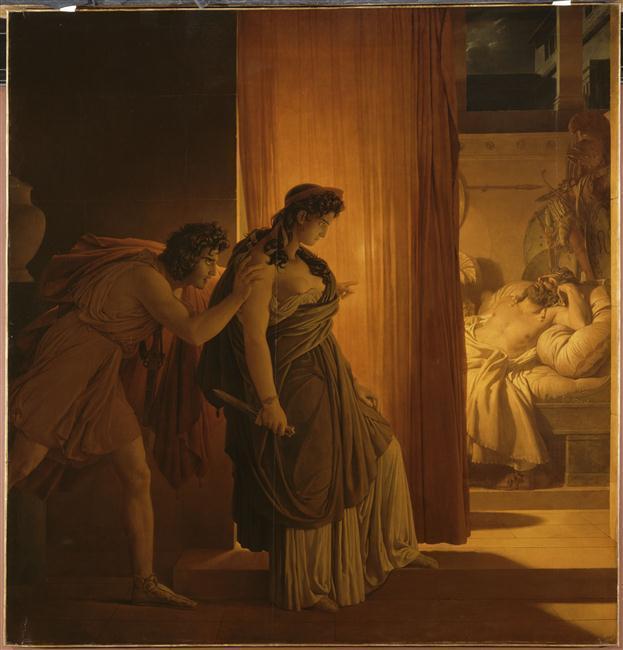
In his Agamemnon, Aeschylus narrates how Cassandra prophesies the death of Agamemnon and, through Clytemnestra's mouth, how she kills her husband Agamemnon upon his return from the Trojan War while he is taking a bath, stabbing him with a knife and entangling him in a cloak. Water, weapon, and drowning, three deaths.
123 The astrologers set out, in the reasoning
about Astrology, this knowledge:
every man who is born, from his birth,
breathe under a sign until the last breath.
129 There was a king of Moors, Alcaraz name had;
born him a son fair, only one he had;
sent for the wise men, wanted to ask them
the sign and the planet of the child that was born.
130 Among the star-gazers who came to see,
five of them there were of full knowledge:
on knowing the day in which he had to be born,
a master sentences: −«He shall be stoned».
131 The second judged and said: −«This one shall be burned».
Said the third: −«The child will fall from a cliff».
Said the fourth: −«The infant will be hanged».
Said the fifth: −«In water he will drown».
132 The king seeing that there were judgments not agreed
sent to have the wise men put in prison,
had them locked up in places apart:
thought their judgments as proved deceits.
133 Once already the child had reached good age,
asked his father that he would be given
to go run in a mountain, hunt some deer,
the king answered approving of degree.
134 They had clear day to start hunting;
already arrived at the mountain they started
to rise suddenly cloudy: began to hail;
a little time passed and it was stoning.
135 Remembering then the tutor of what judged
the wise star-gazers who had examined his sign:
−«Sir −said−, guard yourselves, if those who studied
your sign said the truth and hit».
136 Thought then to find where they would hide,
but as in all case has that must happen
that what God orders as it must be,
following normal course, cannot be turned,
137 in the middle of the hail the child was stoned;
when passing a bridge, a great lightning fell,
the bridge cracked: there he fell off;
on an oak tree by the river his clothes hanged.
138 Being thus hanging where all saw him
that he would drown in water they could not avoid;
the five prophecies were fulfilled well
and the wise star-gazers came out true.
139 As soon as the king knew this sorrow,
sent to have the star-gazers of prison free,
made them much good and ordered them use
the science of the stars, of which there is no doubt.
Arcipreste de Hita, Book of Good Love
Here we see how the prophecy of death is not believed and in this case we would be before an evolution of the "triple death" ritual, as the child suffers a quintuple death: stoned by hail, burned by lightning, fallen off a bridge, hanged on a tree and drowned in the river.
Among the sacrifices carried out with "triple death," we find some variations, as the victim had to die either drowned or poisoned, hanged from a tree or strangled and beheaded, wounded by a cutting weapon or burned. Thus, the rite has been interpreted in two ways (Evans, 1979: 152s):
- Three successive deaths, each with a different ritual. An example would be that described in The Chronicle of Nestor.
- A single death, with three distinct methods. Here would fit the deaths described for Odin and Agamemnon.
This rite was related to the Indo-European tripartite ideology by French historian Dumézil (Dumézil, 1953: 118-159), who organized several aspects of culture into three "functions" or levels (Dumézil, 1958):
- Heaven: function of praying, authority, magical-religious sovereignty and legal.
- War: function of fighting, the war group.
- Fertility: function of productivity, wealth and work.
In connection with the gods referred to by Lucan (Luc. I, 444-447), Esus would be the god related to heaven, Taranis with war, and Teutates with fertility (Evans, 1979: 154).
Similarly, a Finnish ballad tells that Christ names the three sins of Mary Magdalene, the murders of her three sons: one of them is burned, another drowned and the third buried alive. Christ adds that, had they survived, they could have become knight, bourgeois, and priest respectively (Talley, 1970: 143-146), i.e., they would have dedicated themselves to war, production, and religion, which directly relates to Dumézil's three functions and entails an attack against the three functions.
In Agamemnon, we see how Clytemnestra considers her husband's death as a sacrifice for sins committed against the three Indo-European functions. These three sins were: sacrificing his daughter Iphigenia as an offering to Artemis so that favorable winds would blow for their journey to Troy; the deaths of young Greek warriors during the war; Helen is associated with wealth and beauty, and Agamemnon, by departing after her to return her to Menelaus, sacked Troy. Thus he committed sins against the three functions: sacrilege against religion (heaven, first group), against those who fight (war, second group) and against wealth and beauty (fertility, third group). Agamemnon is thus a trifunctional sinner, deserving a tripartite punishment (Evans, 1979: 160-166).
Conclusions
The deaths of the bog mummies presented here are related to an expiatory sacrifice for having offended the deities of heaven, war and fertility, and the places chosen (bogs and peatlands) would be considered liminal, places of connection and union between the world of the living and the world of the dead. It would thus be the maximum types of capital punishment. We are before material remains of a ritual collected by numerous narratives from Europe and Asia, confirming thus what was recorded in written sources.
It would be advisable to conduct an in-depth study and review of all the mummified bodies found in these particular wetland locations across Europe, with the aim of determining the causes of their deaths and their likely connection with "threefold death".
With certainty we will have more findings of such mummies in the future, which will increase our knowledge about these people and their rituals.
Bibliography
Almagro-Gorbea, M. (2012). “The ritual of the "triple death" in Hispania Celtic. From Lucan to Book of Good Love”, Ilu. Revista de ciencias de las religiones, 7–39.
Almagro-Gorbea, M. (2013). Literatura hispana prerromana: creaciones literarias fenicias, tartesias, iberas, celtas y vascas, Real Academia de la Historia, Madrid.
Archpriest of Hita. (2005). Book of Good Love, 19th ed. Castalia, Madrid.
César, J. (1986). C. IVLI CAESARIS COMMENTARIORVM DE BELLO GALLICO. LA GUERRA DE LAS GALIAS (with the notes of Napoleon). Translation by José Goya and Munain and Manuel Balbuena Ediciones Orbis, S.A., Barcelona.
Dumézil, G. (1953). Du mythe au roman. La saga de Hadingus. Paris.
Dumézil, G. (1958). L’Idéologie tripartie des Indo-Européens, Collection Latomus 31, Brussels, Latomus.
Aeschylus. (2011). Tragedies. Translation by Enrique Ángel Ramos Jurado. Alianza Editorial, Madrid.
Evans, D. (1979). “Agamemnon and the Indo-European Threefold Death Pattern”, History of Religions 19, 2, 153-166.
Fisher, R. L. (1970). “Indo-European Elements in Baltic and Slavic Chronicles”, in Puhvel, J. (ed.), Myth and Law among the Indo-Europeans, Publications of the UCLA Center for the Study of Comparative Folklore and Mythology 1, 147-158.
Grilletto, R. (1989). The Mummies: from the pyramids to the crypts of the Sanctuaries, from the bogs of Denmark to the offices of scientists, a fascinating journey through time and space. EDAF, Madrid.
Haywood, J. (2016). The Men of the North: The Viking Saga. Ariel, Barcelona.
Jeremiah, K. (2014). Living Buddhas: The Self-Mummified Monks of Yamagata, Japan. McFarland.
Krenzer, U. (2006). Compendium of forensic anthropological methods for the reconstruction of osteo-biological profile. Serie de Antropología. CAFCA Centro de Análisis Forense y Ciencias Aplicadas. Guatemala.
Lucan, M.A. (1984). Farsalia. Translation by Antonio Holgado Redondo. Biblioteca clásica Gredos 71. Gredos, Madrid.
Martínez Blanco, C. (2021). The Three Times Dead. Mummies, Bogs and Rituals, ArqueoTimes Magazine.
/articles/thrice-dead-bog-mummies-and-rituals/
Olmos, R. (1992). “The emergence of the image in Iberian society”, in R. Olmos (ed.) The Iberian Society through the Image. Ministry of Culture. Madrid.
Palao Pons, P. (2001). The Book of the Celts. Robinbook, Barcelona.
Pliny the Elder. (2010). Natural History. Books XII-XVI. Translation by Francisco Manzanero Cano, I. García Arribas and María Luisa Arribas Hernáez. Biblioteca Clásica de Gredos, Ed. Gredos, Madrid.
Renfrew, C., Bahn, P.G. (2007). Archaeology: theory, methods and practice, 3rd ed. Akal, Madrid.
Tacitus, C.C. (1999). Agrícola; Germania; Dialogue on Orators. Translation by José María Requejo Prieto. Gredos, Madrid.
Talley, J. E. (1970). “The Threefold Death in Finnish Lore”, in Puhvel, J. (ed.), Myth and Law among the Indo-Europeans, Publications of the UCLA Center for the Study of Comparative Folklore and Mythology 1, 143-167.
Ubelaker, D. H. (1999). Human skeletal remains: excavation, analysis, interpretation, 3rd ed. Washington: Taraxacum.
Velasco, M. (2005). A Brief History of the Celts, Breve Historia Collection. Nowtilus, Madrid.
War, D. J. (1970). “The Threefold Death: An Indo-European Trifunctional Sacrifice?”, in Puhvel, J. (ed.), Myth and Law among the Indo-Europeans, Publications of the UCLA Center for the Study of Comparative Folklore and Mythology 1, 123-142.


Comments