


Long sleeves, feminization and masculinity in classical sources
Descriptions of effeminate or sexually passive characters in Roman sources are very common, both in literature as well as historiography and political discourse. The accusation of effeminacy was very frequent to discredit an enemy or mock him, resorting to some topics that may seem strange to us today.
Julius Caesar was the subject of jokes for his hair removal and baldness, both characteristics associated with effeminate people (Cantarella, 1992, pp. 155–164). This was compounded by his usual attire: a laticlavian tunic with long sleeves, poorly fastened with a loose belt worn above the customary position (Suet. Iul. 45.3). Both the sleeves and the way of wearing the belt were feminine elements (Ramírez de Verger y Agudo, 1992, pp. 124–125).
Similarly, when Cicero wanted to mock the friends of Catiline, he described them as «well-groomed, elegant; shaved or with well-tended beards; in tunics with long sleeves; dressed in veils instead of togas» (Cic. Cat. 2.22; trad. J. Aspa). Of the emperor Gaius Caligula, Suetonius said that «he often appeared in public with mantles covered with ornaments and precious stones, a tunic with sleeves and wearing bracelets; sometimes dressed in silk and adorned with a cíclada», all elements of feminine attire. Seneca, in an eulogy to Epicurus, had to defend him by saying that «he is also a strong man, although his clothing has long sleeves» (Sen. Ep. 33.2; trad. I. Roca).
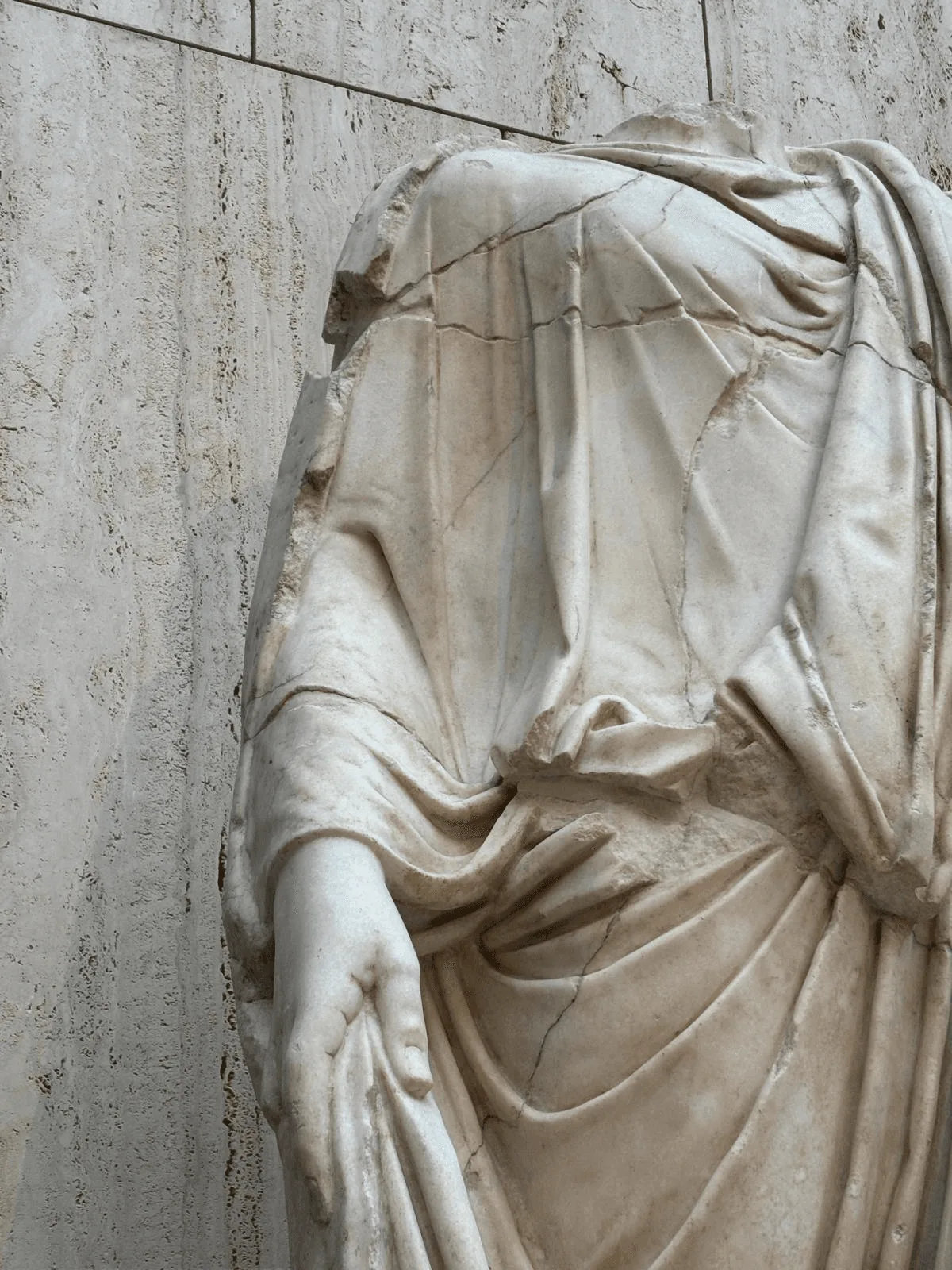
Therefore, it can be observed that the long sleeve is a more feminine attribute of clothing, whose use by men is a cause for mockery, along with other complementary elements such as loose belts, veils or silk. This effeminate character does not seem to depend solely on an aesthetic or fashion issue, but rather on what the garment symbolized in relation to work, leisure and the Roman ideal of masculinity.
The origins of the topic: a look from sociology
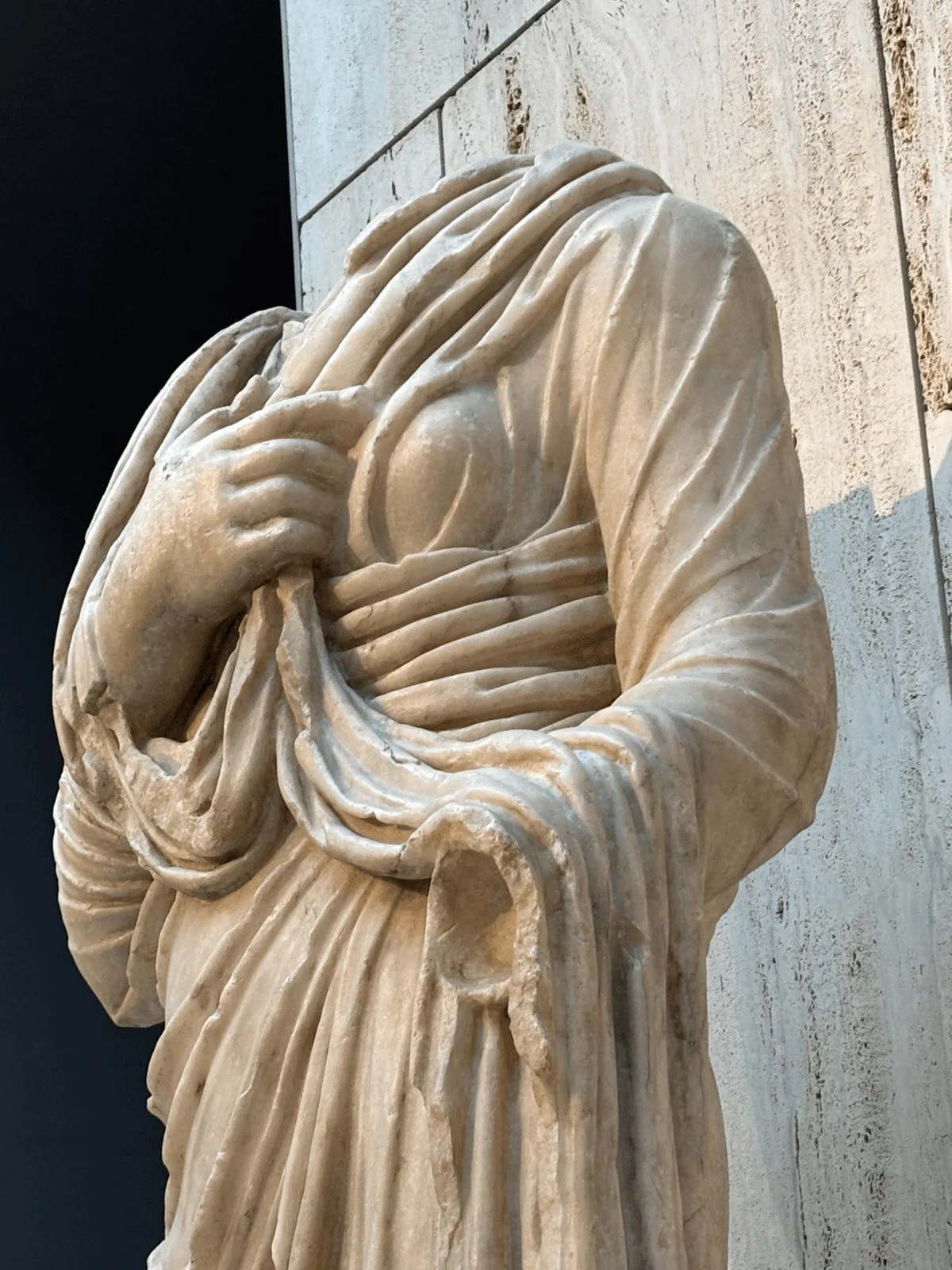
Aulus Gellius wrote during the time of Marcus Aurelius the Noctes Atticae, a compendium of twenty books where he noted curiosities that caught his attention, as if it were a notebook. Among these, he included the origins of the association between long sleeves and women:
That a man wore tunics that extended beyond the arms, to the beginning of the hands and almost to the fingers, was indecorous in Rome and throughout Latium. With Greek words, our people called chirodytae (of long sleeves) these tunics, and they considered it only proper for women to wear a long and widely extended dress, so as to protect the arms and legs from view. However, at first Roman men wore only togas, without tunics; later they used short and tight-fitting tunics that ended before the shoulder, a type which the Greeks call ὲξωμίδεζ (without sleeves). (Gell. 6.12; trad. A. Gaos, p. 70)
We see that originally women wore long clothing for decorum, to cover their arms and legs, while men wore togas without sleeves. And when the tunic was introduced in Rome due to Greek influence, it was designed with short sleeves leaving the extremities uncovered. The length of the sleeve is also detailed: not until the wrist as today, but reaching the palm of the hand and limiting at the fingertips.

If we think about sexuality in Roman culture, the moral valuation of relationships between men was an extension of social order. That is to say, for Romans, the immoral part in homosexual relations was the one who assumed the passive role, as it implied taking on a feminine role of being penetrated, while the active maintained his gender's attitude (Williams, 2010, p. 214). What defined the passive (cinaedus) was the adoption of elements proper to the opposite sex, and therefore it is natural that the use of long sleeves would be associated with this figure.
Conclusions
The relationship between wearing long sleeves and feminization is a firmly established topic in Roman culture, whose roots date back to the most archaic times when the Roman man wore only the toga and later short tunics that left arms uncovered. This is because the long sleeve was an impractical garment for manual labor, thus appropriate for women, whose clothing had to demonstrate their separation from physical work as a visible symbol of leisure and status. Of course, this applied primarily to upper-class women who set the ideal standard, while those in lower economic positions resorted to the half-sleeve solution, which was equally distinctive of male tunics.
When a man wore a tunic with sleeves, he was showing an inability for tasks proper to the citizen, and thus effeminacy. Pointing out its use was not trivial mockery but a way to question masculinity, respectability, and moral standing of the individual. Thus, clothing becomes a key element in understanding how Rome constructed and defined boundaries between masculine and feminine, work and leisure, and virtue and vice.
Classical Sources
Aulus Gellius. Noctes Atticae. Translated by Amparo Gaos Schmidt, Mexico, Universidad Nacional Autónoma de México, 2002.
Cicero. Discourses V. Translated by Jesús Aspa. Madrid, Gredos, 1995.
Seneca the Younger. Moral Letters to Lucilius. Translated by Ismael Roca Meliá, Madrid, Gredos, 1986.
Suetonius. Lives of the Twelve Caesars (vol. I). Translated by Rosa María Agudo Cubas, Madrid, Gredos, 1992.
Bibliography
Cantarella, E. (1992). Bisexuality in the Ancient World. Yale University Press.
Olson, K. (2008). Dress and the Roman Woman: Self-presentation and Society. Routledge.
Ramírez de Verger, A., & Agudo, R. M. (1992). Suetonius. Lives of the Twelve Caesars. Gredos.
Veblen, T. (2014). The Theory of the Leisure Class. Alianza.
Williams, C. A. (2010). Roman Homosexuality. Oxford Univ. Press.


Comments