

The Basque people have been the subject of numerous historical manipulations over time: the historicism of the 19th century, solidified well into the 20th century, sought a foundation upon which to support both regionalist/separatist and nationalist postulates. However, the review of contemporary sources related to this ethnic reality -primarily Greek and Roman texts- and the renewal of historiography have nuanced the stereotypes created around the history of this ethnic group.
Were the Basques always an independent people radically indifferent to coexisting with other peoples?
Pre-Roman Period (until 3rd century BC)
The only available source for this period consists of archaeological remains, as there are no written sources about this people or referring to them prior to the work of the Roman historian Titus Livius, which contains the earliest known information about the Basques.
During the transition from the Neolithic to the Bronze Age, an increase in population became evident and possibly the first settlements appeared (Peréx 1986, p. 51). The Basques began settling on both banks of the valleys of rivers tributary to the Ebro, experiencing these settlements different transformations until the consolidation of Hispania as a Roman province.
Late Republican Period (3rd - 1st century BC)
The positioning of the Basques in favor of Pompey's side during the Sertorian Wars -(82-72 BC), a conflict narrated by Titus Livius-, is the first written reference to their existence. It is believed that this position was due to a decree issued by Gnaeus Pompeius Strabo, who, as military commander-in-chief with imperium, granted Roman citizenship and a series of rewards to a squadron of Hispanic horsemen, the turna salluitana, in recognition of their valor during the siege of the city of Asculum (Santos, 1992, p. 142). The Roman historian Salustius (Histories, II, 93, 1-12) highlighted Pompey's contact with Basques in the northern mountainous area in 75 BC (Cantón, 2005, p. 135).
Pompey Magnus (106-48 BC) established a winter camp in Iruñea -Pamplona- that year of 75 BC, upon which later the city of Pompaelo was founded; the inhabitants of this settlement were granted the right to Roman citizenship: an authentic clientel network emerged that looked after the personal interests of the consul.

High Imperial Period (1st century BC - 2nd century AD)
There was a period of territorial expansion for Basques: the Ebro River was crossed, and incursions were made into the territories of the Jacetani and Suessetani. As far as direct causes are concerned, most researchers accept the punishment/reward binary in relation to the bellicose attitude of annexed areas and the peaceful or friendly attitude of the Basques (Cantón, 2005, p. 130). This has led several authors to propose a possible cooperative attitude between Basques and Romans, with these accepting some expansion by the former.

Following the administrative reform of Augustus (27 BC - 14 AD) of the provinces, the Basques were included within the Hispania Citerior Tarraconensis, specifically in the Conventus Caesaraugustanus.
Tacitus (Histories, IV, 33, 6) narrated that Emperor Galba (68-69 AD) recruited several Basque contingents, in the year 69 AD, to counter resistance loyal to Emperor Nero (54-68 AD) in the province of Germania. In the second century AD, Basque soldiers continued participating in missions of the Empire as auxiliary forces, mainly stationed in Britain and Mauritania.
Did the Basques then want to be integrated into the empire? It seems so, since military service was one of the premier means of social promotion. On the other hand, it has been documented that Basques were present outside their territory as workers or in provincial administrative roles such as the flamen of Tarraconensis.
"Dark Ages" (3rd - 5th century AD)
This period is referred to as such due to the scarcity of written testimonies, so archaeology provides us with information. It coincided with the Late Imperial Period, characterized by instability in the Roman state.
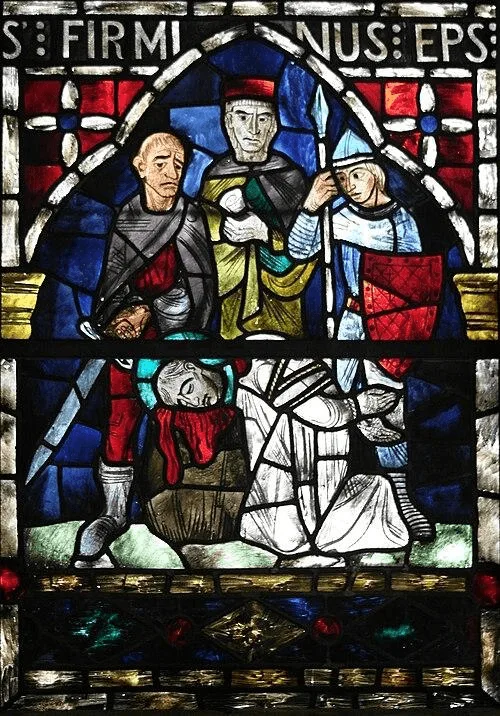
Of what has been documented about this period, it is noteworthy that certain Basque Christians were persecuted by Emperor Domitian (69-96 AD), with the case of Saint Fermin being the most relevant. Born in pompelonense parents, Firminus was the first bishop of Amiens, martyred around 303 AD; his legendary origin has become history since he is venerated as patron of Pamplona (Ramírez, 2015, p. 378). Despite this episode, Christianity consolidated in Basque territory throughout the fourth century AD.
Visigothic Period (5th century - 711 AD)
Various Germanic peoples -Visigoths, Suevi, Vandals and Alans- penetrated the Iberian Peninsula from the first decade of the fifth century AD, consolidating the Visigoths against other "barbarians." On the other hand, the Franks settled in Gaul, leaving the Basques surrounded by these two kingdoms.
It was not until the sixth century that, after a relative coexistence, the first significant episodes of hostility began. First, mid-century the city of Pamplona was conquered by Frank contingents under the command of King Childebert I (511-558), and later King Clotarius I "the Elder" (558-561). However, news that Visigothic troops were approaching the area caused a Frankish withdrawal from Vasconia.
There was a period of thirty years of calm until Leovigild (568-586), King of the Visigoths, invaded strategically part of Basque territory. In it he founded Victoriacum-Vitoria-, within the context of Visigothic campaigns in northern Spain, with the probable aim of pressuring its inhabitants to exert more force on the Frankish people (Alonso, 1987, p. 281). In response, many Basques banded together to raid surrounding Visigoth territory, through burning urban and rural areas as well as capturing prisoners and their belongings.
During the seventh century, King Suintila (621-631) stood out in campaigns that succeeded in subduing the Basques, who were forced to financially support the creation of the Visigothic settlement of Oligicus-Olite-, as well as deliver captives to the Visigoths, as a pledge not to rebel.
Between the reigns of Chindasvinto (642-653) and Recesvinto (653-672), Basques supported the noble rebel, Froya, in 653 AD. This Visigothic noble did not accept Recesvinto's succession, organizing a campaign across the Ebro with Basque assistance and laying siege to Zaragoza. However, they were defeated and Froya was assassinated (Orella, 2004, p. 76).
King Wamba (672-688) had to deal with the Basques. Taking advantage of a rebellion in the Narbonensis province against him, he made a rampage through Vasconia that led its inhabitants to surrender within seven days. Additionally, he repaired damage caused to buildings in Pamplona, which was an important defensive stronghold.
The last Visigothic king, Rodrigo (710-711), also showed hostility towards the Basque people. He received news of the Arab invasion while in Pamplona's territory besieging the city; this means that Pamplona was under Basque control in 711 AD (Alonso, 1987, p. 285).
Conclusions
The historical trajectory of the Basques was based first on close collaboration with Rome, benefiting their military elite and allowing a certain territorial expansion eastward and westward. Second, they adopted several aspects of Roman culture while maintaining many of their own cultural characteristics, thus not achieving total Romanization. Third, with the spread of Christianity, they were one of the peoples where this religion triumphed. Lastly, it is worth noting their resistance to Germanic occupation, especially that of the Visigoths.
Bibliography
Alonso Ávila, A. (1987). Navarra and the Basques during the Visigothic period. Prince of Viana. Supplement 7, 277-292.
Blázquez, J. M. (2008). The Basques in literary sources from Antiquity and current historiography. Veleia, 20, 103-148.
Cantón Serrano, E. (2005). On the expansion of Basques in literary sources. Veleia, 22, 129-143.
Strabo (1992), Geography, Editorial Gredos.
Mezquíriz Irujo, M. A. (2007). The Romanization of the Basques. Veleia, 24-25, 963-976.
Orella, J. L. (2004). History of Euskal Herria. Volume I: The Basques of the past. Txalaparta.
Ortíz de Urbina Álava, E. (2009). Local, provincial and state representation of the Basque elite in Roman times. Andreu, J. (Ed.), The Basques in ancient sources: around an ethnic group of the Iberian Peninsula, Barcelona, Colleció Instrumenta, 457-478.
Peréx Agorreta, M. J. (1986). The Basques. Settlement in Roman times. Institution Prince of Viana.
Ramírez Sádaba, J. L. (2015). Basques through the lands of the Roman Empire. Prince of Viana, 261, 373-384.
Salinas de Frías, M. (2018). The peoples of the Iberian Peninsula before Rome. Síntesis.
Santos Yanguas, J. (1992). Indigenous society and Roman society in Basque territory. Prince of Viana. Supplement 14, 135-151.
Sayas Abengochea, J. J. (1999). From Basques to Romans and back to being Basques. BIBLID 1(44), 147-184.


Comments