
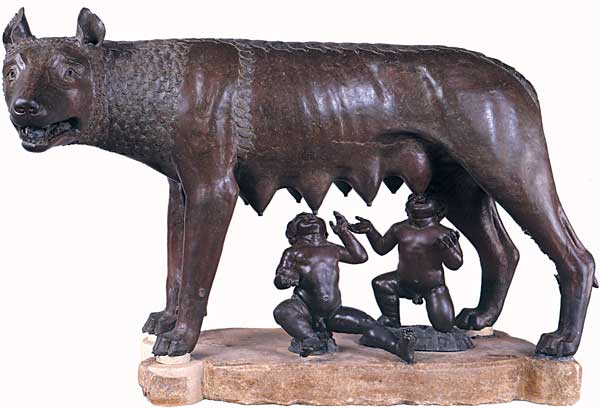
The Capitoline Wolf or Luperca is a bronze sculpture located in the Capitoline Museums (Rome, Italy), although there are copies all over the world, such as the one outside the museum that millions of tourists photograph. The sculptural ensemble consists of three figures: a she-wolf and two small anthropomorphic figures being suckled. This recreation responds to the foundational myth of Rome dated in 753 BC, where the wolf would be Luperca and the children Romulus and Remus, the mythical founders of the city. However, when we talk about this legend, we have to take into account that there are two versions:
The first one, as recorded by Titus Livius, narrates how in the 7th century King Nunmius is governing in Alba Longa (city founded by Ascanius son of Aeneas), until his brother Amlonius decides to depose him and proclaim himself king, but to secure the reign he imprisons Nunmius and imprisons Rhea Silvia (daughter of Nunmius) making her a vestal virgin and with whom he has two sons, Numitor and Amlonius. To Numitor, the elder, he leaves the ancient throne of the house of Silvia. Violence, however, proved stronger than paternal will or respect due to his brother's seniority, for Amlonius expelled him and seized the crown» (Titus Livius, trans. 2018: page 10).
One day Rhea Silvia dreams that she is forced by the God Mars and becomes pregnant with twins, but when her uncle Amlonius finds out he breaks into a rage, as being a vestal virgin she cannot become pregnant and even less so of a God. As a result, he attempts to kill her for breaking her vow of chastity.
Finally, the daughter of Nunmius is murdered, and Amlonius tries to finish off the twins. For this purpose, he orders one of his workers to dispose of them. However, moved by compassion for them, he leaves them in a basket in the river Tiber.
The basket with the children did not drift too far, allowing the twins not to drown. The basket landed near a cave known as Luperca, located between the hills of Capitol and Palatine where among other animals lived a woodpecker bird and a she-wolf that had just given birth (these two animals were sacred to Mars).
The wolf approached the twins and instinctively cared for them until one day a shepherd passing by named Faustulus heard their crying and decided to pick them up and take them home along with his wife Acca Larentia to raise them.
When the twins grew up, their parents revealed their true identity to them, and they decided to avenge and honor their grandfather Nunmius by heading towards the city of Alba Longa.
Once Romulus and Remus arrive at the city, they kill their uncle Amlonius who years earlier had murdered their mother Rhea Silvia, tried to murder them, and was imprisoning their grandfather.
When Amlonius is finally killed, his grandfather is restored to the throne, and the twins leave Alba Longa heading to where Faustulus had found them, deciding to establish their own city. Here arises a dispute between the brothers as Remus wanted to build the city on the Aventine Hill while Romulus wanted it built on the Palatine.
After a long confrontation, Remus is injured and dies shortly after, so Rome is finally founded on the Palatine. The city adopts as its symbol the sculpture of the Capitoline Wolf in honor of Romulus and Remus.
The second legend also recorded by Titus Livius narrates that not would it be a wolf caring for the children, but Luperca would have been a woman. This theory is based on the fact that «lupa» in Latin means «prostitute», etymology also shared by the term «lupanar», i.e., of Roman brothels. According to this second narrative, it was a prostitute who found the children in a basket at the banks of the Tiber and took care of them as if they were her own with help from Faustulus, her husband, who worked as a shepherd away from the capital.
The figure of the Capitoline Wolf and the twins Romulus and Remus have generated significant debate regarding the dating of the famous sculpture generating mainly two theories. The first theory defends that it belongs to Etruscan art while the second proposes a medieval chronology.
Capitoline Wolf, Plaza de la Artilleria Segovia
First theory, belonging to Etruscan art.
This theory is proposed by the archaeologist Johann Joachim Winckelmann in the 18th century. His proposal would date the sculpture as a work of the 5th century BC, corresponding to Etruscan art. Sources such as Cicero, Pliny the Elder and Titus Livius had already exposed in their treatises the existence of a sculpture in the Roman Forum that represented the foundation of Rome through a mythological legend, which could refer to this.

Second theory, belonging to the Middle Ages.
However, this previous theory is seen as nullified when at the end of the 19th century the sculpture is restored and German researchers discover that the method used for the founding process does not correspond to Etruscan times but rather to the Middle Ages, specifically the 12th and 13th centuries. After this, a carbon-14 test was conducted to achieve greater accuracy in dating the sculpture, and finally, in 2007/2008, it was officially announced that the new dating would establish the work's date between 1020 and 1152 AD («dating the statue to 1020–1152 CE with a confidence level of 95.4%») (L. Calcagnile et al., 2019: 211). It is also noteworthy that the sculptural ensemble was not entirely created at first, but the figures of the children were added later in the 15th century. This leads to thinking that the original sculpture did not represent the Capitoline Wolf initially but had a purpose as an apotropaic animal. In a second stage remains the mystery whether the work is original medieval or a copy of an earlier sculpture.

Conclusion
After what has been exposed, we can conclude that the sculptural work known as the Capitoline Wolf or Luperca does not belong to Etruscan times but rather to medieval times, even though there is still debate about whether it corresponds to a copy of an earlier sculpture.
Bibliography
Augias, C. (2007). The Secrets of Rome: History, Places and Characters of a Capital City. Debate.
Calcagnile, L., D’Elia, M., Maruccio, L., Braione, E., Celant, A., & Quarta, G. (2019). Solving an historical puzzle: Radiocarbon dating the Capitoline she wolf. Nuclear Instruments and Methods in Physics Research Section B: Beam Interactions with Materials and Atoms, 455, 209-212. https://doi.org/10.1016/j.nimb.2019.01.008
Carruba, M.A (2006) The Capitoline Wolf: A Medieval Bronze (Introduction by Adriano La Regina). De Luca Editori d´Arte.
Livio, T (2018). The Foundation of Rome: Romulus and Remus. Edhasa.


Comments