
Introduction
The Autrigones are a pre-Roman ethnic group that inhabited the northern part of the Cantabrian coast. Currently, they would occupy parts of the provinces of Álava, Vizcaya, Cantabria, and Burgos, which during the Iron Age were inhabited by tribes such as the Cántabros, Caristios, Várdulos, Verones, and Turmogos.
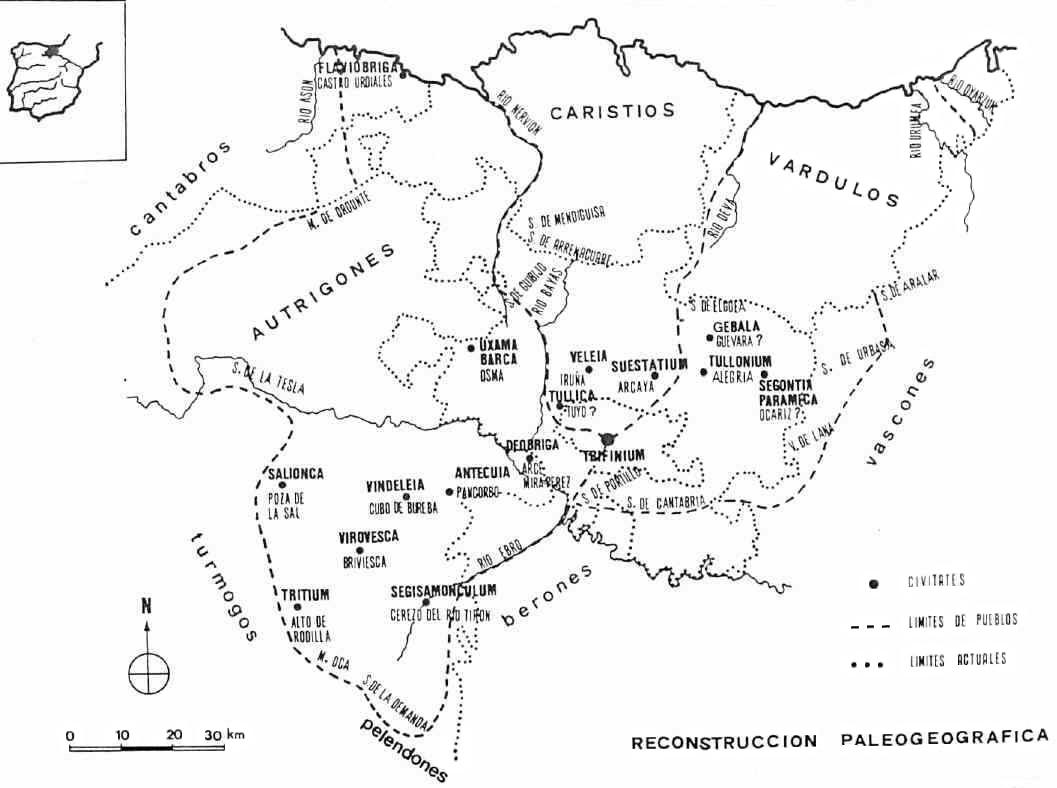
This is a tribe about which there isn't much information; it is generally grouped as Celtic, attributing to them all the characteristics that this entails, but reality is far more complex than that. In this brief review, through the use of archaeology and classical sources, an attempt is made to reconstruct, grosso modo, the current knowledge about this ethnic group.
Archaeological and Documentary Information
Firstly, we need to place ourselves at the transition from the Final Bronze Age (13th century BCE – 725 BCE) to the Iron Age, a moment when archaeologically and for this entire region, there is perceived a break with previous indigenous traits. This occurs due to the arrival of Indo-European peoples who incorporate new construction techniques and technologies. The greatest evidence of this are fortified settlements or castros, which are located in strategic places (accesses to valleys or along natural routes), serving to control an extensive space, as well as the transhumance routes that generally become commercial routes. Evidence of this can be seen in the subsequent creation of Roman roads over spaces traditionally used for centuries (Gorbea Pérez, 2004).
These cultural-technological processes would reinforce throughout the Iron Age, which in this space is subdivided into two: Early Iron Age (725 BCE – 450 BCE) and Late Iron Age (450 BCE – Roman conquest). The incorporation of iron metallurgy, as well as an increase in food production, led to a considerable population growth and also conflicts over controlling those same products (livestock heads, manufactured goods...).
Similarly, it has been possible to confirm through archaeology that the territory where the Autrigones are located is an area that encompasses very different geographical realities and which had a notable influence on the cultural development of the various settlements. Traditionally, two zones have been differentiated: a Mediterranean slope with clear Iberian or Celtiberian influences, and another Atlantic slope, which presents distinct characteristics from the former, more archaic. These theories are corroborated through the typological study of ceramics from different slopes, which aligns with what classical sources tell us about them.

Considering the information provided by classical sources, while it is true that not all of them agree on how to describe this group, there is a majority consensus in identifying them all as one.

The information provided by classical sources about the ethnic group of the Autrigones is quite late. The first reference to this tribe is made by Titus Livius in the 1st century AD, when he informs about the Sertorian Wars, where the peoples of the autrigones and berones implored Pompey's help to fight against Sertorius, sending guides and cavalry as auxiliary troops. The next piece of information is even more explicit, stating that during the siege of the city of Vareia, the defenders called upon all the cavalry from the country, including that of the autrigones (Solana, 1974: 111-112). From this first mention it can be inferred that for this historical moment, in the 1st century BC, the autrigones were in close contact with their neighboring tribes and had a good understanding of the Roman horizon. We can say that the Autrigones were a warrior society where cavalry seems to play the main role in military actions. Therefore, it is a minimally organized society.
Subsequently, in the 2nd century AD, Lucius Annaeus Florus cites that one of the reasons for the beginning of the Cantabrian Wars was the continuous attacks by the Cántabros on the tribes of the vacceos, turmogos, and autrigones (Solana, 1974: 112-113). From this it can be deduced that these areas were integrated within the Roman orbit, romanized or in the process of becoming so, and under their protection.
Another example of the total integration of the Autrigon population into the Roman army comes through epigraphy. An inscription dated to the 1st century AD, found in Cyrene (Africa), presents Pompeius Ligyrus Autricoann, a cavalryman in the Cohorte I Hispanorum (San Vicente, 2009: 1002-1003). Without delving into analyzing his tria nomina, it is evident that he is embedded within the Roman machinery, far from his place of origin and with a Latin nomen.
Lastly, for the 2nd century AD, Ptolemy attributes to the autrigones the following cities: Uxamabarca, Segisamonculum, Virvesca, Antecuia, Deobriga, Vindeleia, Salionica, Flaviobriga and Tritium.
Theories
In summary, classical sources do not narrate the organizational-economic level of these pre-Roman societies; this information can be deduced from what they "don't tell us." Therefore, what do we really know about this ethnic group? Historiographically there are various theories regarding them. One theory posits their central European origin, possibly arriving in the Iberian Peninsula during one of the various migrations that occurred throughout the Iron Age. On the other hand, opposing this theory are indigenists who argue for a Basque origin of the Autrigones, basing themselves on toponymy from those rugged areas where Celtic culturalization did not take hold and where there exist vestiges of Basque names (Fernández Palacios, 2002: 95-98).
In any case, it is impossible to clarify which theory may be correct, among other things due to the process of acculturation that this region underwent. In a complex and long-term process like this one, there should not be a simple explanation sought after, as none exists. Archaic theories and those based on race must be discarded since we do not even know what language these people spoke. Whether it was Iberian or Basque is something that escapes us (Almagro Gorbea, 2008).
Bibliography
- Almagro Gorbea, M. (2008): The Origins of the Basques, Delegation at Court of the Royal Society of Friends of the Country, Madrid, 2008.
- Fernández Palacios, F. (2002): Linguistics and History of Asón to Cadagua: (Pre-Roman and Roman Periods), Universidad Complutense de Madrid, Madrid, 2002.
- Gorbea Pérez, M. (2004): Communication Routes in Autrigon, Caristio, and Várdulo Territory, KOBIE 6, San Sebastián, 2004, pp. 403-410.
- Peñalver, X. (2008). The Iron Age. The Basques and Their Neighbors: The Last Millennium Before Our Era. Txertoa Editions (Euskal Gaiak Abarka SL) Donostia, San Sebastian.
- San Vicente González de Aspuru, J. (2009): Auxiliae Autrigones, Várdulos and Caristios in the Roman Army, Half a Century of Archaeology in Eastern Cantabria and Its Surroundings: Proceedings of an International Congress, Instituto Alavés de arqueología, 2009, pp. 993-1010.
- Santos, J., Emborujo, A., & de Urbina, E. O. (1992): Paleogeographic Reconstruction of Autrigones, Caristios and Várdulos. Universidad Complutense, Department of Prehistory and Ethnology.
- Solana Sainz J. M. (1974): The Autrigones Through Literary Sources, Colegio Universitario de Álava, Vitoria, 1974.


Comments