

In 1536, King Henry VIII of England lost his third wife after a difficult childbirth. Jane Seymour had given him what he so desperately wanted: a male heir. But at too high a price. Now the monarch was widowed once again, so factions at Court began to desperately search for potential candidates who could fill the void left by the much-loved Queen Seymour. The powerful Howard family also tried to move quickly. However, other parties managed to get ahead and presented Henry with a potential successor: Anne of Cleves. The king seemed fascinated with her portrait, so any other option was discarded. The Howards would have to settle for finding young women within their own family who could become ladies-in-waiting to the new queen. It was then that Katherine Howard came into consideration.

Far from the Court and the grand stages of power, in a rustic mansion located in Lambeth, an elderly Duchess of the Howards ran a house where she raised daughters of impoverished aristocrats who had no means to support them. The young Katherine was one among many girls living in that home without paternal figures and surrounded by an environment filled with mischief and adventures. In the future, she would be accused of discovering too early sexual encounters with Francis Dereham, secretary to the Duchess, and also with her music teacher, Henry Mannox. Perhaps these were more about constant harassment on those nearly defenseless young women rather than consensual meetings. Whether or not these episodes occurred, everything changed for her in 1539 when Thomas Howard, Duke of Norfolk and uncle of Katherine, called her to Court. He had secured a position for her at the service of the new queen.
From Lady-in-Waiting to Queen of England
The new royal marriage was a failure from the start. Anne of Cleves did not possess any of the qualities that Henry VIII so valued: elegance, sensuality, and an innate ability to navigate the intrigues of this Court. Modern historiography often agrees that the problem lay less in the alleged ugliness that Henry went out of his way to proclaim, even going as far as calling her a "Flemish mare." Rather, the issue was that Anne came from a duchy austere and very distant from the games of desire and power played in the courts of Paris and London. Her attire, manners, and even her inability to adapt to a king constantly ill and irritable due to an injured leg that never fully healed worked against her. In these circumstances, Katherine Howard tried to survive the suffocating atmosphere in the queen's quarters. Her cheerful and playful demeanor was a breath of fresh air amidst the difficult times Queen Anne faced.
Curiously, or perhaps not surprisingly, she also caught the attention of the king himself. Henry, behaving like an indulged child and letting his adolescent love take over, decided he had chosen a new queen for him: his fourth wife. Without even allowing this young girl to blink, the Howards decided to use her to their advantage and forced her into seducing the king. Could Katherine have loved Henry? It's hard to believe. At that time, he was no longer a chivalrous knight; he was constantly ill due to an infected leg wound, felt the setbacks of age, had gained much weight, and his manic and paranoid character was becoming dangerous. But the issue was that Katherine had no option to escape this marriage, just as none of Henry's six wives did.
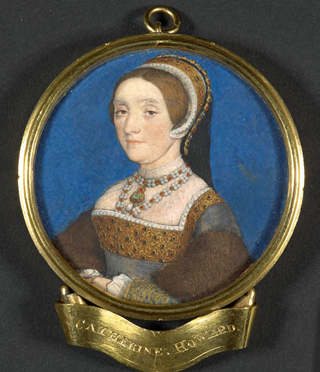
The thorns of the English rose: the difficult path of the new queen
At seventeen years old, Katherine married a man who was already approaching fifty. She knew practically nothing about the customs and ceremony expected of an authentic queen, and her own family was too busy basking in their privileged situation to worry about helping her. Although she enjoyed organizing dances and tea parties in her chambers, her daily life often seemed monotonous and boring. In fact, to cope better with her routine, she leaned on one of her ladies-in-waiting: Lady Jane Boleyn, Viscountess Rochford. The widow of Henry's second wife, the disgraced and executed Anne Boleyn, Lady Jane had lost everything in the past and now clung to the new young queen to guide her through Court and, obviously, gain personal benefits. But if anyone made Katherine's new position bearable it was a royal servant. Thomas Culpeper was, among other things, an attractive and seductive young man, a kind of Adonis who managed to rejuvenate even the aging Henry. It is possible that Katherine and Thomas knew each other when she was still lady-in-waiting to Anne of Cleves. But what matters is that, risking far more than their positions, they began a dangerous secret romance.
Taking advantage of a journey Henry organized to York, Katherine and Thomas sought any opportunity to have secret sexual encounters. In these meetings, Lady Jane Boleyn acted as confidante and covered for the lovers. How different was Thomas from his elderly and irritable husband! Katherine seemed comforted in the arms of this young man who, in his letters, did not stop showing her the adolescent love he felt for her. The problem was that this game of secrets got out of control too quickly. The arrival at Court of Francis Dereham, her supposed youthful lover, seeking a position among the queen's staff and the rivalry that began to grow between him and Culpeper eventually made their romance public. As was inevitable, the matter reached the ears of rival families of the Howards. After all, if Katherine fell, so would her entire family, including the Duke of Norfolk.
On November 23, 1543, an enraged and nearly stunned Henry VIII ordered that Katherine and Lady Rochford be taken to the Tower of London for interrogation. Finally, the English rose fell into the same "golden trap," as Philippa Gregory called it in her novel. Thomas Culpeper and Francis Dereham were tortured and brutally executed, with their heads placed on spikes at the gates of London. As for Katherine, she reportedly spent the night before her death practicing how to place her head on the executioner's block. The next day, the disgraced queen asked forgiveness for her betrayal to the Crown and was also executed. A few hours later, Lady Jane Rochford followed suit.
Conclusions
If anything can be said about Katherine Howard is that she never knew how to navigate the Court with skill, where political survival - and personal as well - had become truly difficult to achieve. Although traditional historians focused mainly on her infidelities, it's true that this young queen was, like all six of Henry VIII's wives, a victim in the hands of more powerful others, namely her own family: the Howards.

Bibliography
Fraser, A. (2005), The Six Wives of Henry VIII, Ediciones B, Barcelona.
Hackett, F. (1989), Henry VIII and His Six Wives, ed. Juventud, Barcelona.
Gregory, Philippa (2010), The Golden Thorn, ed. Planeta, Madrid.
Pérez Martín, M. J. (2018), Maria Tudor: The Great Unknown Queen, Riapl, Barcelona, 2018.
Weir, A. (2010), Henry VIII and the Court of the Tudors, ed. Planeta, Madrid, 2010.
Wilkinson, J. (2017), Katherine Howard: The Tragic Story of Henry VIII's Fifth Queen, ed. John Murray Publishers, London.


Comments