

The coin is more than just legal tender. It also serves as a propaganda tool used by most political powers for centuries. It represents the prestige of the highest authority and disseminates the message that this authority wishes to convey to the world (Francisco Olmos 2021, 211-278).
Today we would not understand a coin without the face of the monarch, or some other national symbol in the case of republics, and neither did people in the fourteenth century. Therefore, when King Fernando I of Portugal died in 1383, a single coin was minted in the name of his heir, Beatriz. This coin hides behind it the story of a struggle for power that will go down in Portuguese history as the First Interregnum.
The figure of Beatriz is relatively unknown. Historiography has overlooked her, treating her as a secondary player in the conflict between Castile and Portugal. Recently, César Olivera shed light on her life and political implications (The Queen Beatriz, Olivera Serrano 2005). Her work has been fundamental to understanding both her and the conflict that arose from her father's succession.
How did this situation come about? We need to go back years, to 1369. Pedro I of Castile died at the hands of his illegitimate brother, Enrique II. This event marked the end of the legitimate line of Castilian kings, replaced by a bastard branch, henceforth known as the Trastámara. However, the right to the throne of these latter is questioned by the daughter of the deceased king, the Duchess of Lancaster, and by King Fernando I of Portugal.
This marks the beginning of what are called the Fernandine Wars, a conflict with distinct phases in which the Trastámara always prevail over their Portuguese neighbor. These defeats feature prominently Beatriz, the only daughter of the king, who changes her fiancé with each new peace treaty. Finally, she is engaged to:
- 1373-1380:Fadrique, Duke of Benavente and illegitimate son of Enrique II. The kings of Portugal eventually received dispensation for this marriage (Archivo General de Simancas, PTR,LEG,47,5).
- 1380:Enrique, eldest son of Juan I of Castile, in turn son and successor to Enrique II.
- 1380-1382: Eduardo of Norwich, nephew of the Dukes of Lancaster, allies with Portugal during the Third Fernandine War.
- 1382: Fernando, younger son of Juan I of Castile and future Fernando I of Aragon. This matrimonial proposal put an end to the Third Fernandine War.
This last engagement seems definitive, but it is thwarted when Queen Beatriz's mother dies in 1382. Leonor Téllez de Meneses orchestrates a new matrimonial project and replaces the Infante Fernando with her recently widowed father, King Juan I.
This marital agreement was particularly advantageous for Leonor. According to the marriage capitulations, Beatriz maintains her position as heir to her father in the absence of a male child but is prevented from exercising power as queen in Portugal. Instead, Queen Leonor will govern as regent until Beatriz's eldest son reaches fourteen years of age. The agreement insists that royal prerogatives belong to the wife of the king and not to his daughter or her husband, including the right to mint coins (Torre do Tombo, Gavetas, Gav. 17, mç. 6, n.º 10).
Now, Beatriz is very young. So much so that Pedro Luna, papal legate and future "Pope Luna," had to issue a ruling compelling Beatriz to consummate her marriage at thirteen years of age when the age of majority was fourteen (Archivo General de Simancas, PTR,LEG,47,18). If her mother's plan were successful, it could take several years until her daughter gave birth to a son and another fourteen until this child could rule. During all that time, Leonor could retain power in Portugal, although we already know that this was not the case.
Fernando died in 1383 shortly after Beatriz's wedding. Immediately, Leonor asserted what had been agreed upon and proclaimed her daughter queen, and herself regent. In these circumstances, she ordered silver coins to be minted in Santarém, a city controlled by the widowed Queen.
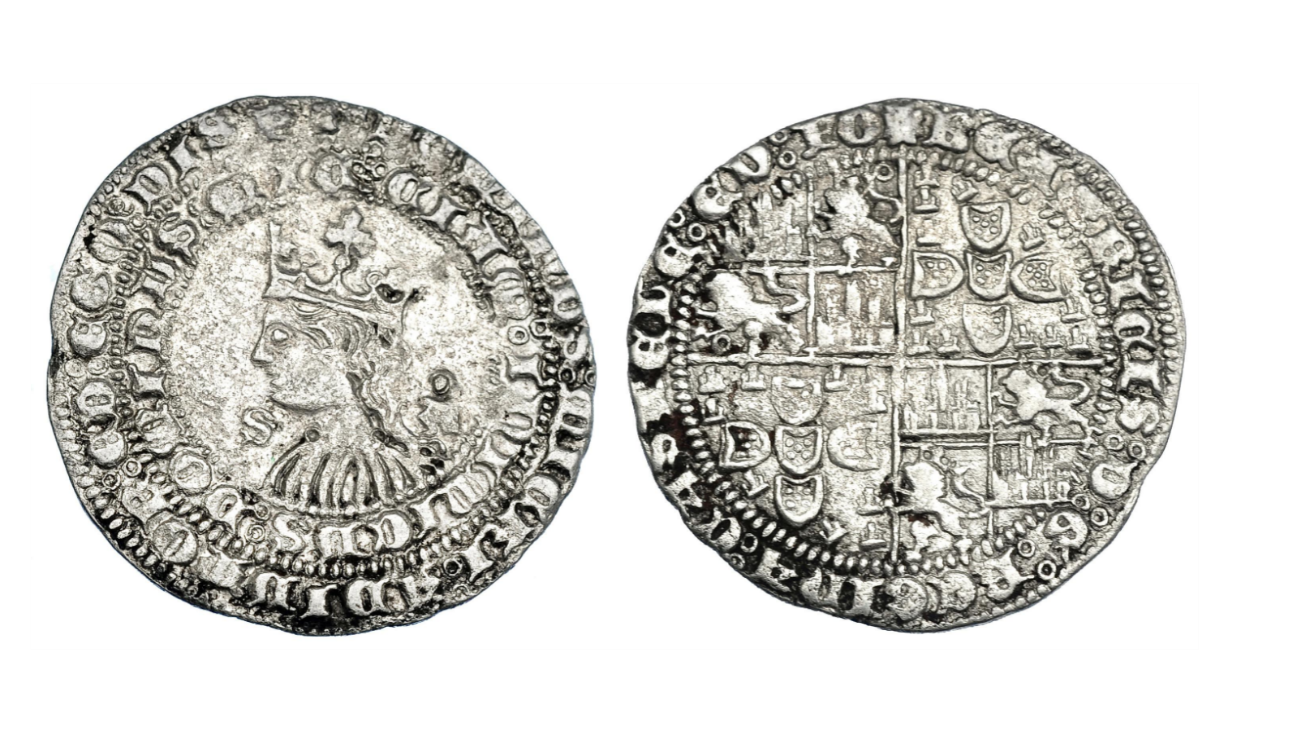
On the obverse of the coin, one can see a crowned bust of the queen looking to the left. The legend, arranged in double fillet, reads: DOMINVS MICHI AIVTOR ET EGO DISPICIAM INMICVS DOMINVS MIC (Gomes 2003, 104). This is a biblical reference (Psalms 117, verse 7), and it can be translated as "The Lord helps me, and I will look down from above on my enemies."
This phrase was already used by Pedro I of Castile during his conflict with his brother Enrique (Francisco Olmos 2003, 305-307). It is common to use a religious legend on silver coins, especially from the Book of Psalms. However, that both Pedro I and Beatriz's mother chose precisely this one was not accidental. In both cases, the coin was minted when not everyone accepted the authority of the monarch, and he appealed to his divine right to legitimize himself.
On the reverse is placed a heraldic quartering with the arms of Castile (1 and 3) and Portugal (2 and 4). This goes against what was agreed by Fernando I, who did not want elements from Castile to be included in the coin minted by his wife. The legend refers to the monarch: BEATRICIS DEI G REGINA CASTELE ET PO. It prioritizes her position as a spouse and the title and arms of Castile. Her position as queen and owner of Portugal is relegated to second place. This same heraldry can be seen in the pendant seal that Beatriz used as Queen Consort of Castile (Guglieri Navarro 1974, 276-277).

As a young sovereign without power and married to a foreigner, Beatriz finds herself in a difficult position. This is compounded by the fact that she is not the only one claiming the throne. Before Fernando I, all Portuguese kings had male heirs, and some do not understand why a woman should ascend to it. As an alternative, Juan de Castro, son legitimized of Pedro I of Portugal and Inés de Castro (treated as illegitimate by his half-brother Fernando), is put forward. Upon the death of the king, Juan de Castro was imprisoned by Juan I of Castile. The confinement of the claimant did not end the hostile climate in Portugal.
Through this coin, the regent aims to remind people that the throne belongs to her daughter. With its minting and circulation, she is informing the Portuguese people that there is a new sovereign. Following Fernando I's wishes, Beatriz appears on the coin without her husband, demonstrating Portugal's independence.
It remains to explain why the arms and title of Castile appear if they are prohibited by capitulations and meant to signify Portugal’s independence. There is fear of an annexation with Castile but also fear of Trastámara forces. Leonor Téllez de Meneses comes to power as a very unpopular ruler, and many question her daughter's right to the throne. Her main asset is the alliance with her son-in-law, though he will not be willing to let her govern. With the arrival of the Castilian king and an unexpected rival within Portugal, Queen Leonor will exit the game forcefully, but that we'll see in part two.
Bibliography
Gomes, A. (2003): Portuguese Coins and the Territory that is Portugal Today. Lisbon: Asociación Numismática de Portugal.
Guglieri Navarro, A. (1974): Catalog of Seals from the Sigillography Section of the National Historical Archive vol. 1. Madrid: Ministry of Education and Science.
Francisco Olmos, J. M. de (2003): The Coin in Late Medieval Castile. Means of Propaganda and Economic Instrument. In J. C. Galende Díaz (coord.), II Scientific Conference on Documentation of the Crown of Castile (13th-15th centuries) (277-246). Madrid: UCM.
Francisco Olmos, J. M. de (2022): The Two Sides of the Coin: Means of Economic Exchange and Means of Political and Religious Propaganda. In M. E. Martín López and J.
M. de Francisco Olmos (dirs.), Social Communication in Medieval Europe (211-278). Madrid: Dykinson.
Olivera Serrano, C. (2005): Beatriz of Portugal. The Dynastic Struggle Avis-Trastámara. Santiago de Compostela: CSIC e Instituto de Estudios Gallegos "Padre Sarmiento".


Comments