La moneda es algo más que una pieza de curso legal. También es un objeto propagandístico utilizado por la mayor parte de poderes políticos desde hace siglos. Representa el prestigio de la máxima autoridad, y difunde el mensaje que esta quiera dar al mundo (Francisco Olmos 2021, 211-278).
Hoy en día no entenderíamos que en una moneda no apareciera el rostro del monarca, o algún otro símbolo nacional en el caso de las repúblicas, y en el siglo XIV tampoco. Por ello, cuando el rey Fernando I de Portugal fallece en 1383, se acuña una única moneda en nombre de su heredera, Beatriz. Esta moneda esconde tras de sí la historia de una lucha por el poder, que pasará a la historia de Portugal como el Primer Interregno.
La figura de Beatriz es relativamente desconocida. La historiografía ha pasado de largo, tratándola como una actriz secundaria de la pugna entre Castilla y Portugal. Recientemente, César Olivera ha arrojado luz sobre la vida y las implicaciones políticas de la reina Beatriz (Olivera Serrano 2005). Su obra ha sido una base fundamental para entenderla a ella y al conflicto que trajo la sucesión de su padre.
¿Cómo se llega a esta situación? Hemos de retrotraernos años atrás, a 1369. Pedro I de Castilla muere a manos de su hermano ilegítimo, Enrique II. Este evento supone el fin de la rama legítima de los reyes de Castilla, suplantados por una rama bastarda, en adelante los Trastámara. Sin embargo, el derecho al trono de estos últimos es cuestionado por la hija del rey difunto, la duquesa de Lancaster, y por el rey Fernando I de Portugal.
Este es el origen de las llamadas Guerras Fernandinas, un conflicto con distintas fases en las que los Trastámara siempre se imponen sobre el vecino portugués. Estas derrotas tienen como protagonista a la única hija del rey, Beatriz, que va cambiando de prometido con cada nuevo tratado de paz. Finalmente, queda prometida con:
1373-1380: Fadrique, duque de Benavente e hijo ilegítimo de Enrique II. Los reyes de Portugal llegarán a recibir dispensa para este matrimonio (Archivo General de Simancas, PTR,LEG,47,5).
1380: Enrique, hijo mayor de Juan I de Castilla, a su vez hijo y sucesor de Enrique II.
1380-1382: Eduardo de Norwich, sobrino de los duques de Lancaster, aliados de Portugal durante la Tercera Guerra Fernandina.
1382: Fernando, hijo menor de Juan I de Castilla y futuro Fernando I de Aragón. Esta propuesta matrimonial pone fin a la Tercera Guerra Fernandina.
Este último compromiso parece ser el definitivo, pero se trunca cuando la reina de Castilla muere en 1382. La madre de Beatriz, Leonor Téllez de Meneses, orquesta un nuevo proyecto matrimonial, y cambia al infante Fernando por su padre recién enviudado, el rey Juan I.
Este acuerdo matrimonial era especialmente ventajoso para Leonor. Según las capitulaciones matrimoniales, Beatriz mantiene su posición como heredera de su padre a falta de hijo varón, pero se le impide ejercer como reina en Portugal. En su lugar, la reina Leonor gobernará como regente hasta que el primogénito de Beatriz cumpla catorce años. El acuerdo insiste en que las atribuciones regias corresponderán a la esposa del rey, y no a su hija y su yerno, incluido el derecho de monedaje (Torre do Tombo, Gavetas, Gav. 17, mç. 6, n.º 10).
Ahora bien, Beatriz es muy joven. Tal es así que Pedro Luna, legado pontificio y futuro «Papa Luna», debe dictar una sentencia obligando a Beatriz a consumar su matrimonio con trece años, cuando la mayoría de edad se alcanzaba con catorce (Archivo General de Simancas, PTR,LEG,47,18). Si el plan de su madre tuviera éxito, podrían pasar varios años hasta que su hija diera a luz a un hijo, y otros catorce hasta que este pudiera gobernar. En todo ese tiempo, Leonor podría retener el poder en Portugal, aunque ya sabemos que no será así.
Fernando fallece en 1383, poco después de la boda de Beatriz. Inmediatamente, Leonor hace valer lo pactado y proclama reina a su hija, y a sí misma regente. En estas circunstancias, ordena hacer reales de plata en Santarém, ciudad controlada por la reina viuda.
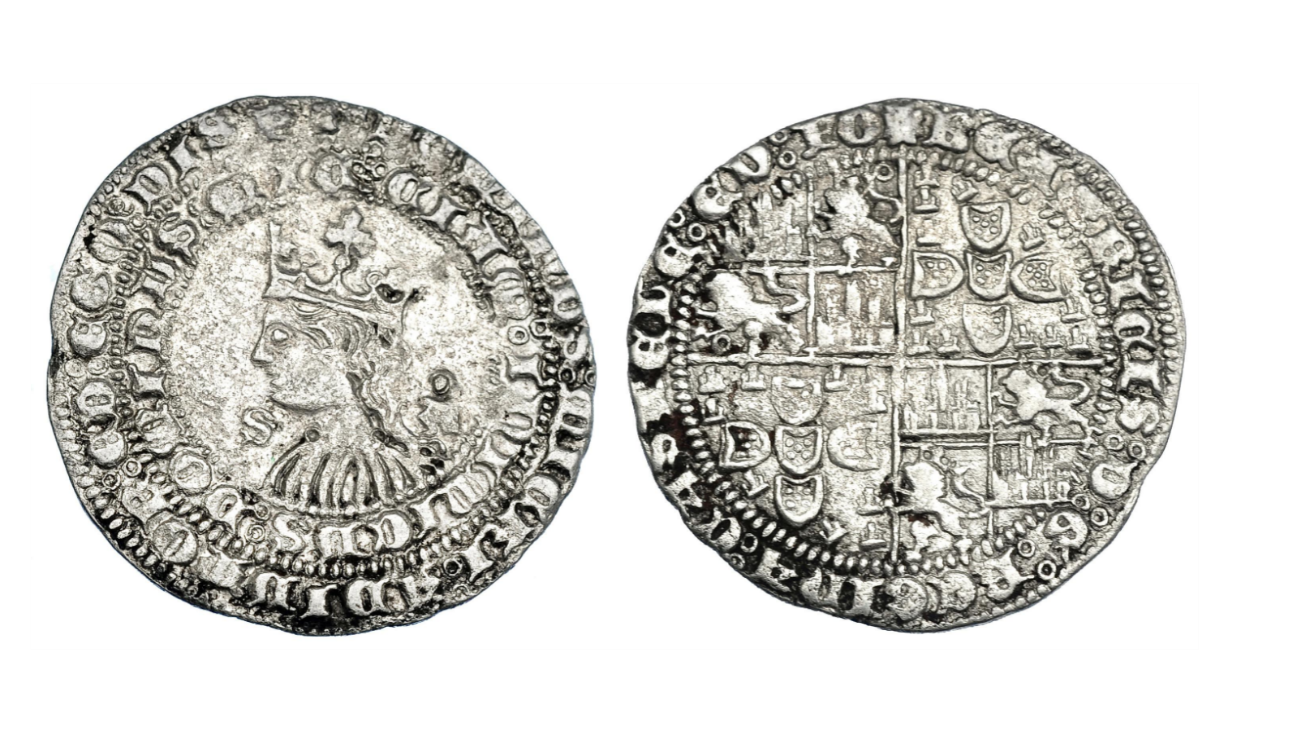
Real de la reina Beatriz (Jesús Vico, subasta 158, lote 727, 14 de abril de 2022)
En el anverso de la moneda se puede apreciar el busto coronado de la reina, mirando a izquierda. La leyenda, dispuesta a doble orla, dice: DOMINVS MICHI AIVTOR ET EGO DISPICIAM INMICVS DOMINVS MIC (Gomes 2003, 104). Se trata de una referencia bíblica (Salmos 117, versículo 7), y se puede traducir como «El Señor me ayuda, y voy a mirar desde arriba a mis enemigos».
Esta frase ya fue utilizada por Pedro I de Castilla durante su enfrentamiento con su hermano Enrique (Francisco Olmos 2003, 305-307). Es común usar una leyenda religiosa en las monedas de plata, especialmente del Libro de los Salmos. Sin embargo, que tanto Pedro I como la madre de Beatriz eligieran precisamente ésta no es casualidad. En ambos casos, la moneda se hace cuando no todos aceptan la autoridad del monarca y este acude a su derecho divino para legitimarse a sí mismo.
En el reverso se coloca un cuartelado heráldico con las armas de Castilla (1 y 3) y Portugal (2 y 4). Esto va en contra de lo acordado por Fernando I, que no quiso que se incluyeran elementos castellanos en la moneda que hiciera su esposa. La leyenda hace referencia a la monarca: BEATRICIS DEI G REGINA CASTELE ET PO. Se mantiene en primer lugar su posición como esposa, primando el título y las armas de Castilla. Su posición como reina propietaria de Portugal queda relegada a un segundo plano. Esta misma heráldica podemos apreciarla en el sello pendiente que usa Beatriz como reina consorte de Castilla (Guglieri Navarro 1974, 276-277).
Dibujo de sello pendiente de Beatriz, por Miguel Couso Martínez
Como una soberana joven, sin poder y casada con un extranjero, Beatriz se encuentra en una posición complicada. A esto se suma que no es la única que se postula al trono. Antes de Fernando I, todos los reyes de Portugal han tenido un hijo varón, y algunos no entienden por qué ha de ascender una mujer al trono. Como alternativa, se postula su tío Juan de Castro, hijo legitimado de Pedro I de Portugal e Inés de Castro, tratado como bastardo por su medio hermano Fernando. Muerto el rey portugués, Juan de Castro es encerrado por Juan I de Castilla. El confinamiento del pretendiente no terminará con el clima hostil en Portugal.
Mediante esta moneda, la regente intenta recordar que el trono pertenece a su hija. Con su acuñación y puesta en circulación, se está informando al pueblo portugués que hay una nueva soberana. Siguiendo los deseos de Fernando I, esta aparece en la moneda sin su marido, demostrando que Portugal sigue siendo independiente.
Queda por responder por qué aparecen las armas y el título de Castilla, si las capitulaciones lo prohíben y se quiere señalar la independencia de Portugal. El miedo a una anexión con Castilla existe, pero también el miedo a las fuerzas de los Trastámara. Leonor Téllez de Meneses llega al poder como una gobernante muy impopular, y con mucha gente cuestionando el derecho de su hija. Su principal baza es la alianza con su yerno, aunque este no estará por la labor de dejarla gobernar. Con la llegada del rey de Castilla, y un rival inesperado dentro de Portugal, la reina Leonor saldrá de la partida de forma forzosa, pero eso lo veremos en la segunda parte.
Bibliografía
Gomes, A. (2003): Moedas portuguesas e do territorio que hoje é Portugal. Lisboa: Asociación Numismática de Portugal.
Guglieri Navarro, A. (1974): Catálogo de sellos de la Sección de Sigilografía del Archivo Histórico Nacional vol. 1. Madrid: Ministerio de Educación y Ciencia.
Francisco Olmos, J. M. de (2003): La moneda en la Castilla bajomedieval. Medio de propaganda e instrumento económico. En J. C. Galende Díaz (coord.), II Jornadas Científica sobre Documentación de la Corona de Castilla (siglos XIII-XV) (277-246). Madrid: UCM.
Francisco Olmos, J. M. de (2022): Las dos caras de la moneda: medio de intercambio económico y medio de propaganda política y religiosa. En M. E. Martín López y J. M. de Francisco Olmos (dirs.), La comunicación social en la Europa medieval (211-278). Madrid: Dykinson.
Olivera Serrano, C. (2005): Beatriz de Portugal. La pugna dinástica Avís-Trastámara. Santiago de Compostela: CSIC e Instituto de Estudios Gallegos “Padre Sarmiento”.
This translation was generated automatically using qwen2.5:14b-instruct and has not been reviewed by a human editor. It may contain errors, omissions or awkward phrasing — for the authoritative version, please read the original in Spanish. Found a mistake? Let us know at info@arqueotimes.es.
The coin is more than just legal tender. It also serves as a propaganda tool used by most political powers for centuries. It represents the prestige of the highest authority and disseminates the message that this authority wishes to convey to the world (Francisco Olmos 2021, 211-278).
Today we would not understand a coin without the face of the monarch, or some other national symbol in the case of republics, and neither did people in the fourteenth century. Therefore, when King Fernando I of Portugal died in 1383, a single coin was minted in the name of his heir, Beatriz. This coin hides behind it the story of a struggle for power that will go down in Portuguese history as the First Interregnum.
The figure of Beatriz is relatively unknown. Historiography has overlooked her, treating her as a secondary player in the conflict between Castile and Portugal. Recently, César Olivera shed light on her life and political implications (The Queen Beatriz, Olivera Serrano 2005). Her work has been fundamental to understanding both her and the conflict that arose from her father's succession.
How did this situation come about? We need to go back years, to 1369. Pedro I of Castile died at the hands of his illegitimate brother, Enrique II. This event marked the end of the legitimate line of Castilian kings, replaced by a bastard branch, henceforth known as the Trastámara. However, the right to the throne of these latter is questioned by the daughter of the deceased king, the Duchess of Lancaster, and by King Fernando I of Portugal.
This marks the beginning of what are called the Fernandine Wars, a conflict with distinct phases in which the Trastámara always prevail over their Portuguese neighbor. These defeats feature prominently Beatriz, the only daughter of the king, who changes her fiancé with each new peace treaty. Finally, she is engaged to:
1373-1380:Fadrique, Duke of Benavente and illegitimate son of Enrique II. The kings of Portugal eventually received dispensation for this marriage (Archivo General de Simancas, PTR,LEG,47,5).
1380:Enrique, eldest son of Juan I of Castile, in turn son and successor to Enrique II.
1380-1382: Eduardo of Norwich, nephew of the Dukes of Lancaster, allies with Portugal during the Third Fernandine War.
1382: Fernando, younger son of Juan I of Castile and future Fernando I of Aragon. This matrimonial proposal put an end to the Third Fernandine War.
This last engagement seems definitive, but it is thwarted when Queen Beatriz's mother dies in 1382. Leonor Téllez de Meneses orchestrates a new matrimonial project and replaces the Infante Fernando with her recently widowed father, King Juan I.
This marital agreement was particularly advantageous for Leonor. According to the marriage capitulations, Beatriz maintains her position as heir to her father in the absence of a male child but is prevented from exercising power as queen in Portugal. Instead, Queen Leonor will govern as regent until Beatriz's eldest son reaches fourteen years of age. The agreement insists that royal prerogatives belong to the wife of the king and not to his daughter or her husband, including the right to mint coins (Torre do Tombo, Gavetas, Gav. 17, mç. 6, n.º 10).
Now, Beatriz is very young. So much so that Pedro Luna, papal legate and future "Pope Luna," had to issue a ruling compelling Beatriz to consummate her marriage at thirteen years of age when the age of majority was fourteen (Archivo General de Simancas, PTR,LEG,47,18). If her mother's plan were successful, it could take several years until her daughter gave birth to a son and another fourteen until this child could rule. During all that time, Leonor could retain power in Portugal, although we already know that this was not the case.
Fernando died in 1383 shortly after Beatriz's wedding. Immediately, Leonor asserted what had been agreed upon and proclaimed her daughter queen, and herself regent. In these circumstances, she ordered silver coins to be minted in Santarém, a city controlled by the widowed Queen.
Queen Beatriz's silver coin (Jesús Vico, auction 158, lot 727, April 14, 2022)
On the obverse of the coin, one can see a crowned bust of the queen looking to the left. The legend, arranged in double fillet, reads: DOMINVS MICHI AIVTOR ET EGO DISPICIAM INMICVS DOMINVS MIC (Gomes 2003, 104). This is a biblical reference (Psalms 117, verse 7), and it can be translated as "The Lord helps me, and I will look down from above on my enemies."
This phrase was already used by Pedro I of Castile during his conflict with his brother Enrique (Francisco Olmos 2003, 305-307). It is common to use a religious legend on silver coins, especially from the Book of Psalms. However, that both Pedro I and Beatriz's mother chose precisely this one was not accidental. In both cases, the coin was minted when not everyone accepted the authority of the monarch, and he appealed to his divine right to legitimize himself.
On the reverse is placed a heraldic quartering with the arms of Castile (1 and 3) and Portugal (2 and 4). This goes against what was agreed by Fernando I, who did not want elements from Castile to be included in the coin minted by his wife. The legend refers to the monarch: BEATRICIS DEI G REGINA CASTELE ET PO. It prioritizes her position as a spouse and the title and arms of Castile. Her position as queen and owner of Portugal is relegated to second place. This same heraldry can be seen in the pendant seal that Beatriz used as Queen Consort of Castile (Guglieri Navarro 1974, 276-277).
Drawing of pendant seal by Miguel Couso Martínez
As a young sovereign without power and married to a foreigner, Beatriz finds herself in a difficult position. This is compounded by the fact that she is not the only one claiming the throne. Before Fernando I, all Portuguese kings had male heirs, and some do not understand why a woman should ascend to it. As an alternative, Juan de Castro, son legitimized of Pedro I of Portugal and Inés de Castro (treated as illegitimate by his half-brother Fernando), is put forward. Upon the death of the king, Juan de Castro was imprisoned by Juan I of Castile. The confinement of the claimant did not end the hostile climate in Portugal.
Through this coin, the regent aims to remind people that the throne belongs to her daughter. With its minting and circulation, she is informing the Portuguese people that there is a new sovereign. Following Fernando I's wishes, Beatriz appears on the coin without her husband, demonstrating Portugal's independence.
It remains to explain why the arms and title of Castile appear if they are prohibited by capitulations and meant to signify Portugal’s independence. There is fear of an annexation with Castile but also fear of Trastámara forces. Leonor Téllez de Meneses comes to power as a very unpopular ruler, and many question her daughter's right to the throne. Her main asset is the alliance with her son-in-law, though he will not be willing to let her govern. With the arrival of the Castilian king and an unexpected rival within Portugal, Queen Leonor will exit the game forcefully, but that we'll see in part two.
Bibliography
Gomes, A. (2003): Portuguese Coins and the Territory that is Portugal Today. Lisbon: Asociación Numismática de Portugal.
Guglieri Navarro, A. (1974): Catalog of Seals from the Sigillography Section of the National Historical Archive vol. 1. Madrid: Ministry of Education and Science.
Francisco Olmos, J. M. de (2003): The Coin in Late Medieval Castile. Means of Propaganda and Economic Instrument. In J. C. Galende Díaz (coord.), II Scientific Conference on Documentation of the Crown of Castile (13th-15th centuries) (277-246). Madrid: UCM.
Francisco Olmos, J. M. de (2022): The Two Sides of the Coin: Means of Economic Exchange and Means of Political and Religious Propaganda. In M. E. Martín López and J. M. de Francisco Olmos (dirs.), Social Communication in Medieval Europe (211-278). Madrid: Dykinson.
Olivera Serrano, C. (2005): Beatriz of Portugal. The Dynastic Struggle Avis-Trastámara. Santiago de Compostela: CSIC e Instituto de Estudios Gallegos "Padre Sarmiento".
Fernandez Guisasola, L. F. (2022, 5 de septiembre). La reina y el maestre. Propaganda política a través de las monedas del Primer Interregno portugués (Parte I). ArqueoTimes. https://arqueotimes.com/articulos/la-reina-y-el-maestre-propaganda-politica-a-traves-de-las-monedas-del-primer-interregno-portugues-parte-i/




Comentarios