


In the previous article, we discussed the origins of artificial lighting, covering prehistory and part of the Ancient Age. In this second part, we will focus on the Middle Ages, Modern Era, and Contemporary Period to conclude this general overview.
In broad strokes, the history of lighting from the Middle Ages can be summarized as fat (animal or vegetable), wax, gas, coal, and electricity. We will take a quick tour through all these elements.
When we imagine lighting in the medieval period, we often picture liturgical scenes in churches and cathedrals illuminated by candles. Although this image is not incorrect, it does not allow us to understand the enormous variability of techniques and utensils that made artificial lighting a true art form. Contrary to the dark concept of the Middle Ages, there were indeed numerous means for illumination, many of which had their discovery or development during this period and have largely survived until today.
The vast majority of light fixtures used in liturgical spaces were made up of beeswax candles. This led to an increasing demand, which triggered a rise in the number of beehives (Sales i Favà and others, 2021: 290). With the increase in apiaries, spread over less productive agricultural land (mainly public forests), conflicts arose between property owners regarding distances between apiaries, necessitating regulation through municipal ordinances. A documented example are the Seville Ordinances of 1254, which established distances for different regions (Carmona Ruiz, 2000: 394-395).
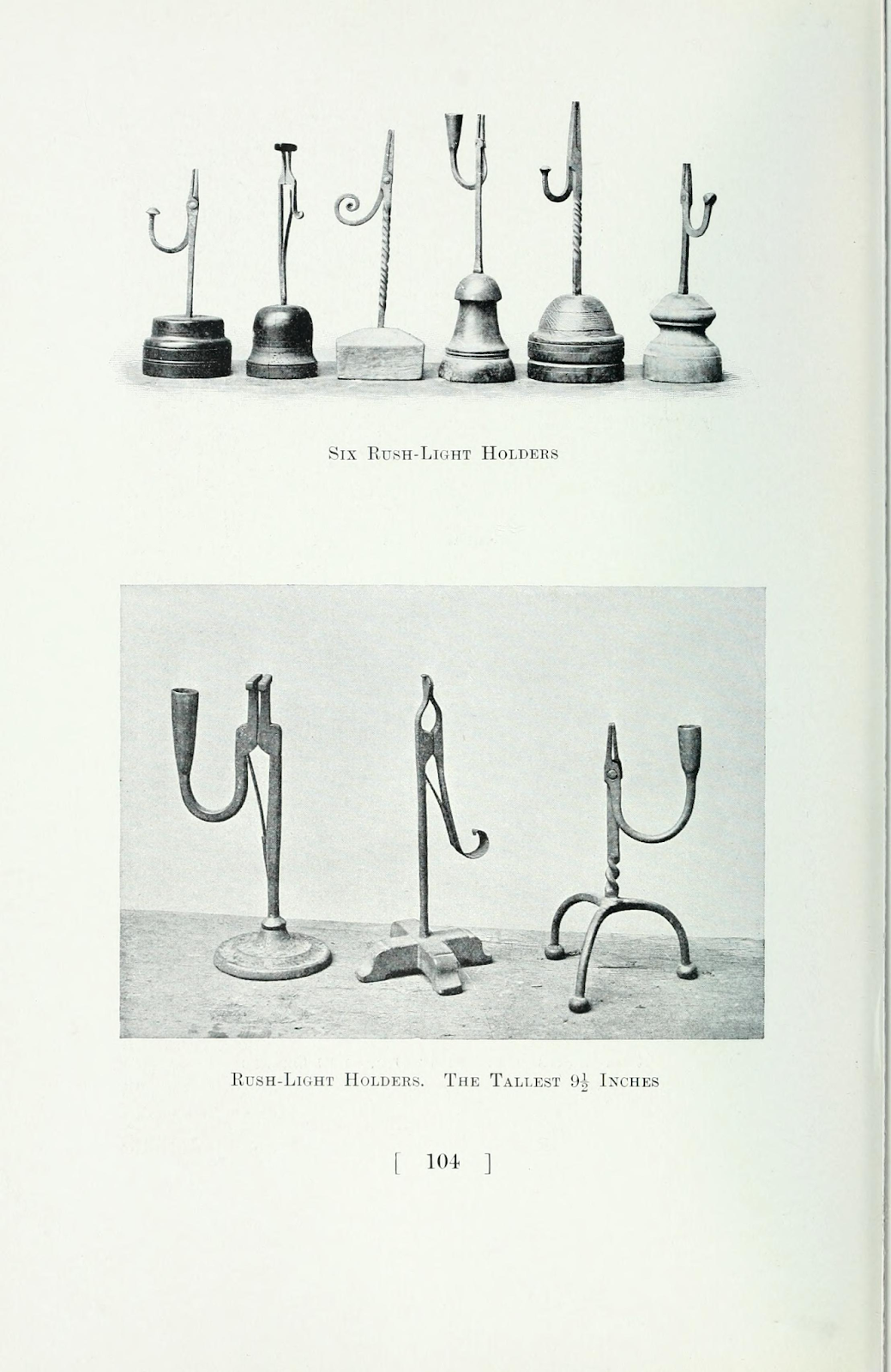
But as we have indicated before, we cannot remain with this skewed view alone. While churches used beeswax candles for their minimal odor and illumination, not everyone could afford the high cost. As a result, it became very popular in homes and workspaces to use animal fat or oil lamps. The animal fat candles or tallow allowed the creation of candles cheaply although with significant inconveniences such as odor or shorter duration. For making these candles, fat was removed after cooking meat. Once cooled, it solidified and by hand was molded around some cord that served as a wick. By hand, they were further shaped into elongated forms resembling today's candles so once hardened again could be used for illumination. Another inconvenience of this candle was its poor stability, twisting and breaking easily as it warmed up. Apart from these candles existed in the Middle Ages the rushlights (rushlights), which were long strips of plant fiber obtained mainly from riverside plants (reeds primarily) that were soaked in tallow (Eveleigh, 1985: p. 5). Oil lamps were also used although they depended greatly on the availability or not of an affordable source of oil. In coastal areas for example it was common to use fish oil.
Over time, candles began to recede into the background as coal, oil and derivatives such as kerosene came onto the scene. With this, new types of lamps were developed that used the purified liquid just like oil lamps: by soaking the wick in the liquid and lighting it.
As we move forward in time, we approach one of the most important discoveries of the 19th century: the incandescent light bulb.
We must clarify that experiments on electricity are already documented since 1660 by Otto von Guericke. However, these initial devices were not capable of storing large amounts of current. It was in 1745, thanks to the Dutchman Pieter Van Musschenbroek, that the Leyden jar was developed, which could store more electrical charge (Ortegon & Suarez, 2011, p. 123). This was followed by the Voltaic pile, invented by Alessandro Volta in 1799 (Forrester, 2016, pp. 2-3). And with this last device, Humphry Davy could discover arc discharge and the carbon arc lamp, which earned him recognition as the inventor of the light bulb (Anders, 2003, p. 1).
Thus, Thomas Alva Edison should not be recognized as the inventor of the light bulb but rather as someone who, starting from existing bulbs (delicate and short-lived), could adapt them and improve them to make them commercially viable—something essential if he wanted them to spread worldwide. On December 31, 1879, he demonstrated his bulb before a hundred people in his Menlo Park laboratory. The bulb presented was capable of lasting up to 14.5 hours, breaking all previous records (Blakemore, E., 2022).

With Edison's incandescent bulb, the first stone of a worldwide revolution was laid and its expansion was only a matter of time. Although initially present in relatively small spaces, it gradually advanced until it replaced public lighting from that era, which then used gas lamps. There is no clear cataloging of which city was the first to be fully illuminated by electric light, although one of the earliest documented cases was Wabash, Indiana, USA on March 8, 1880 (Tocco, 1999: 350-352).
Regarding Spain, one of the earliest references is found in Barcelona, where a demonstration was held in 1852 by pharmacist Domenech to illuminate his pharmacy. We have through some notes the impressions of those who attended the event:
"We had the pleasure of seeing at the laboratory of the distinguished chemistry professor Don Francisco Domènech, located on Union Street, in his pharmacy, a demonstration of electric light obtained by said gentleman through a perfected system. The flame that forms when bringing two conductors together produces such an intense light that it is barely tolerable to the eye..." (Miñana, 2006, 139-140).
Lastly, we could highlight a discovery made some time after electric lighting: the carbide lamp. This method, widely used in speleology, gets its name from the use of calcium carbide stone. When mixed with water, it releases acetylene gas (C2H2), which when lit emits very white light. The carbide or acetylene lamp was invented in 1897 by French engineer Henri Alexandre (Pérez Ruiz, 2022:39). Obviously today this type of device has been largely replaced by LED headlamps, but it demonstrates how the search for better and different methods of illumination is far from over.
Bibliography
Anders, A. (2003). Tracking down the origin of arc plasma science-II. early continuous discharges. IEEE Transactions on Plasma Science, 31 (5), 1060-1069. https://doi.org/10.1109/TPS.2003.815477
Carmona Ruiz, M. A. (2000). Apiculture in Seville at the end of the Middle Ages. Anuario de Estudios Medievales, 30 (1), 387-421. https://doi.org/10.3989/aem.2000.v30.i1.501
Eveleigh, D. J. (1985). Candle Lighting. Bennett Books Ltd. https://www.abebooks.com/CANDLE-LIGHTING-SHIRE-ALBUM-David-Eveleigh/30891853043/bd
Fava, L. S., Sapoznik, A., and Whelan, M. (2021). Beekeeping in late medieval Europe: A survey of its ecological settings and social impacts. Anales de La Universidad de Alicante. Historia Medieval, 22, 275–296. https://doi.org/10.14198/medieval.19671
Forrester, R. (2016). History of Electricity (SSRN Scholarly Paper N.o 2876929). https://doi.org/10.2139/ssrn.2876929
Miñana, J. S. (2006). The first applications of electricity in Barcelona around 1850. Quaderns d’historia de l’enginyeria, VII, 115-195.
Blakemore, E. (2022, April 17). Thomas Edison did not invent the light bulb but improved it. National Geographic.
Retrieved from: https://www.nationalgeographic.es/historia/2022/04/thomas-edison-no-invento-la-bombilla-sino-que-la-mejoro
Ortegon, I. Y. C., & Suarez, J. V. (2011). Leyden jar as an introduction to capacitors. Revista Científica, 13 (1), 121–126. https://doi.org/10.14483/23448350.805
Pérez, A. (2022). Carbide lamps of the Villacarrillo Speleology Group (G.E.V.) and some curiosities. Gota a Gota, 26, 38-47.
Tocco, P. (1999). The Night They Turned the Lights On in Wabash. Indiana Magazine of History, 95 (4), 350-363.


_BHL41412815.jpg)

Comments