

Introduction
They are known as «majolica», the ceramics with earthenware and glazed decoration that emerged in Medieval Europe and during the transition to the Early Modern period (fig.1). Goggin defined majolica in 1968 as:
«(...) a porous ceramic with a smooth paste, covered by vitreous material. The glazing or varnish, as it is sometimes incorrectly called, is opaque and the quality of this opacity is produced by adding tin oxide to a lead glaze. Therefore, majolica differs from other ceramics that have a more or less clear glazed surface»
Chancay, J., 2007, p. 285
According to sources, the origin of its name is not clear, so there are several hypotheses regarding its origin. It may be related to the Spanish island Mallorca or «maiolica», being the most important export zone for Moorish ceramics. Another possibility is that it derives from «málica» or Málaga, one of the first regions where glazed ceramic was used during the 13th century.
In Europe, it was known as maiolica in Italy, faiança in Portugal, Delft in the Netherlands, Delftware in England, faience in France or white earthenware in the Spanish Empire (Pasinski, T.; Fournier, P., 2014, p. 1).

According to Alejandra Castañedo in her thesis, the production technique and glazing are originally from Sassanid Persia, which was later adopted by the Muslim Umayyad dynasty and brought to the Iberian Peninsula during the Muslim conquest of the 8th century. The Muslim tradition selects clays with fluxes, and then mixes them with clay and subjects the material to a decantation process (to achieve the necessary plasticity for shaping ceramic forms). Subsequently, the vessels were slowly dried and subjected to double firing, both for the clay and for the glaze of the desired decoration, followed by pigmenting from various types of oxides.
Exportation of Majolica Ceramics to the New World
Majolicas can be found in colonial archaeological sites, from Canada to Argentina. The production that took place in Europe during the 16th century was exported to the New World and became the origin of new local productions (Pasinski, T.; Fournier, P., 2014, p. 1).
Through Spanish conquests in the New World, European potters completely changed ceramic production, to satisfy colonists and officials with simple majolica dinnerware, which gained great popularity among the upper classes of the time. The most admired were Hispanic and Italian majolicas. Various sources demonstrate that exports reached Honduras and Panama from the Iberian Peninsula (Pasinski, T.; Fournier, P., 2014, p. 1).
Portuguese majolica is found in large parts of Brazil, Uruguay, and Argentina; French and Dutch majolica in Caribbean deposits and the southern Atlantic coast, as well as British majolica in Argentina from the 16th to the 19th centuries (Pasinski, T.; Fournier, P., 2014, p. 2).
However, in various colonial archives, such as those of Guatemala, complaints are found about the high cost of ceramic imports. This is why, since 1550, local majolica production began to be encouraged in different cities: Mexico, Puebla, Panama Viejo, Oaxaca... After the 17th century, exports of Spanish and Italian majolica decreased. However, in Brazil, Uruguay, or Argentina, no local industries would be found, and most pieces would be of European origin (Pasinski, T.; Fournier, P., 2014, p. 1).
Trujillo (Peru)
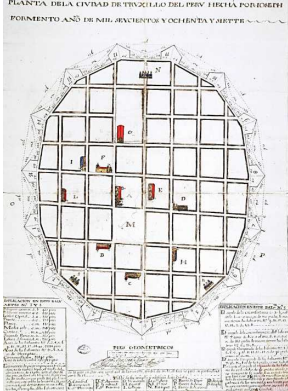
In the case of Trujillo (fig.2), pottery work is known from the «Padrón de Indios» of 1613, a document that provides firsthand information about organization and management by Viceroy Don Juan de Mendoza y Luna. This was written by Miguel de Contreras, a notary who shows that seven of the 1287 men living in Lima are potters born outside the city but offer their services there for the development of Lima's commerce. They create large potteries with workers, officials, and masters (Aguado, S., 2019, pp. 36-38).
Colonial ceramics produced in Trujillo are found in the southern part of the country for the supply of the city with domestic production such as pots, jugs, jars, plates... The glazed pottery industry includes a range of colors, with cobalt blue standing out among them, featuring geometric patterns and landscapes. It's worth noting that chemical materials are important for creating different types of glazes and colors, all imported to the American colonies (Aguado, S., 2019, pp. 40-47).
The sales points for products were pulperías or commercial stores dedicated to selling small quantities of goods for daily consumption, such as food. In the extension of Trujillo there are a total of 20 pulperías where ceramic materials sold included dinnerware and other pieces for storage, along with products like honey, vinegar, or wine that required containers and were therefore very sought after (Aguado, S., 2019, pp. 48-47).
Conclusions
The evidence of majolica ceramics from Trujillo (fig.3) provides the possibility to know the evolution that majolica had in South America, which initially arrived by European export and later was created in various potteries, imitating this highly demanded ceramic type.
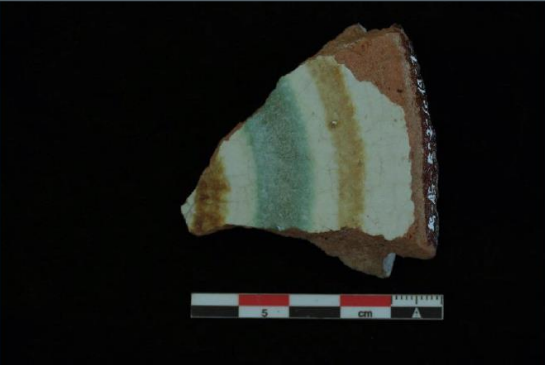
Thus, the compilation of data from various ceramists in the area has provided information about the quarries of Trujillo used for local majolica production, as their chemical and mineralogical processes have been analyzed.
All these archaeological evidences tell us today that Trujillo was one of the most strategic and important cities from the 16th century onwards, as it had a large number of potteries created by Spanish potters who gradually incorporated pottery traditions to the indigenous population and created new models of local majolica and new production techniques for this ceramic type.
Therefore, the existence of numerous potteries in Trujillo indicates that they supplied a large part of the Trujillo region and its surroundings, and even traded throughout much of America, making Peru one of the earliest regions in production and commerce.
Bibliography
Aguado Peña. S. E. (2019). «Colonial Ceramics in the City of Trujillo, Sites: Colonial Church of Huanchaco and Current Municipal Theater House, 17th-18th Centuries. An Approach Through Historical Archaeology and Archeometric Analysis». Thesis to obtain the Academic Degree of Master's in South American Archaeology with a Mention in Archeometry, Modeling and Analytical Techniques. National University of Trujillo. Available at: https://www.academia.edu/42007423/Cer%C3%A1mica_colonial_en_la_ciudad_de_Trujillo_sitios_Iglesia_Colonial_de_Huanchaco_y_Casona_Colonial_actual_Teatro_Municipal_ss._XVI_-_XVIII._Una_aproximaci%C3%B3n_a_partir_de_la_Arqueolog%C3%ADa_Hist%C3%B3rica_y_el_an%C3%A1lisis_Arqueom%C3%A9trico
Castañeda, A. (2012). «Majolica as an Archaeological Data: Evaluation of Majolicas through Neutron Activation Analysis, Typologies and Ordinances». National School of Anthropology and History (INAH-SEP), Mexico. Available at: https://www.academia.edu/17313311/La_may%C3%B3lica_como_dato_arqueol%C3%B3gico_evaluaci%C3%B3n_de_las_may%C3%B3licas_a_partir_de_an%C3%A1lisis_por_activaci%C3%B3n_neutr%C3%B3nica_tipolog%C3%ADa_y_ordenanzas
Fournier, P., Blackman, M., Ronald L. (2009). «Use of Instrumental Neutron Activation Analysis (INAA) in the Study of Majolica Origin in Mexico». Distrito Federal. Arqueología 42. Editor National Institute of Anthropology and History. Publication Date: December 1, 2009. Available at: http://www.mediateca.inah.gob.mx/repositorio/islandora/object/articulo:10706
Pasinski, T.; Fournier, P. (2014). «Ceramics: Majolica in Colonial Latin America». Encyclopedia of Global Archaeology. New York: Springer Science + Business Media. Doi: https://doi.org/10.1007/978-1-4419-0465-2_1341
Shávelzon, D. (2018). «Catalog of Historical Ceramics of Buenos Aires (16th-20th Centuries), with Notes on the Region of La Plata». Imprint Digital SRL. Florida – Province of Buenos Aires. Available at: https://www.academia.edu/36603770/Cat%C3%A1logo_de_ceramicas_historicas_de_Buenos_Aires_y_R%C3%ADo_de_la_Plata


Comments