


"Ship in sight, powder ready; ship near, powder at hand."
Transporting gold, silver, precious stones, and other rich goods from America to Spain was a task exposed to an endless array of dangers, both atmospheric and military. Hurricanes, typhoons, incursions by corsairs and pirates (such as Drake (1540-1596) and Hawkins (1532-1595)), and attacks by enemy states (like the English, Dutch, and French fleets) led to the establishment of the India Fleets in the Indian Route (Olcina, 2018, p. 6), but what did this entail?
What is it?
As a consequence of Columbus's arrival to America in 1492, a series of commercial dynamics based on the state monopoly through various mechanisms emerged: official control, private collaboration, single port, protected navigation (Laviana, 2006: 19). It is for this reason that the Hispanic Monarchy created the Indian Route, an entire mechanism regulating economic, social, religious, and cultural relations between the metropolis and overseas possessions. Initially, this official control was exercised by the House of Trade in Seville, under the Archbishop Juan Rodríguez de Fonseca (1451-1524) - following the Portuguese model of the Casa da Índia - and created in 1503 through a royal provision signed by the Catholic Monarchs. Nonetheless, in 1511 new ordinances were promulgated to adapt to new realities, a Junta (section of the Council of Castile) was formed in 1511, as well as the Council of Navigators composed of expert mariners and cosmographers (Vicente Yáñez Pinzón, Amerigo Vespucci, Juan de la Cosa, Juan Díaz de Solís) (Sánchez, 2024: 69, 74).
It would not be until 1523 that the Real and Supreme Council of India was created in response to the increasing density of Indian traffic. This institution was responsible for the politics and administration of viceroyalties, possessing governance competencies, military, judicial, religious, commercial, etc., supporting the Crown (Sánchez, 2024, p. 75). Thus, a Pact of Colonization was achieved, which consisted in exploiting those lands for the benefit of the Motherland, involving protectionism of national manufactures and exclusivity of trade with the West Indies (Laviana, 2006, p. 21-22). An example of this was the control of migration, reserved to Spaniards whose information (data on aspects such as their nature, social position, sentences by the Holy Office, etc.) were verified (Fraile-Delgado, 2021, p, 29, 32-33).
Within this context, the India Fleets were established, a navigation system characterized by organizing ships into convoys to ensure their protection with military escort. In 1526, the first precedents appeared but it was not until 1543 when group navigation became mandatory with the promulgation of ordinances and regulated in 1564 (Laviana, 2006, p. 28). Thus, two convoys were established (image 1):
- The Flota de Nueva España: departing in April-May with destination to Veracruz.
- The Flota de Tierra Firme or the Flota of Galeons: departing in August with destination to Cartagena de Indias and Nombre de Dios/Portobelo.
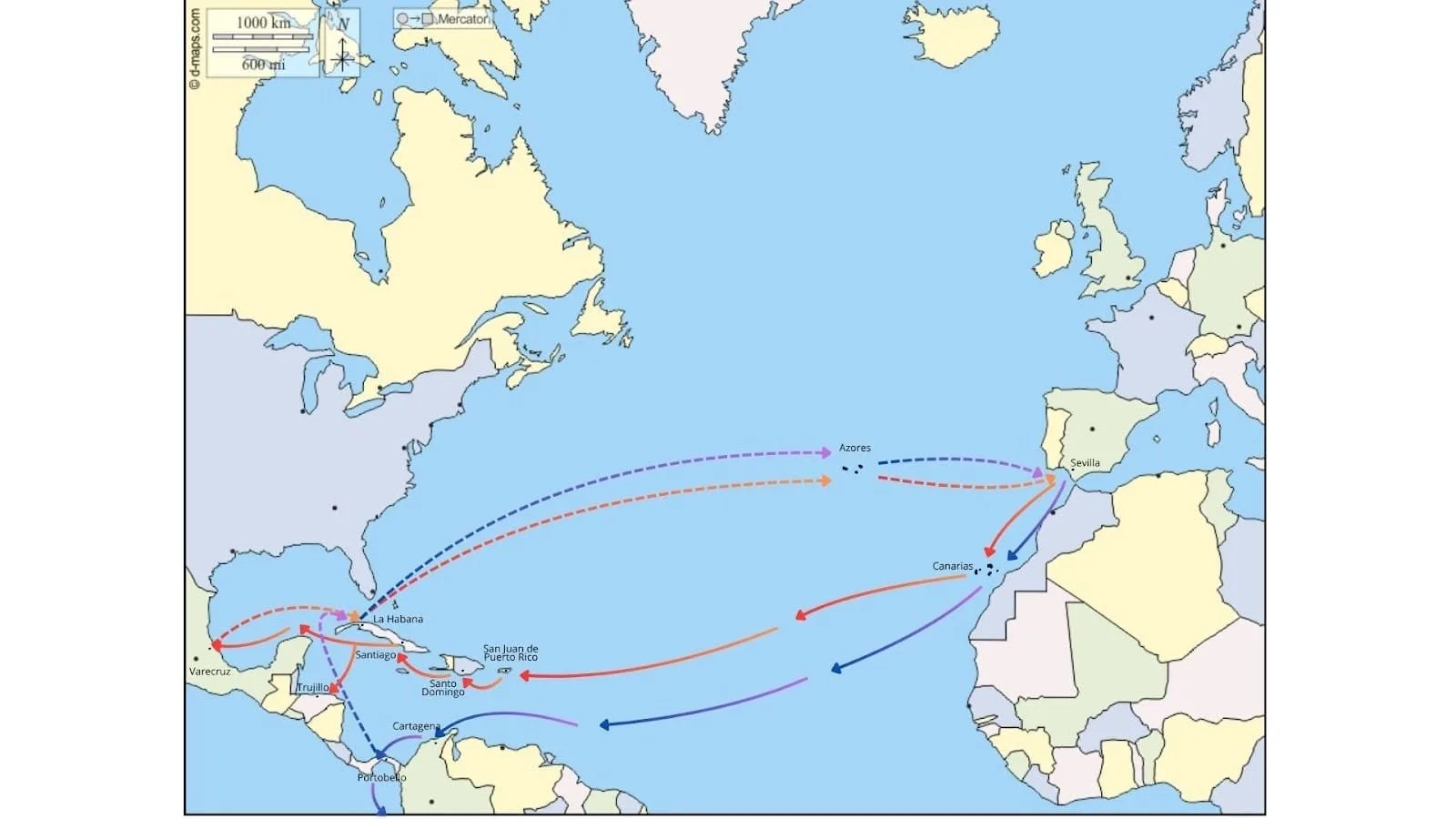
Characteristics of the India Fleets
The Fleets presented a series of innovative characteristics at first, but unsustainable over centuries. These were composed of three types of ships: war or navy, merchant or cargo, and scouts. The merchant ships carrying precious metals were caravels, naos, carracks, and galleons (Sánchez, 2024, p. 93). The Flota de Nueva España was escorted by two large galleons, the Captain and the Rear Admiral, warships. On the other hand, the Flota de Tierra Firme was protected with six, eight or more galleons (Laviana, 2006: 28). This system of ships was financed through the "damage tax" paid by the ship owners of merchants. In Seville, there was a Tariff Office over the Atarazanas functioning as a fiscal barrier (Pérez-Millaína, 2024, p. 29).
The Flota de Nueva España departed in April or May towards the Caribbean from where ships would divide to ports of San Juan Puerto Rico, Santo Domingo, Santiago de Cuba, leaving boats in Puerto Rico, Honduras, Santo Domingo and Cuba, to end at San Juan de Ulúa, facing Veracruz (Mexico), where they spent winter. In contrast, the Flota de Tierra Firme or Flota of Galeons departed in summer with destination to Colombia and Panama. Ports like Portobelo connected the Indian Route with the Galeón de Manila and the Fleets of the South Sea. This last one protected silver from Potosí from El Callao port to Panama. Also, the Armada de Barlovento was created based in Veracruz. In these cities, markets were established where products from different Spanish territories were traded. The dates were chosen according to environmental conditions, avoiding hurricanes and rainy seasons and epidemics of tropical zones. Regarding return, the ships and escort regrouped in Havana to start the return to Seville (Sánchez, 2024, p. 95, 99-101) passing through the Bahamas channel, Bermuda, Azores, Cape St Vincent, Guadalquivir bar and Sanlúcar de Barrameda. This journey was much more dangerous due to the transport of goods from ships and its tactical and factual consequences. It is worth highlighting the strategic relevance of the Canary Islands archipelago, which served as an essential stop for provisioning before crossing the Atlantic, benefiting from the characteristic trade winds of the region (Fraile-Delgado, 2021, p. 102-103; Laviana, 2006, p. 29) (image 2).
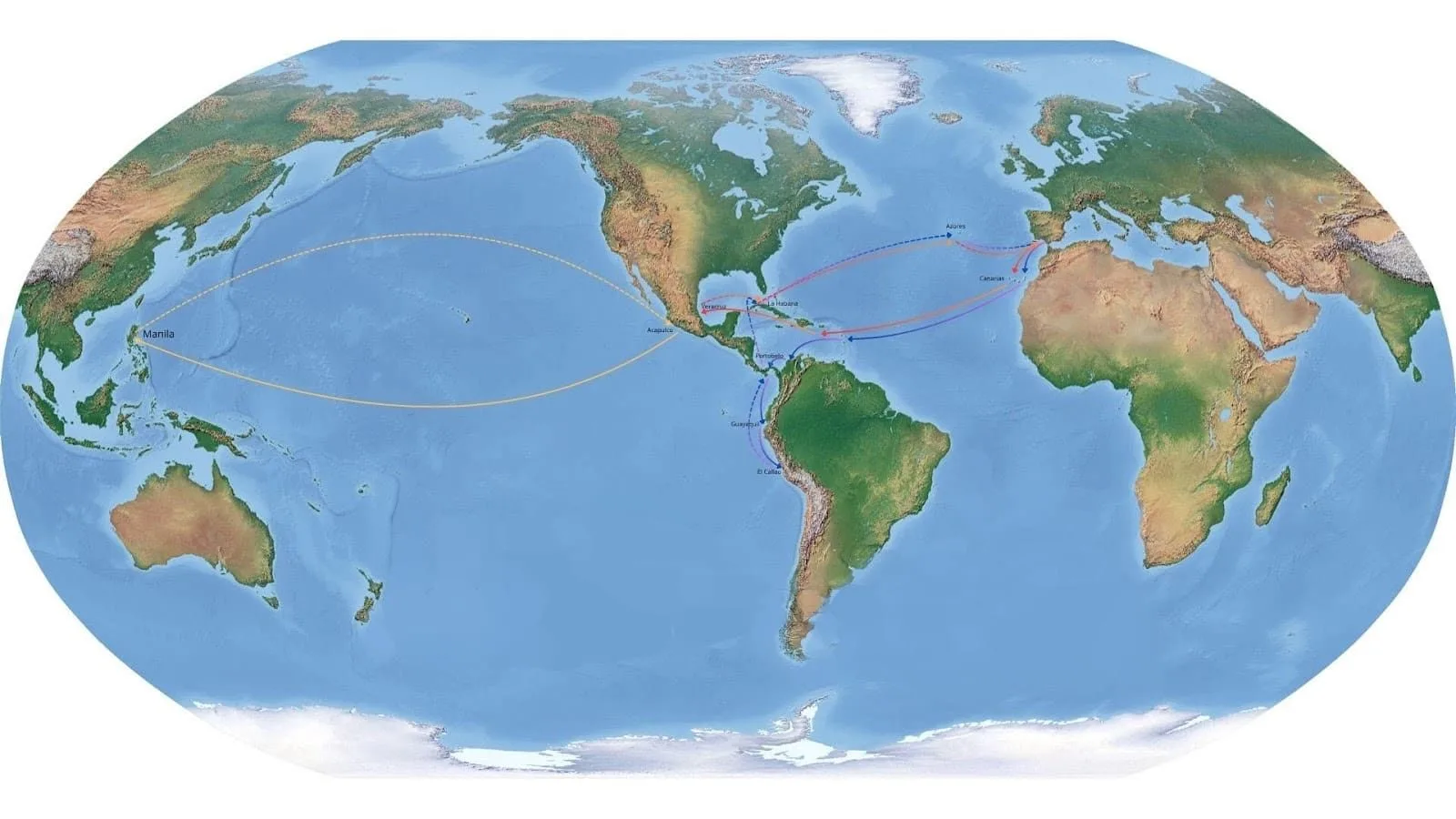
As a complement to this naval protection, there were fortifications built in port cities such as Cartagena de Indias and Havana. Notable is the work of engineer Bautista Antonelli who designed many of these bastioned defenses (Gil, 2018, p. 3).
This entire fleet structure managed to protect its objectives suffering few attacks, except for the cargo of the Flota de Nueva España in 1628 which was captured by the Dutchman Piet Heyn in Matanzas Bay (Cuba). Despite great benefits, the system was rigid and poorly adaptable to unforeseen inconveniences of transatlantic navigation such as the speed of slower ships that made faster ones reduce their pace. This increased costs due to more days at sea (Laviana, 2006 p. 28).
Seville: single port
The Indian Route began and ended in Seville, a port that centralized the Indian trade. From 1529 onwards, eight Spanish ports were expanded for departure from the Iberian Peninsula. The Hispalense city (image 3) was chosen due to its favorable characteristics for heading towards America. The Guadalquivir Valley was a fruitful agricultural region producing and trading wine, wheat, olive oil, and salted fish; all necessary for long voyages. Its inland port status at 90 km from the mouth of the Guadalquivir provided greater security against pirate attacks, enemy powers, and environmental disasters. Despite this, Sanlúcar bar hindered navigation so loading and unloading took place in Cádiz or Sanlúcar de Barrameda. On the other hand, Seville had a nautical tradition since the 13th century, a strong merchant guild, good connection with Castilla Interior, and a large population (Fraile-Delgado, 2021: 30; Laviana, 2006, p, 27).
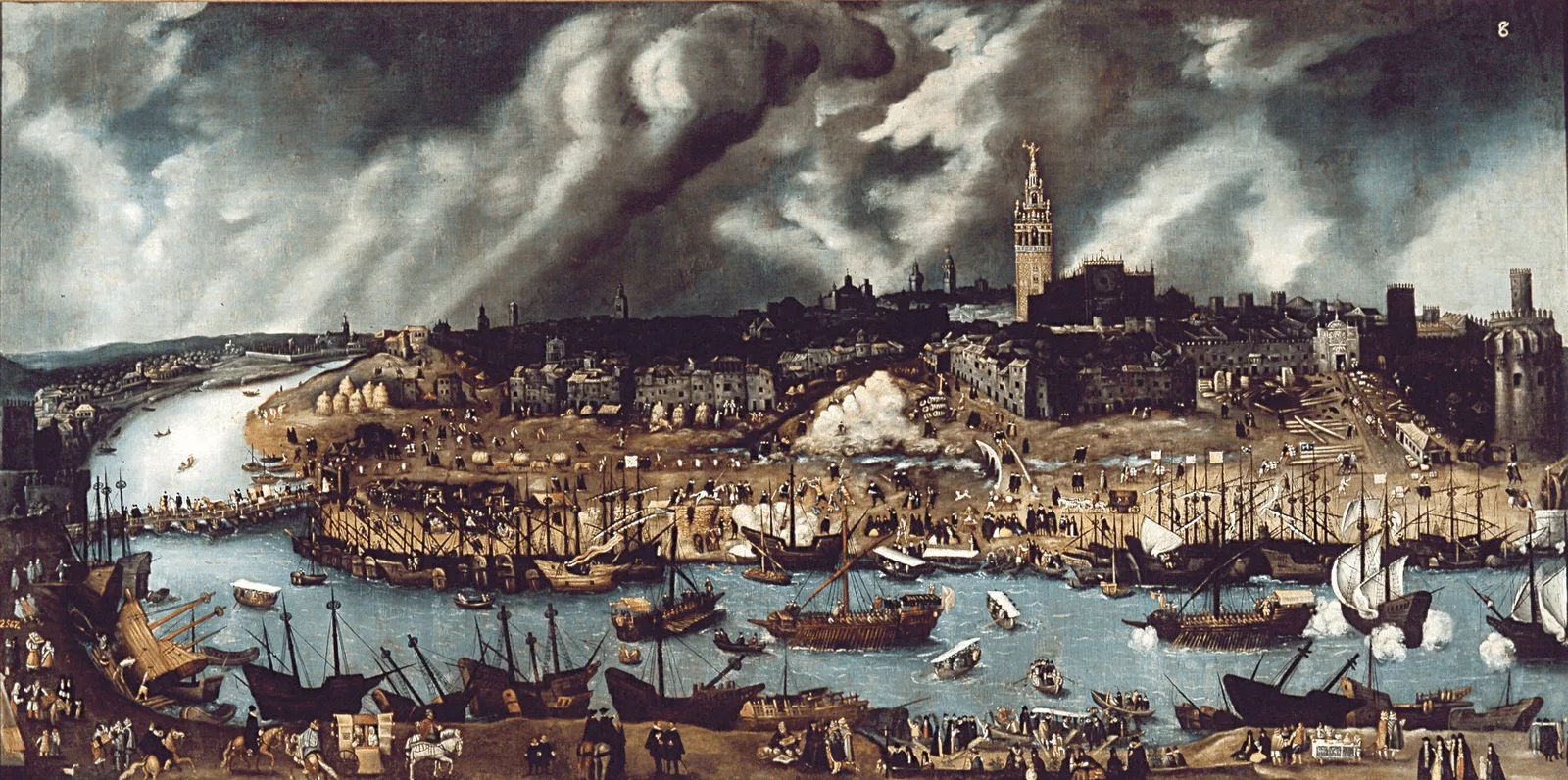
Figure 3. "View of the city of Seville" painted at the end of the sixteenth century by Alonso Sánchez Coello. Museo de América (Madrid). In this painting, one can observe Seville as the port of departure for the Flota de Indias. Source. License: Public Domain.
End of convoy
The end of the India Fleets and commercial monopoly occurred due to the rising cost of goods due to military expenses for ships, slow navigation, delays, and rigidity in the calendar. Added to this was the intensification of smuggling, scarcity of American markets, and marginalization of entire regions like the Río de la Plata (Laviana, 2006, p. 29). In the seventeenth century, irregularities intensified despite attempts by the Crown to address them. The military context of the eighteenth century further accentuated this situation. In 1739, conflict with England began, during which time they dominated the seas. This led to independent navigation avoiding interception at the dates marked for Fleets. On October 12, 1778, the Regulation and Real Tariffs for Free Trade of Spain to India was promulgated and in 1789 it came into effect, opening ports belonging to the Viceroyalty of Peru to foreign trade, followed by those of New Spain in 1789. Finally, the House of Trade, located in Cádiz since 1717, lost functions until its suppression during Charles IV's reign (1748-1819) (Fraile-Delgado, 2021, p. 31; González, 2024, p. 113-114).
Conclusions
In summary, this naval structure of merchant and military ships was one of the complex mechanisms that sustained Spanish hegemony and supplied products and precious metals to both sides of the ocean. Thus, the Hispanic Crown maintained commercial monopoly over those possessions leading to episodes of attacks, smuggling, and siege on cities. This work does not seek glorification of the past but rather objective exposition of historical facts.
Bibliography
Fraile-Delgado, F. J. (2021). From Olivares to India: Transatlantic journeys and sociological profiles in the Modern Age. Ab Initio, (14), 28–56.
Gil Olcina, A. (2018). Canary Islands in the Indian Route: The winds of the crossing. Anuario de Estudios Atlánticos, (65), 065-023.
González Fernández, M. (2024). Implementation of the India Fleets. In The India Fleets. Monographic Notebook No. 89 (pp. 91–120). Institute of History and Naval Culture, Ministry of Defense.
Laviana Cuetos, M. L. (2006). The organization of the Indian Route or the obsession with monopoly. The maritime trade overseas. Monographic Notebooks of the Institute of History and Naval Culture, (52), 19–35. https://hdl.handle.net/10261/26615
Pérez‑Mallaína Bueno, P. E. (2024). Antecedents of the India Port and Atarazanas in Seville. In The India Fleets. Monographic Notebook No. 89 (pp. 9–38). Institute of History and Naval Culture, Ministry of Defense.
Sánchez González, R. (2024). Institutions of the Indian Route. In The India Fleets. Monographic Notebook No. 89 (pp. 69–90). Institute of History and Naval Culture, Ministry of Defense.


Comments