
In Baños de la Encina, a wide array of calvaries carved in stone persists, present both in religious and civil buildings as well as spaces linked to water: fountains, watering troughs, wells, and norias. Although some may go unnoticed due to their simplicity, these symbols enclose a strong protective and ritual charge.
The relationship between crosses, horseshoes, and other apotropaic signs with places of water reveals the continuity of very ancient beliefs, at times of pre-Roman origin, integrated over time into popular religiosity. Through several examples preserved in the municipality, this work analyzes the symbolic and protective function of these calvaries and their possible connection to ancestral traditions.
Calvaries linked to fountains, springs, and wells
Present in factories with different functions and geological origins, offering diverse traces and showing varied forms, in Baños de la Encina we identify a series of calvaries related to very different areas: tumular, apotropaic, identity-related, among others almost reaching sixty samples. Related both to civil buildings as well as popular devotion sites (Cantarero Quesada, 2025), there are also those in which water has special relevance, whether in fountains, wells or norias.
Adscribed to the first typology, we have the water trough pillar of Callejón del Pilar, next to the head of the parish church of San Mateo. There, a very elaborate calvario adorned with rounded forms and a particular base can be found. Alongside the cross, less than a meter away, appears a horseshoe, an ancient pagan protective symbol representing good fortune. As one can see, its allegorical content has endured over time, both in the religious sphere as well as among members of the stonemasons guild. On the other hand, the horseshoe, as a lapidary mark, also appears chiseled and in good number on the main hall of San Mateo, before the Door of Forgiveness. Although the horseshoe as an equestrian piece does not appear in Europe until the 4th-5th centuries AD, associated with Celtic and Gallic peoples, the motif of the horseshoe already existed beforehand as a protective symbol or lapidary mark. This can be verified just outside the urban core of Baños de la Encina, in the dehesa (wooded pasture) of Burguillos (Bailén). In this wooded area, near the old shepherd's house, several examples of horseshoes chiseled into a red sandstone rock or letter stone can be found. Alongside it, other lapidary marks can be appreciated, such as a deity with sexual character, which has both male and female attributes, and other epigraphic elements that chronologically could date to the Late Copper Age or early Bronze (López Martínez et al., 2020). Being a pagan mark of protective nature, its presence, in dominant form, is related to spring water.
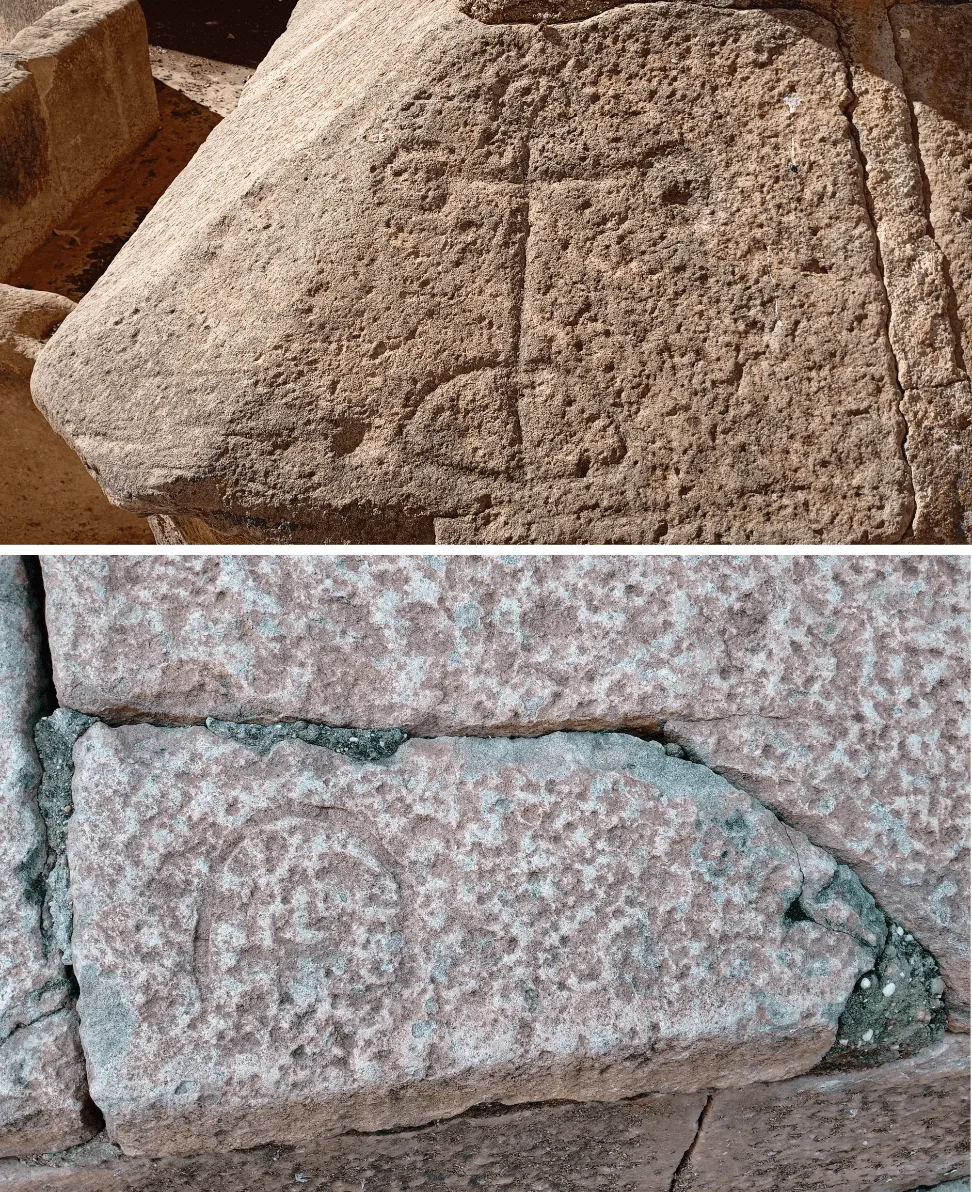
How is it possible that a pagan symbol with pre-Roman origins could integrate all its meanings into the Christian symbolic corpus? Perhaps in a simple way under the cloak of legends and myths. It was reinterpreted as the footprint left by Saint James' horse -- although also attributed to other saints and heroes -- when he fell upon his enemies sword in hand; though in more elaborate circumstances, the saint's help arrives to assist a Christian army suffering from thirst and on the brink of defeat. In that situation, the apostle's horse would leave its footprint and water would begin to flow from the imprint, changing the course of battle. There are numerous instances where certain waters under Saint James' auspices, thermal and with therapeutic properties, have favored the health of the population (Pedrosa Bartolomé, 2000).
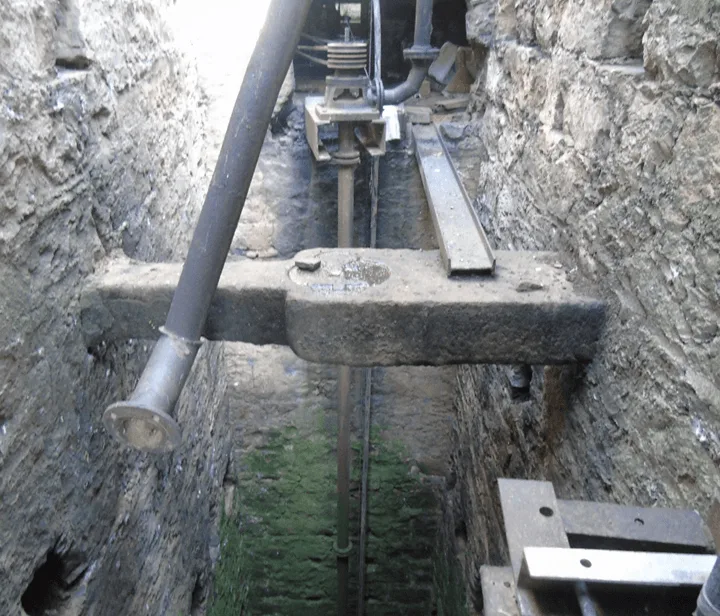
In turn, grouped in a second epigraphic section, that of the norias, we have identified two calvaries. This does not mean there were no more, as much of the tread stones of the over thirty Baños de la Encina norias have been demolished by time and new uses. The first is chiseled on the exterior face of a marrano (a stone that served as lintel), inside the well of the Penecho waterwheel, located in the left bank of the Linares road. Its carving quality does not envy the magnificent calvaries present in the lintels of the most prestigious houses in town, almost all built under the protection of Carlos IV's desamortizations and the War with the French.
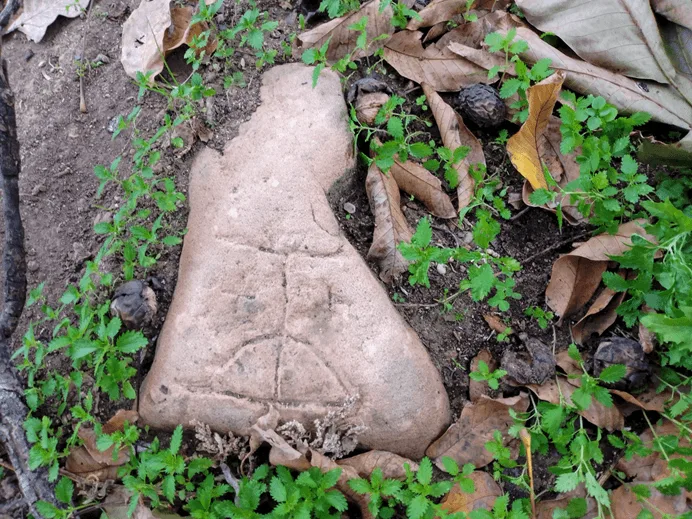
The second, immensely simple, appears incised on an enormous river boulder and participates of the curb that shapes the tread stone of Los Gatos or Maquilera's garden, in the Colmenera area, next to the Bailén road and the Los Huertos ditch. In a certain way, it could resemble a Tau cross, but its semicircular base, crossed by the vertical beam, recalls the base of the calvaries carved in San Mateo's water trough pillar and the Sol Gate, also in San Mateo. The cross is accompanied by two very schematic lateral crosses, so much that they could be confused with small stars or simple lauburus.
Other calvaries related to water
Much more singular are the calvaries present in a kind of sanctuary erected on Peñalosa's rocky outcrop. At some distance from the river, but raised at the watershed of Valdeloshuertos and La Rumblosa streams, where both drain into Rumblar, the ensemble is integrated by four crosses or anthropomorphic cruciforms, numerous cazoletas (small bowls) carved in a slate table or altar oriented to east, and a set of alquerques (stone enclosures) and reticulados. The cruciforms are located within the territorial context of Peñalosa archaeological site, an Argaric settlement attributed to Bronze Age cultures (Contreras Cortés et al., 2024). Their arms and head end in triangles or circles and rise on a triangular base. One of the cruciforms shows a simple cross with base, while another preserves only its lower half due to severe deterioration of its upper part.
Conclusions
Undoubtedly, these elements have an apotropaic and protective character. Loaded with symbolism, they protect abundance and ward off diseases in fountains, watering troughs, and springs, while in norias and wells seem linked to the fertility of garden and meadow lands. More complex is the interpretation of Peñalosa's motifs. Although initially identifiable as modern or contemporary calvaries, various formal and contextual aspects cast doubt on this identification. The site does not present occupations post-Bronze Age and some morphological features -- triangular or circular endings, triangular bases, and descending vertical lines -- bring them closer to the schematic anthropomorphic figures of prehistoric rock art than to traditional Christian calvaries documented in Baños de la Encina. This is compounded by the presence of cazoletas, reticulados, and small alquerques, elements possibly ritualistic and apotropaic (Lorenzo Arribas, 2021).
Bibliography
Cantarero Quesada, J. M. (forthcoming). Calvaries, simple Latin crosses and tumular crosses, Baños de la Encina (Jaén). Boletín del Instituto de Estudios Giennenses.
Contreras Cortés, F., Moreno Onorato, M. A., Arboledas Martínez, L., & Alarcón García, E. (2024). Peñalosa (Baños de la Encina, Jaén). Official guide of the Bronze Age site. Universidad de Granada.
López Martínez, J. J., Moreno Onorato, A., Arboledas Martínez, L., & Padilla Fernández, J. J. (2020). Enhancement of historical and natural heritage in the Monte Público de Burguillos (Bailén, Jaén). Locvber, 4, 33–34.
Lorenzo Arribas, J. (2021). The medieval alquerque, a protective symbol. Digital Journal of Medieval Iconography, XIII(23), 107–142.
Pedrosa Bartolomé, J. M. (2000). Legendary footprints on rocks: oral traditions and comparative mythology. Revista de Folklore, 238, 111–118.


Comments