

In sacred rituals ex-votos were considered offerings dedicated to God, the Virgin or Saints to thank for a previously requested favor, thus perceiving these objects as the result of a miraculous act. Although these gifts emerged at the beginning of Christianity, it will not be until the late 16th century when social and religious circumstances signaled a notable expansion of such objects. In this article we aim to analyze this type of individual offering during the Baroque period.
Approach and Consolidation
The debates generated by Protestants shook the foundations of Christianity, with the Council of Trent being the directional axis to correct the spiritual and moral character of the Catholic religion as well as addressing the conditions for the use and function of sacred images and relics including other forms of approach between individuals and divinities such as ex-votos. In this context, sessions 3 and 4 held in 1565 were crucial for providing arguments to ensure the continuity of Christological, Marian, and other representations of celestial hierarchy figures. As a result, to counteract the debates generated, the Catholic Church established certain aesthetic and morphological guidelines to ensure that artists faithfully manifested the doctrinal plans of the church (González, 2017, pp. 78-79; Muntión, 2023, pp.170-171; Saravia, 1960, pp.129-130).
The Holy Office promoted the figures of the overseer and classifier, responsible for "inspecting and approving religious works destined for public display and removing or correcting those that are dishonest, heterodox, outdated, or of low quality» (González, 2015, pp.312-313), a situation that subjected the ideology of academic artists to being shaped by ecclesiastical conditions, turning them into tools for the institution. Regarding the use and purpose of ex-votos, they were initially approved by Church Fathers, but paradoxically at the Tridentine Council it was agreed not to admit new miracles without prior verification and acceptance by the bishop (Saravia, 1960, p. 131). The anonymous nature of ex-votos, individualism, and lack of authorship invite reflection on the non-existence of a meticulous review of these offerings due to their consideration as underlying elements between ecclesiastical practices and generated by the lower-middle class, ultimately, a class that lived in systemic contradiction: so necessary for the church's own survival yet <<invisible>>. In summary, the union of these factors illustrates certain autonomy with the Catholic institution.
Subsequently, during the Ancien Régime, prolonged periods of war, diseases, plagues, and poor harvests shook society, economy, and religion in the country. This scenario would translate into the germ catalyst for the process of flourishing and popular religiosity associated with: circulation of relics, festivals, pilgrimages, Marian worship, promises or offerings among other religious expressions and sociocultural identity.
Within the framework of the 17th and 18th centuries, ex-votos appear as a symptom of an aggravating context where the community manifests the imperative need to pour all their faith in the Virgin and certain saints as a transcendent experience. In search of hope and answers to daily human questions, such as healing from illness, lack of work or uncertainty about death. During this process, petition formed the main channel that guaranteed the connection between heaven and earth; afterward, the Christian expected to obtain the desired benefit through a miraculous act. We bring into discussion the words of Martha Marielba who defines this exchange as "a trade of faith between the sacred and the human" (Herrera, 2014, p. 51). In summary, in this web there is a clear dichotomy since for the ecclesiastical network the introduction of ex-votos into popular life represented an equally beneficial situation. Public exposure of the votive element meant spreading its intrinsic character consolidated by the celestial being's interception capacity and the power of individual faith, transforming this sanctified object into a subtle and eloquent instrument to encourage faith and attract the audience.
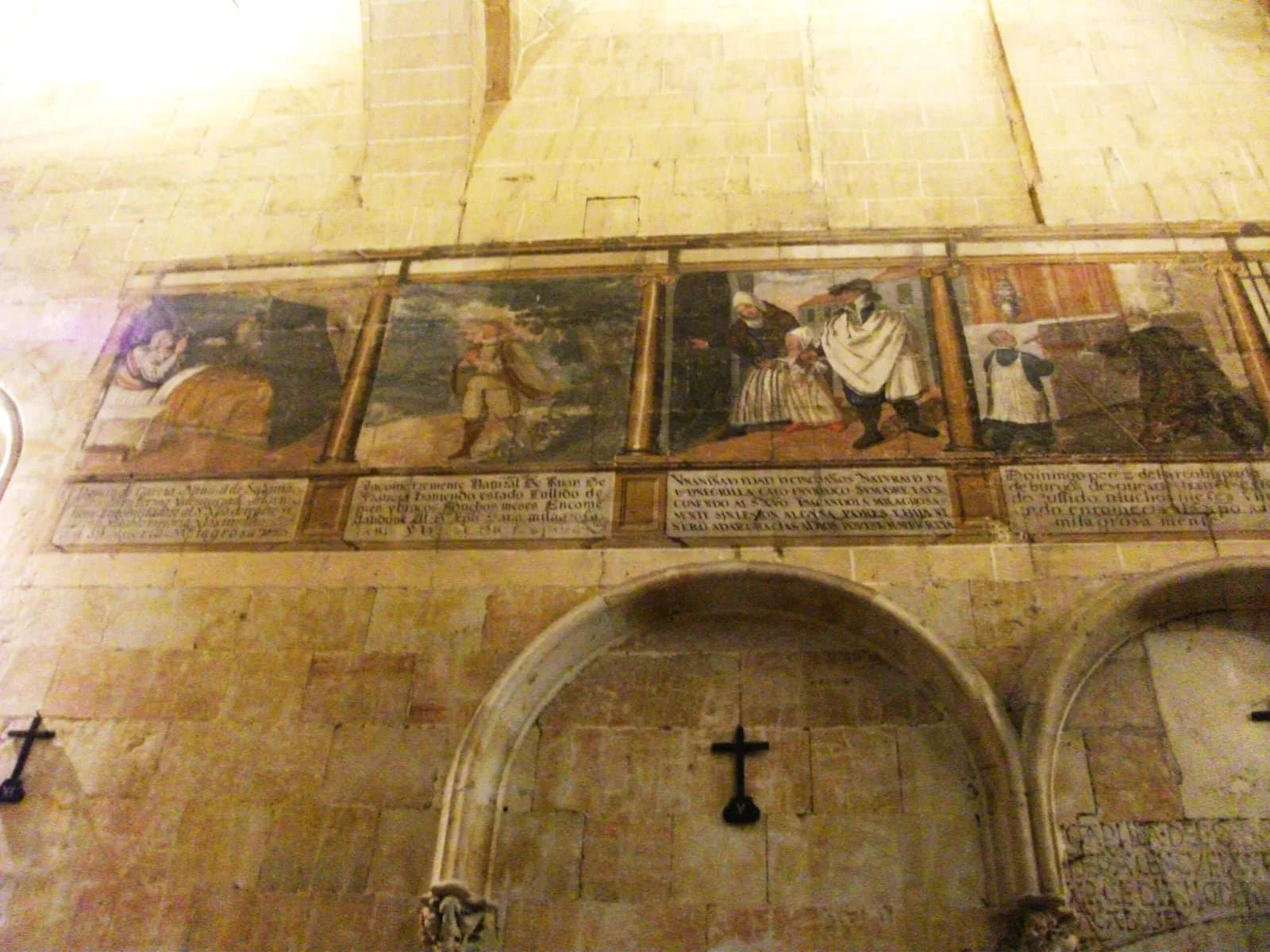
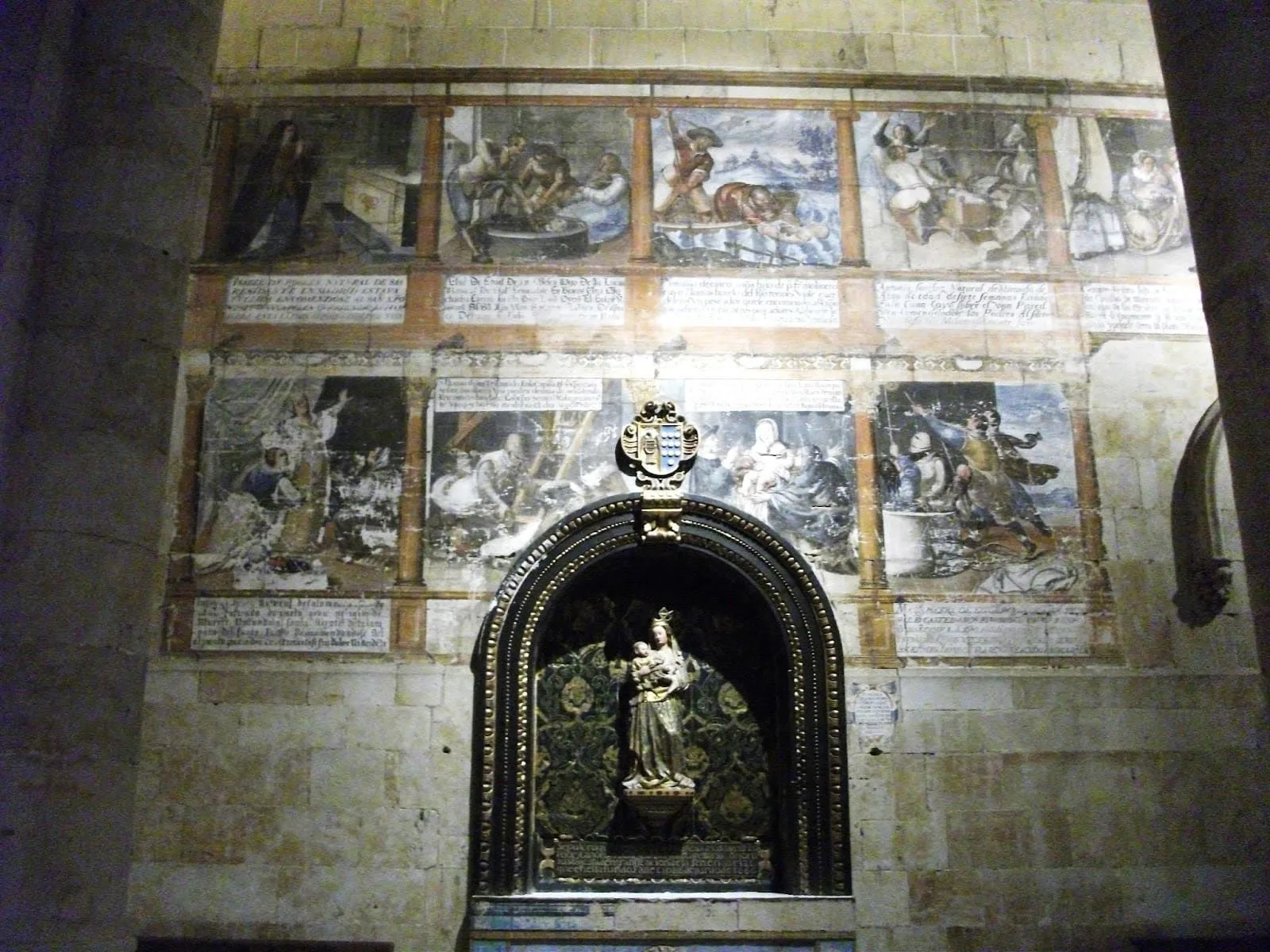
On the evangelical wall of the Old Cathedral of Salamanca, as seen in Figure 1, there are preserved votive paintings fragmented into 18 separate frames separated by architectural elements whose inscription inserted at the bottom of the illustrations recounts each of the demands resolved miraculously by the Christ of Battles (Montaner, 1987, p. 39). On the other hand, this example serves to clarify one of the facets of ex-votos: documenting the type of furniture, attire, interiors and landscapes of a specific period, turning these paintings into visual chronicles (León, 2015, p. 2147).
Indeed, they are not only religious objects but also important cultural and historical documents that allow us to understand the mindsets, beliefs, and circumstances of life for common people. They reveal hopes, fears, and forms of devotion in a deeply religious society.
Unfortunately, the Vatican II Council will be the cornerstone of the disappearance of all manifestations of popular religiosity. The modifications introduced as a result of this synod, held between 1962 and 1965, significantly impacted liturgical celebrations, Christian life, and the religious perspective of the Roman Curia towards other Catholic expressions; promoting in effect, a purification and modernization of the Church. In this paradigm, thorough cleanings of walls in sanctuaries were carried out by default leading to the disappearance of narrative and symbolic offerings. Indeed, Vatican II sharpened the need for an intense renewal driven by the maturity of the church that had been gestated during different ecclesiastical stages, thus breaking away from the traditionalism sustained until then (Muntión, 2023, p. 171; Alberigo, 2015, pp. 10-16).
Conclusions
After the long journey of analysis we conclude that these offerings are discarded as "minor art" due to their consideration as factual evidence for addressing different aspects of identity and culture since they consecrate a historical, religious, ethnographic, pedagogical, psychological, and anthropological source. Additionally, the anonymity of most ex-votos allows us to propose an existing hierarchy between Baroque artists: academics and artisans.
We cannot conclude this study without questioning the reach of these objects among contemporary Christians. After the results of the Vatican II Council, ex-votos were considered outdated materials; however, faith has been decisive in maintaining their presence within society more than expected, although the production of such offerings certainly diminished over time and their format is different.
Ultimately, these objects are reminders of a religious past that due to its interdisciplinary content deserve to be the focus of research while for today's Christian audience faithful to their beliefs, they remain offerings or sacred objects directed towards a divinity that has miraculously resolved a previously requested petition.
Bibliography
Alberigo, G. (2015). A Brief History of the Second Vatican Council (1959-1965): In Search of Renewal in Christianity, 2nd edition. Salamanca: Ediciones Sígueme.
González, J. (2025). Sacred Images and Visual Preaching in the Golden Age. Spain: Akal.
González, C. (2017). The Spirit of the Image: Art and Religion in the Hispanic World of the Counter-Reformation, 1st edition. Spain: Cátedra.
Herrera, M. (2014). Ex-votos to saints and patrons: The power of sacred images. Revista de Mueología Kóot. 5, 50-61
León, M. (2015). Popular religiosity and pictorial ex-voto: symbiosis of art, culture and devotion. In Juan José Iglesias Rodríguez et al. (Ed), Commerce and Culture in the Modern Age. Communications from the XIII scientific meeting of the Spanish foundation for modern history. (pp. 2141-2158). Seville: University of Seville.
Montaner, E. (1987). The Baroque Painting in Salamanca, Spain: University of Salamanca.
Muntión, C.. (2023). Pictorial ex-votos. Documents for the history of La Rioja. Berceo. 185, 165-193.
Saravia, C. (1960). “Impact in Spain of the Council of Trent Decree on Images”. Seminario de Estudios de Arte y Arqueología. 26, 129-143.


Comments