


In the ancient city founded by the Greek god Bacchus (god of wine), Nabrissa, Antonio Martínez de Cala y Xarana, known as Antonio de Nebrija (Aelius Antonius Nebrissensis) (c. 1441-1522), the first Hispanic humanist was born. Due to his work and contribution to the development of the Castilian language, it was declared that 2022 would be the "Cultural Year Nebrija" commemorating the fifth centenary of his death (1522-2022) and approved by the Excl. Ayuntamiento de Lebrija on March 27, 2019 (Figure 1).
This year is marked by a great cultural offering in remembrance of the humanist, featuring exhibitions about his life and work, theater performances, book publications and presentations, among other activities that aim to reflect the importance of this Sevillian figure of universal stature.
Historical-cultural context of Nebrija
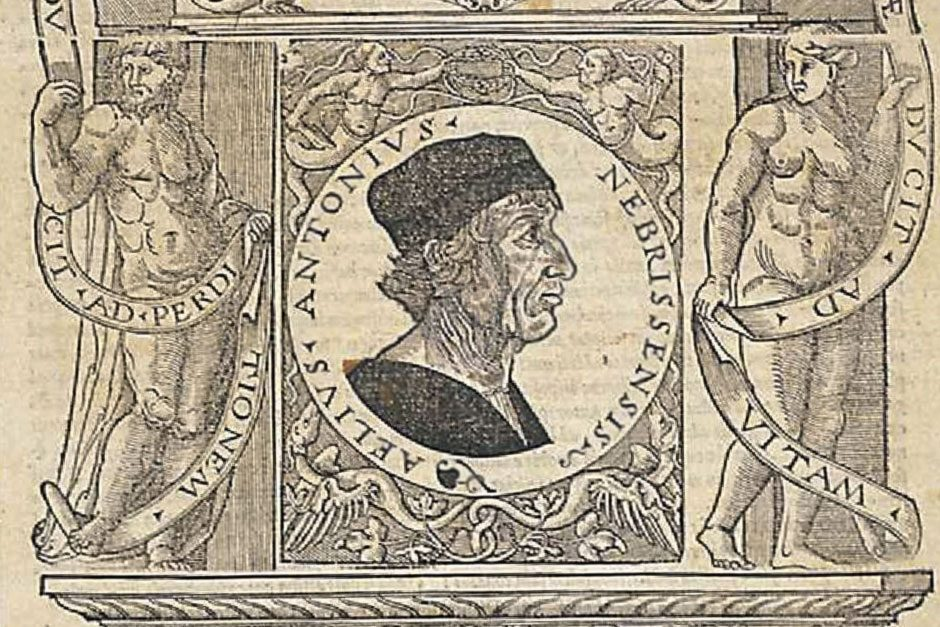
Nebrija (Figure 2) lived in a context marked by changes that occurred at the political, economic, social and cultural levels. This period was a transitional stage between the Middle Ages and the Modern Age (historians date its beginning either from 1453 with the fall of Constantinople to the Turks or from 1492 with the arrival of Europeans in the American continent). It shifted from a theocentric mindset, where God was at the center of the universe and thought, to an anthropocentric one, placing man at the center. However, this change did not happen overnight; it was gradual. The recovery of Greco-Roman knowledge and the development of the humanist movement in Italy, to which Nebrija belonged, contributed to this shift in mindsets along with the dissemination of new ideas thanks to Johannes Gutenberg's printing press (Velasco, 2019: 2-7).
During this transitional period, the unification of the kingdoms of Castile and Aragon took place, followed by the conquest of the Nazari Kingdom of Granada and later that of Navarre. Except for Portugal, the Iberian Peninsula was united under the Crown of the Trastámara Dynasty (Catholic Monarchs) followed by the Imperial Crown of the Habsburgs (Charles V) (Rouco, 2019: 317).
Spanish dominion did not remain in Europe but extended to new vast territories. In 1492, the Genovese Christopher Columbus arrived at Guanahaní Island supported by Queen Isabella I of Castile and King Ferdinand II of Aragon, the Catholic Monarchs. Due to this odyssey in America, Spanish spread becoming the second most spoken language (Sánchez, 1994: 553-554).
What was Nebrija's work?
Nebrija was a complete Renaissance man. He was a polyhedral and polymath figure. As a humanist, he studied the philology of the Castilian language and classical languages (Latin, Greek, and Hebrew), was a linguist, teacher, professor at the Universities of Salamanca and Alcalá de Henares, cosmographer, writer, poet, historian (and passionate about the vestiges of past civilizations), royal chronicler, pedagogue, printer, and editor. This is added to his interest in law, medicine, astronomy, and education, reflected in the various texts he left behind (Declaratory Institutional Act, Ayuntamiento de Lebrija).

In his writings, one can appreciate a continuous search for the refined Latin of ancient Romans through knowledge of the Romance language, the vernacular tongue. In 1481, he completed the Latin Grammar, and in 1492, the Castilian Grammar (Figure 3), the first grammar of Castilian and a modern European language. His dictionaries include Spanish-Latin-Latin-Spanish, the treatise De liberis educandis (on pedagogy), Ars Rhetorica (on rhetoric), De bello Nauariense (on history) and Aenigmata iuris civilis (on law) (Peñalver, 1992: 221-222).
What was Nebrija's life like?
The Nebrisan dedicated his life to his studies, moving to Salamanca at fifteen years old. After his experience in Castile, he left for Bologna (Italy), at nineteen years old, where he embraced Italian Humanism as part of the Royal College of Spain in Bologna. His stay in the city lasted ten years before returning to Castile to focus on strengthening Latin against those who discredited Greco-Roman culture. Finally, his last years were spent in Alcalá de Henares. Nebrija passed through different municipalities throughout his life such as Medina del Campo, Villanueva de la Serena, Córdoba or Zalamea de la Serena, leaving a marked footprint (Ayuntamiento of Alcalá de Henares, 2021).
His humanist career was financially supported by various patrons who contributed to Nebrija's work. Among these noble lords were the Archbishop of Seville, Alonso de Fonseca (c. 1415-1473) (tutoring his nephew Juan Rodríguez de Fonseca), Juan de Zúñiga (c. 1488-1546), Cardinal Francisco Jiménez de Cisneros (c. 1436-1517) or the Catholic Monarchs (Ferri, Biblioteca Virtual Miguel de Cervantes).
In a time where religion was key to controlling society, Elio Antonio was persecuted by the Inquisition accused of heresy for questioning the Greek and Hebrew translation into Latin of the Vulgate Bible (by Saint Jerome) in 1506. It would be then when Cardinal Cisneros, with whom he collaborated on the Biblia Políglota Complutense, played a significant role in his salvation by defending him at the "sacred tribunal" (Ferri, Biblioteca Virtual Miguel de Cervantes).
Relevance: Why is Nebrija's work still so important?
Nebrija's work transcended borders. The publication of his grammars influenced the creation of other European grammars, such as Italian and French; additionally, it contributed to movements for preserving pre-Columbian indigenous languages with the formulation of so-called "American grammars." He fought for the survival of the Castilian language, access to Latin, and teaching Spanish to those who did not have it as their mother tongue (Peñalver, 1992: 223-224).

The Andalusian became one of the humanists who introduced Italian Renaissance in the Iberian Peninsula around 1470. He had a modern mindset. He sought to form knowledge independent from his cultural, ethnic, national, religious or sexual origins. An example of this was replacing him at the Chair of Rhetoric at the University of Alcalá de Henares with his daughter Francisca (despite having several male children from his marriage with Isabel Montesinos de Solís), being one of the first women teachers in university settings. Additionally, he published Apología in 1507, an appeal against censorship in favor of freedom of expression (Fundación Antonio de Nebrija, V Centenary).
To conclude this brief review of Nebrija's life, the Ayuntamiento de Lebrija is preparing a candidacy for inclusion of the Latin Grammar of 1481 and the Castilian Language Grammar of 1492 as Memory of the World before UNESCO.
Bibliography
Peñalver, Manuel (1992): Nebrija: From Yesterday's Grammar to Today's Grammar. CAUCE: 14-15, 221-231. University of Granada.
Sánchez, Jesús (1994): Spanish in America. ASELE. Actas IV. Miscelánea. Centro Virtual Cervantes.
Velasco, Ambrosio (2019): Humanism: Fundamental Concepts and Phenomena of Our Time. Universidad Nacional Autónoma de México.
Rouco Collazo, Jorge (2019): Review: Ernest BELENGUER: The Trastámara. The first political lineage in Spain. 8. 314-317.
Fundación Antonio de Nebrija: https://www.nebrija.com/vcentenarioantonionebrija/vida.php
Declaratory Institutional Act on the Fifth Centenary of Elio Antonio de Nebrija's Death (2021): http://www.lebrija.es/export/sites/lebrija/.galleries/documentos-noticias/DECLARACION-V-CENTENARIO-ELIO-ANTONIO-PLENO.pdf Ayuntamiento de Lebrija.
Ferri, José María: https://www.cervantesvirtual.com/portales/elio_antonio_de_nebrija/autor_biografia/ Biblioteca Virtual Miguel de Cervantes.
Ayuntamiento of Alcalá de Henares (2021): https://www.ayto-alcaladehenares.es/alcala-de-henares-sede-de-la-cumbre-de-alcaldes-de-la-ruta-nebrisense/


Comments