

Port Royal is a city located in southeastern Jamaica that was occupied by the Spanish until England took control in 1655. It quickly became a center of trade, as well as a strategic and very relevant location for piracy (Gilmore and Reid, 2014: 282).
Once Jamaica was conquered, the crown decided to establish people in various places on the island to be responsible for its defense and care, but they did not take long to set sail in search of riches that the land they worked did not offer them because, in addition, many had previously dedicated themselves to piracy.
The city of Port Royal was one of the places that prospered due to these types of illicit activities. This was compounded by an increase in such activities from privateers, who were protected by British law and thus allowed to act independently with their attacks being seen as patriotic. In 1664 Sir Thomas Modyford arrived in Jamaica, whose role concerning piracy was very significant, for although he came to promote and improve the sugar plantation system, he ended up fostering piracy.
England wanted to turn both Port Royal and Jamaica into a major sugar producer, creating plantations all over the island, and Modyford did not take long to conclude that without a steady supply of slaves there was no way to stimulate production in the plantations, but at that time they were at war with the Dutch, which made slave trade difficult.
It was then when he decided to encourage pirates and privateers to attack Dutch ships, even defending piracy as legal in Jamaica since he found it beneficial for his business, and could be a good source of slaves for the plantations. Barely a year later he made a deal with Henry Morgan, a pirate who has gone down in history for his attacks on Panama, Cuba, Nicaragua, Venezuela, among others. Such attacks were always justified by Modyford, which led to Port Royal acquiring the designation of 'nest of pirates' (Hanna, 2015: 102-114).
Slowly but surely, Port Royal grew as a city from an economic standpoint. Due to the indulgence that seemed to be shown towards pirates in this place, their streets were soon populated by them, living up to the designation that had been imposed on it. It was the pirates themselves who kept the local economy going, for they sold what they took from other ships to local merchants and spent their money in taverns and small local establishments, stimulating the economy.
This facilitated maintaining good relations with merchants, and thus gaining social status. All of this was beneficial for Port Royal and Jamaica as a whole, but not so much for the British Empire, which did not want its colonies to accumulate too much wealth or have local upper classes with such power. Despite this, pirates gained significant social importance in Port Royal, so much that some even acquired land to exploit, as was the case of Henry Morgan who settled and died in this city (Mares, 2015: 25-28).
Between 1660 and 1690 the city maintained these conditions of piracy proliferation, but around 1687 things began to change. Laws against piracy started being promulgated, with the first pirates being hanged that same year. These measures were mainly taken by plantation owners and merchants who had been affected economically and socially by piracy. This moment marked the beginning of the end for piracy in the city, which gradually lost strength as more laws were continuously enacted. However, the key moment to understand the end of Port Royal came a few years later, in 1692 (Hanna, 2015: 141-143).
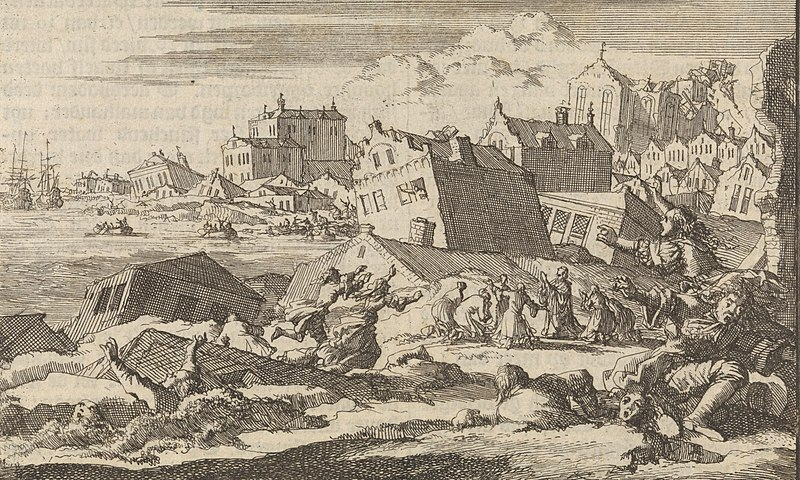
On June 7, 1692, around 11:40 AM a massive earthquake occurred, accompanied by several tsunamis. The city collapsed within minutes due to the fact that it was built on water-saturated sand and gravel, making the ground unstable, especially during earthquakes (Fig.2). Buildings did not take long to collapse, and in areas closer to the port, streets sank under the sea (Mulcahy, 2008: 392-404).

The entire island of Jamaica was affected by this, and Port Royal sank almost completely, losing half the city to the bottom of the sea, which put an end to one of the most important pirate enclaves in Jamaica and what was known as the world's most wicked city (Fig.3).

Bibliography
Hanna, M. G. (2015). Pirate Nests and the Rise of the British Empire, 1570-1740. University of North Carolina Press.
Mares, M. (2015). The British Contribution to the Development of Piracy in the Golden Age of Piracy. University College London.
Reid, B. A., & Gilmore, R. G. (eds.). (2014). Encyclopedia of Caribbean archaeology. University Press of Florida.
Mulcahy, M. (2008). The Port Royal earthquake and the world of wonders in seventeenth-century Jamaica. Early American Studies, 6(2), 391-421.
Cohen, C.M. (2017). Raising Port Royal: A geospatial reconstruction of the 1692 city through integrated GIS and 3D modeling. Doctoral dissertation. Texas A&M University.


Comments