

This article will analyze the figure of Princess Olga of Kiev. Known for a bloody legend of revenge or currently revered as a saint, Princess Olga was an important political agent in the 10th century. Her actions allowed her people, of Scandinavian origin, to fully settle in territories conquered just decades before and consolidated the political structure that would later give rise to Russia.
Origin of Rus’
The term Rus’ or Rhôs appeared in Byzantium in the 9th century as a reference to those who lived between the Black Sea and the Baltic Sea, especially Varangians. The territories where they inhabited were called ‘Ρωσία or Rhôsia, that is, land of the Rus. Initially it was associated with barbarism, as the Rus’ were understood to be savages (Meyendorff, 1981, pp. 9-11).
These Varangians, identified as Rus’, were Scandinavian merchants settled from mid-9th century (Fernández Riquelme, 2015, p. 171). Led by Riúrik, they established themselves in the south following trade routes and fought with other peoples already present (Hita Jiménes, 2001, pp. 168-174). Among the inhabitants of the new territories were Byzantine missionaries. This did not prevent Riúrik from attacking Constantinople in the year 860 (Arrignon, 1983, pp. 130-31).
Before his death in 879, Riúrik entrusted the succession and guardianship of his son to his relative Oleg. This was a highly bellicose ruler who continued the expansion southward. He conquered Kiev and moved the capital that Riúrik had established in Nóvgorod there. He besieged Constantinople for a second time in 911, dying shortly after (Hita Jiménes, 2001, pp. 132-136).
Oleg was succeeded by Igor, the son of Riúrik. During his reign, Constantinople was attacked again on two occasions: in 941 and in 944 (Arrignon, 1983, pp. 130-131). All confrontations that the Varangians had with Byzantium were resolved through commercial agreements. Given their long history as merchants, it is possible that these agreements were from the beginning the end of their attacks.
Princess Olga
Shortly after her last treaty with Byzantium, Prince Igor was assassinated by Mal, prince of the Drevlians, when he demanded tribute (Hita Jiménes, 2001, p. 182). His widow, Princess Olga, took charge of the kingdom as regent for her son Sviatoslav. The Chronicle of Nestor details how one of Olga’s first actions as ruler was to avenge her husband's death by killing the Drevlians in various ways.
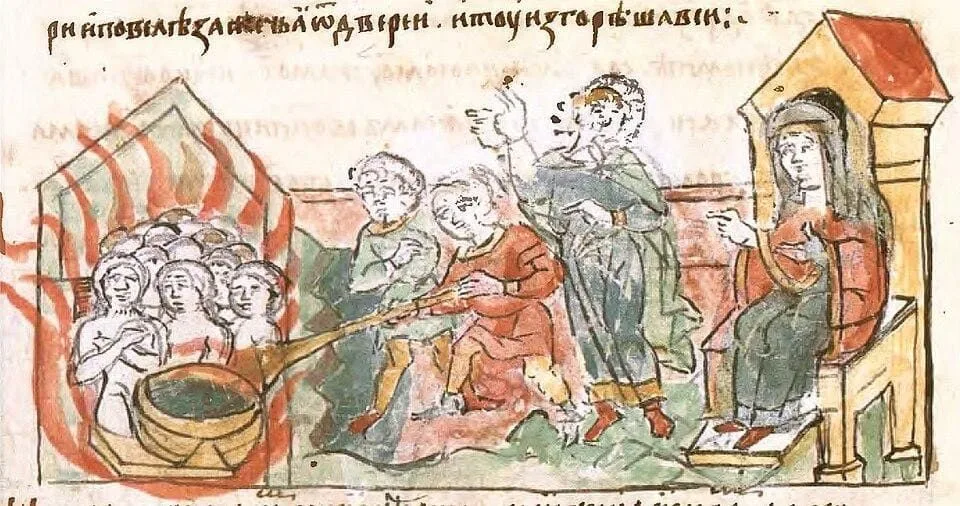
Prince Mal proposed marriage to Olga, widow of his victim. She pretended to accept and sent a delegation to her fiancé who she threw into a pit that had been dug in front of her palace. The princess justified herself by saying that the envoys had acted improperly with her and requested that Mal send other men. When the new Drevlian representatives arrived, Olga ordered them to take a bath and burned them alive. To complete her revenge, she asked Mal to organize a feast where he would order the death of this man and his entire troop. Subsequently, the widow of Kiev waged war on the rest of the Drevlians, exterminating the people who had killed her husband (Espinel, 2016, pp. 34-36).
This episode is the most well-known from Olga’s regency, although she also stood out for her fiscal and administrative reforms. Inspired by Byzantium, she divided the territory into military provinces (druzhinas), to which she requested tax collection once a year (Martin, 1995, pp. 11-12).
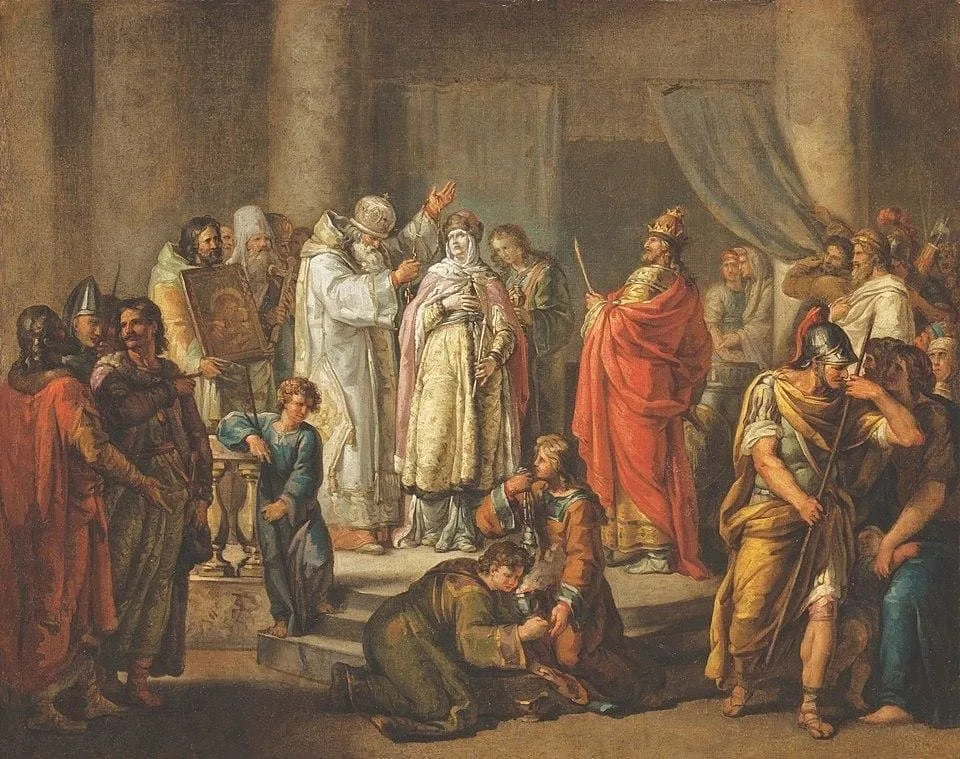
Unlike her predecessors, the princess managed to approach Byzantium without needing to defeat them in battle. In 957 she made a visit to the capital where Constantine VII received her with military honors that, according to Arrignon (1983, p. 133), were only given to an equal. It should be noted that the Byzantine emperor did not recognize any superior authority and therefore could not treat Olga as an equal but rather a ruler of great importance.
Olga’s visit culminated with her baptism into Christianity, officiated by Patriarch Polieuctus, under the sponsorship of Emperor Constantine and Empress Helena, from whom she took her baptismal name (García de la Puente, 2004, p. 66). Upon returning to Kiev, Olga brought with her a priest who helped her stay away from paganism for the rest of her life (Mouravieff, 1842, pp. 9-10).
Olga’s conversion should not be understood as an act motivated solely by devotion but also by politics. The Riúrik dynasty had allowed different religions in its territory, including Christianity (Martin, 1995, p. 6). However, it lacked a majority and regulated belief that could serve as an element of cohesion within the territory and with the Byzantine Empire.
The Conversion of Vladimir I
Sviatoslav died in 972. After a dispute among his children, the sole survivor, Valdimiro of Nóvgorod, was crowned in 980. Prince Vladimir took a different stance from his predecessors and wanted to unify his subjects under one faith. According to legend, he called representatives of the main religions, disapproved of the Jews’ lack of territory, the austerity of Catholic liturgy, and Islamic restrictions on alcohol. Finally, he chose Orthodox Christianity for its majestic ceremonies (Martin, 1995, pp. 1-7).
A more subjective story with a religious perspective claims that Vladimir converted due to his grandmother Olga. According to this version, Olga had cared for her grandchildren while Sviatoslav was at war and Vladimir would have been aware of the prestigious wisdom of his grandmother. However, there is no evidence validating this account (Mouravieff, 1842, pp. 10-13).
It has also been suggested that Vladimir’s conversion was due to his marriage with Anna Porphyrogenita, sister of Emperor Basil II, between the years 987 and 989. This union implied a military alliance and, according to theory, a promise of conversion by the Rus’ (Arrignon, 1983, p. 134; Vasiliev, 1932, pp. 351-352). However, Christianization was an arduous process that could not be completed until the 14th century (García de la Puente, 2004, p. 71).
Conclusions
Olga of Kiev was an accidental ruler who came to power due to her husband’s sudden death. Despite not being expected to wield power, she demonstrated political skill from the start. Her actions suggest that she was less bellicose than her husband and predecessors, seeking agreements with Byzantium through religious and administrative assimilation. However, beyond the legend of her creative forms of revenge, Olga proved capable of executing military action when necessary.
Although her conversion to Christianity was a personal act, it could have impacted her people had not been opposed by her son Sviatoslav. Nevertheless, her grandson Vladimir acted similarly, allying with the Byzantines through marriage and initiating the general conversion that his grandmother could not achieve. It is thus no surprise to see Olga and Vladimir venerated as saints at the same time.
Bibliography
Arrignon, J. P. (1983): Diplomatic relations between Byzantium and Russia from 860 to 1043, Revue des études slaves, 55 (1), 129 – 237.
García de la Puente, I. (2004): The Christianization of Rus’ according to “The Tale of Bygone Years”, Ilu. Revista de ciencias de las religiones, 13, 63-73.
Hita Jiménez, J. (2001): On the origins of Russia and the “Chronicle of Nestor”, Studia historica. Historia medieval, 18-19, 165-186.
Fernández Riquelme, S. (2015): The Third Rome: Myths and Realities in the Historical Birth of Russia as a State, La razón histórica. Revista hispanoamericana de Historia de las Ideas, 31, 168-201.
Meyendorff, J. (1981): Byzantium and the Rise of Russia: A Study of Byzantino-Russian Relations in the Fourteenth Century. Cambridge University Press.
Mouravieff, A. N. (1842): A History of the Church of Russia. John Henry Parker, 1842.
Vasiliev, A. A. (1932). Was Old Russia a Vassal State of Byzantium?, Speculum, 7 (3), 350 – 360.


.jpg)

Comments