


The death of Carlos II without an heir in the year 1700 opens a period of change, which begins with the entry of the Bourbon dynasty into Spain through the Duke of Anjou, who thereafter renounces his title to be known as Philip V, King of Spain.
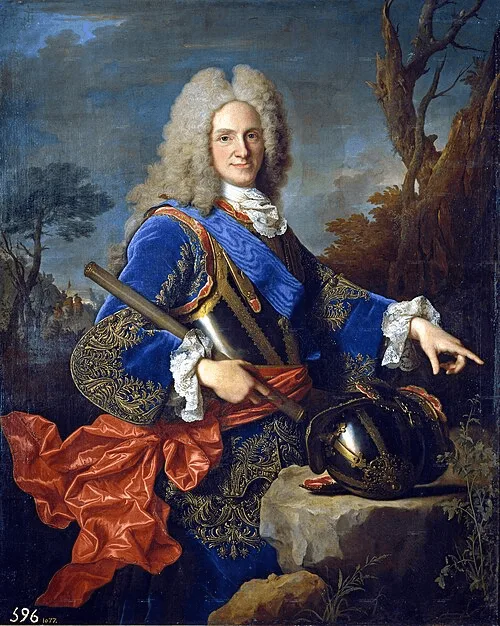
This monarch of French origin is attributed with three pathologies, documented in writings from the time. The first to be notable is the king's addiction to sex, known through anecdotes collected about his first wife, Maria Luisa Gabriela of Savoy. The second is a sporadic voracious appetite, recurrent in the later years of Philip V’s life when his physical state evidenced obesity (Gil-Carcedo García and Gil-Carcedo Sañudo, 2020, pp. 116 – 117). Both have been questioned as it is impossible to discern how much these behaviors could be classified as pathological.
On the other hand, the third one is clearly considered a mental illness: bipolar disorder. Already in his early years as King of Spain during the War of Succession, periods of melancholy are documented, which were later replaced by others of hyperactivity (Gil-Carcedo García and Gil-Carcedo Sañudo, 2020, p. 117). This situation worsened over time until his second wife, Isabel de Farnesio, took the reins of government (Gil-Carcedo García and Gil-Carcedo Sañudo, 2020, p. 118).
And it is his second wife who summoned Carlo Maria Michelangelo Nicola Broschi to court, known as Farinelli, the most famous of all castrati in history.
Carlo Broschi, "il ragazzo"
Born into a family of Italian low nobility in Apulia, he was castrated at the age of 12 years old in 1717. This event granted him the ability to reach an extremely high vocal range; only three years later, he debuted in his first opera, Angelica e Medoro, composed by his teacher Nicola Porpora and libretto by Pietro Metastasio, with whom he formed a friendship (Gies, 2022, p. 33).
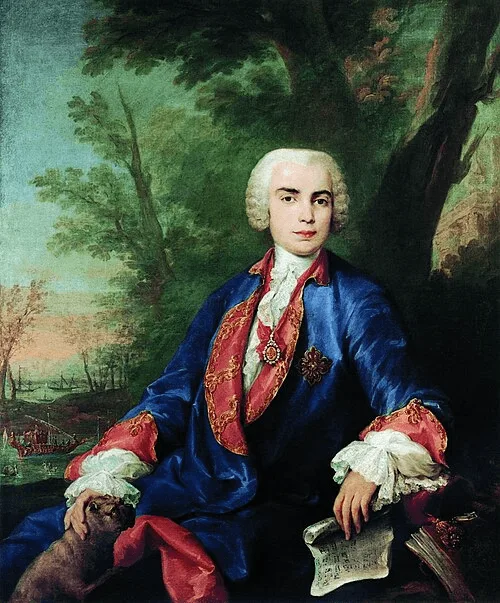
From then on, his fame spread and solidified across Europe, traveling to major cities such as Vienna, Milan, Bologna, Venice, and London. In the latter, he was contacted by Spain's ambassador, Thomas Fitzgerald, at the request of Queen Isabel de Farnesio to visit the Spanish court, where he arrived in July 1737 with the intention of staying for a short period (Gies, 2022, pp. 33 – 34). However, he ended up remaining in Madrid until 1759, the year of King Ferdinand VI's death.
The Musical Miracle
Farinelli’s arrival at Philip V’s court was a result of Isabel de Farnesio's desperate search to pull the monarch out of his episodes of melancholy; episodes that became increasingly frequent and difficult for the court to manage (Martín Saez, 2018, p. 47). It is said she summoned the singer inspired by the widow of the previous king, Mariana of Neuburg, who in the last months of Carlos II's life had hired soprano Matteuccio to ease his spirit (Martínez Shaw and Alfonso Mola, 2001, pp. 155-156).
It seems that the effect was almost immediate. The castrato became a daily therapy that allowed the king to regain part of his life and duties as monarch. He was appointed «Court Singer for His Majesty and My Familiar Servant, dependent solely on me and my very dear and loved Wife due to his singular ability and skill in singing» just a month after his arrival (Martínez Shaw and Alfonso Mola, 2001, p. 156). Thus, the young musician began his journey at the Spanish court, mingling with nobility and developing the mythology of Farinelli as «a new Orpheus, capable of moving the most influential men in Europe with his voice» (Martín Sáez, 2018, p. 42).
From the first day I arrived here, I have followed the same routine of singing every night at the feet of the Sovereigns and am listened to as if it were always my first day. It is necessary for me to pray to God that he keeps me in good health so that I can continue with this life: I drink all holy nights 8 out of 9 arias, there's never rest.
Desde el primer día que llegué aquí he seguido la misma vida de cantar todas las noches a los Pies Soberanos, y siempre he sido escuchado como si fuese el primer día. Me conviene rogar a Dios que me conserve la salud para continuar con la vida presente: me bebo todas las santas noches 8 o 9 arias, nunca hay descanso.
Letter from Carlo Broschi to Sicinio Pepoli, February 16th, 1738 (Martín Sáez, 2018, p. 42).
Often it has been written about the monotony of Philip V regarding the choice of repertoire that Farinelli had to perform. However, according to Sandro Cappeletto's studies (1995), it has been proven that the singer kept more than a hundred works, including arias and sonatas by composers such as Pergolesi, Leo, Hasse, Scarlatti, etc. This does not detract from the fact that the king might have felt greater attraction to some of these works in particular, requesting them more frequently (Martínez Shaw and Alfonso Mola, 2001, p. 157).
But even the power of music could not prevent the fatal outcome. Philip's health deteriorated over time, leading to his death in 1746 after 45 years of rule, one of the longest reigns in Spain (Martínez Shaw and Alfonso Mola, 2001, p. 165). This was not the end for Farinelli in Spain as he continued to serve his successor, Ferdinand VI, until his death in 1759.
Conclusions
Beyond his artistic talent, Farinelli ended up becoming someone very dear in Philip V's court. His presence consolidated an almost mythical image of the musician as a figure capable of influencing, if not directly on state affairs, then on the king himself. Far from being an occasional resource, Farinelli’s music became part of a daily and demanding therapeutic routine, marking and linking the life of the monarch to that of the musician until their last days.
Furthermore, it is necessary to highlight the permanence of the musician in the court of Philip's successor, his son Ferdinand VI (Martínez Shaw and Alfonso Mola, 2001, pp. 165-166), whose topic deserves a dedicated article for further discussion. This fact demonstrates that his figure was fully integrated into the Spanish court structure, becoming an established element of political and cultural life in the kingdom.
Bibliography
Cappeletto, S. (1995). La voce perduta. Vita di Farinelli. Evirato cantore. Turin, EDT.
Gies, D. T. (2022). "The voice of an angel you have:" Carlo Broschi 'Farinelli' (1705-1782) in nineteenth-century Spanish theater. In Mundos del hispanismo: Una cartografía para el siglo XXI: AIH Jerusalem 2019, pp. 33 – 41.
Gil-Carcedo García, L. M., & Gil-Carcedo Sañudo, E. (2020). A sick king in a complicated European moment: The biography of Philip V. Presentation of a case study. Anales de la Real Academia de Medicina y Cirugía de Valladolid, (56), 107-151.
Martín Sáez, D. (2018). The legend of Farinelli in Spain: Historiography, mythology and politics. In Revista de musicología, 41 (1), 41-78.
Martínez Shaw, C., & Alfonso Mola, M. (2001). Felipe V. Arlanza Ediciones.


.jpg)
Comments