

Roman Empresses and Their Representation in Hispania
Chapter 1: Livia Drusilla
After political upheavals and wars that plagued Rome, in the year 27 BC, Octavian received from the Senate the title of Augustus, consolidating a position of political primacy that made him, in fact, the first Roman emperor. A new era begins in Rome, along with it emerges a worthy subject for study: the figure of empresses and the power they wielded behind powerful rulers. This gives rise to a new historical artistic paradigm in the Empire which has generated various debates and studies from their person and consequently, from their artistic representations, a phenomenon that we will examine here focusing on workshops in Hispania.
Livia Drusilla, future Julia Augusta and matriarch of the Julio-Claudian dynasty, was born in Rome in 58 BC and died in 29 AD at the age of 86. Her life is framed within the historical context of the final crisis of the Republic, a period marked by civil wars and political disputes that opened up after Julius Caesar's assassination on March 14, 44 BC (Ruiz Castellanos, 2023, p. 23).
At the age of fifteen, she was forced to marry in 42 BC with Tiberius Claudius Nero, her cousin, a patrician thirty years older than her. After marrying , she became a matrona, a title that Roman tradition granted to women from noble families when they got married (Orozco Masarotti, 2025, pp.175 - 176). Following the birth of Tiberius—son of Livia and Tiberius Claudius Nero who was later adopted by Augustus—the figure of the one who would become the successor to the throne and second emperor of the Empire was consolidated.
Before becoming emperor, Gaius Julius Caesar Octavian Augustus (63 BC - 14 AD) divorced his wife to marry Livia Drusilla, mainly for political reasons and to obtain influential relationships—Livia belonged to the gens Claudia, one of Rome's most prestigious patrician families. Both, Livia and Gaius Julius Caesar Octavian Augustus, divorced their respective spouses on the same day and married shortly after, she was pregnant with her second son, Nero Claudius Drusus, the future emperor (Syme, 2011, pp.283-284).
Livia thus became the mother of the Empire, as emperors from her lineage were proclaimed: first her son, Emperor Tiberius, and later her grandson, Claudius, and great-grandson, Nero.
The Role of the Empress in the Empire
Throughout her life, she played a very important role socially and politically as a benefactor, funding public works such as:
«(…) the restoration and construction of temples like the Portico of Livia and the small sanctuary inside dedicated to Concordia in 7 BC.»
(Hidalgo de la Vega, 2012, p. 62).
Whenever she could, she honored good women and wives of ancient Rome, even offering banquets for the women of the imperial capital (Hidalgo de la Vega, 2012, p. 62).
She was also a very good political advisor to Augustus, ensuring that her husband had no enemies, meaning, Livia could contribute, according to certain interpretations, to the management of political and family alliances within the Augustan environment. Therefore,, Augustus learned from her how to have on his side a large part of the senate and prestigious military figures, which led to the famous Pax Romana, characterized by that political stability during the time Augustus was emperor. As a result,, in gratitude he granted her administration of her own assets, an exceptional privilege at the time (Hidalgo de la Vega, 2012, p. 61).
On the other hand, the figure of the Augusta has been affected by a deepblack legend from Latin authors such as Tacitus and his «Annals» (1st century AD) or Dio Cassius and his «Roman History» in the 3rd century AD. The fact that Livia and Augustus never had legitimate children is the cause for which a modified and distorted history has been projected through criticisms in ancient historiography. Roman historians or writers accused her of being criminal, as all those who were legitimate heirs to the throne from the gens Julia, ended up dead or assassinated—through poisoning or battle so that her son Tiberius could become emperor—due to alleged conspiracies by Livia. However, this black legend has spurred research and reevaluation of her figure by carefully analyzing the data provided by classical historians. Thus, modern authors like Syme (2020, pp.416-422) or Ruiz Castellanos (2023, pp. 25-44), refute these facts arguing that there are no solid proofs linking her to the plots she was accused of.
What is confirmed in Augustus' will is that the empress was adopted by her husband, thus reflecting her institutionalization as Iulia Augusta, granting her great power. This also ties into being declared mater patriae by the Senate because she always accompanied Augustus at the front and stayed in the military camp sharing a soldier's life like other pretorians, which gave confidence and security to military forces (Hidalgo de la Vega, 2012, pp. 31-34).
At her husband's death, in 14 AD Livia, although she did not officially govern nor received formal political powers, did mediate with the Senate so that her son was named princeps, and from there also wanted to be part of the government with her son Tiberius, administering the powers granted to him as emperor. However, he rejected his mother, considering her an obstacle to his reign due to the power Augustus had given her. And because Livia wanted to continue with the same governance plan carried out years earlier with Augustus. Finally, Tiberius rejected her and exiled her from public life until her death. This rivalry between both was already commented on by Tacitus in his «Annals»:
«Some (senators) proposed that she be called 'the mother,' others, 'mother of the fatherland.' The majority proposed adding to Caesar's name that of 'son of Julia.' Tiberius did not cease saying that honors for women (feminarum honores) had to be moderate... The truth was that envy tormented him and he received this woman's elevation as a diminishment of his own»
(Tacitus, trans. in 1979, An. I, 1.14).
At Livia's death, Tiberius did not attend her funeral. Despite this, the Senate wanted to grant her apotheosis for divinization, something his son rejected outright. Thus, Livia's consecration as Diva Augusta came at the hands of her grandson, Claudius, in 42 AD (Hidalgo de la Vega, 2012, pp. 32-34).
The Figure of Livia Drusilla in Hispania
All the above made her figure be praised, who by merit was represented throughout the Empire as an example of mater patriae. As Hidalgo de la Vega affirms, the representation of emperors and empresses did not only obey official propaganda from the Empire but their actions as benefactors were recognized in it. Thanks to her husband beginning to spread a profession of faith towards her person as Diva Augusta, causing many provinces wanted to show affection through their effigies. Even after her death, she became one of the most important women in Rome, so much so that subsequent empresses took her as an example to follow (Hidalgo de la Vega, 2012, pp. 32-34).
Thus, focusing on Hispania and as Goretti Oya affirms, her image was represented as the Venus Genetrix, (who in Roman mythology was the founder of the Julio-Claudian family) and with equivalent deities such as Ceres, Cybele or Juno, symbolizing fertility (hence mater patriae or mother of the fatherland). Upon news spreading that Augustus' grandchildren would truly be heirs to power, production of sculptural portraits of Livia intensified in her honor. A lady image was consolidated based on the Roman tradition ideal as propaganda. Mainly, to influence society exemplifying the value of a good matrona according to the imperial program of Augustus and later with Tiberius (Oya, 2020, pp. 133-134).
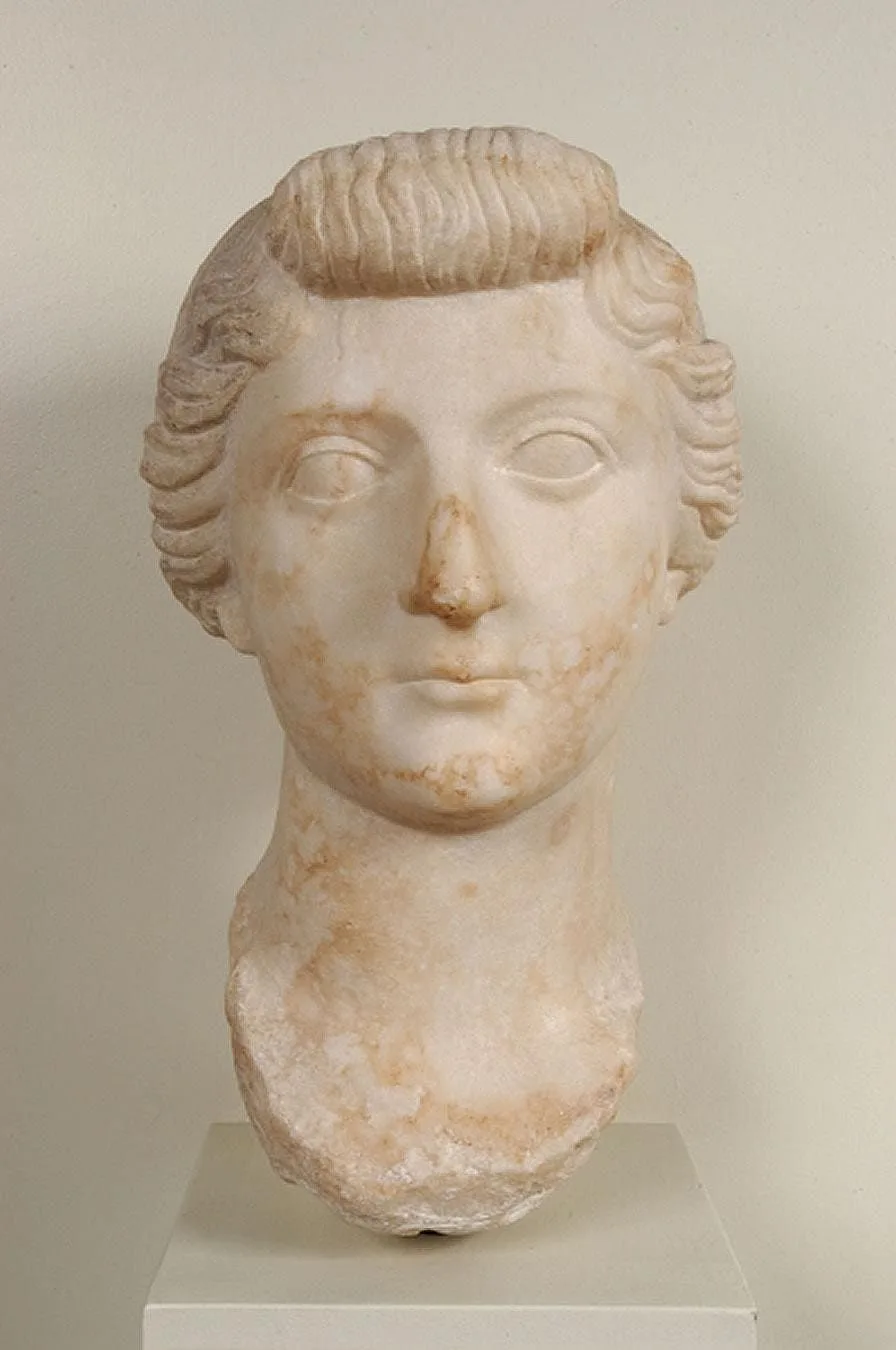
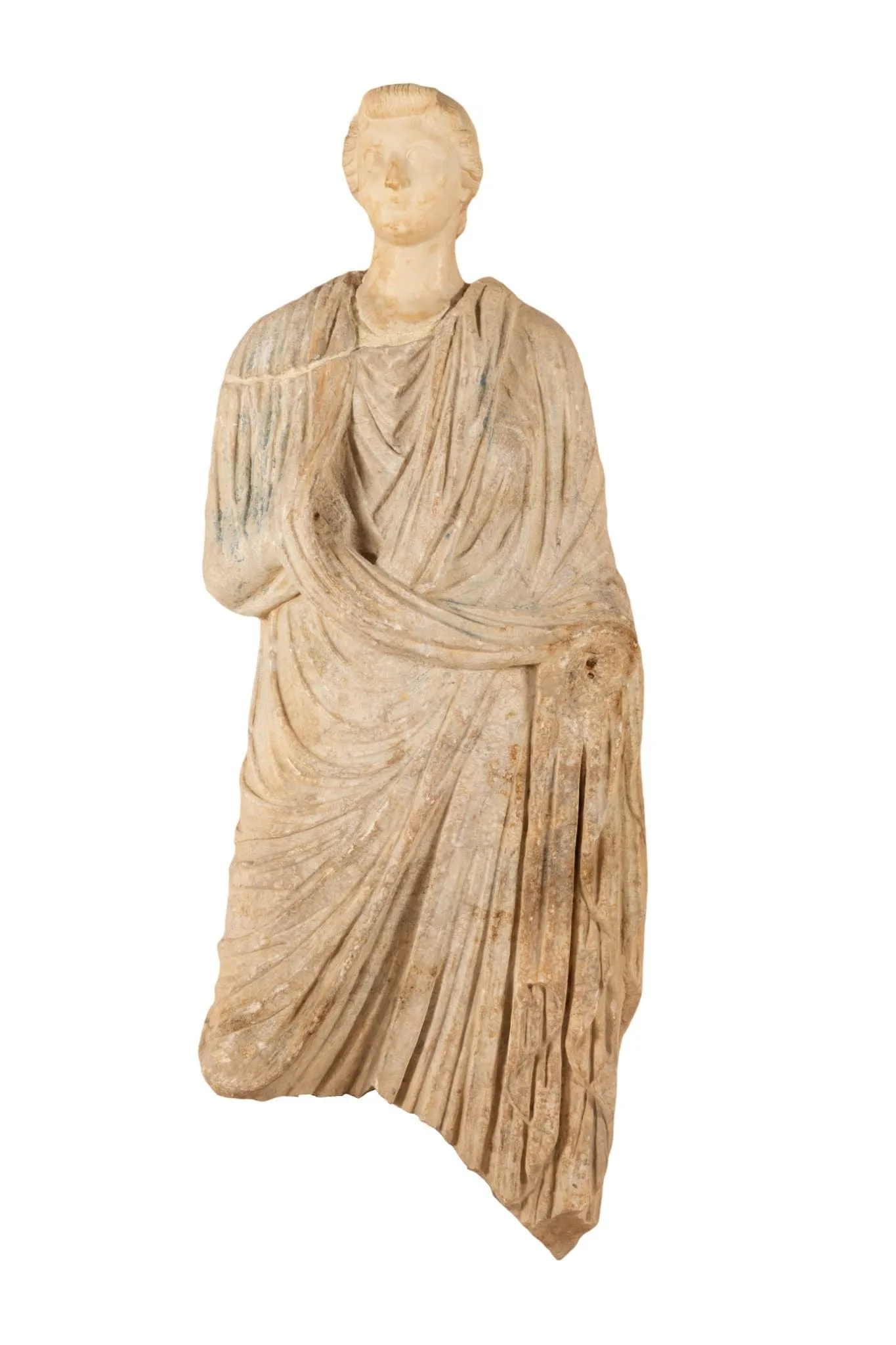
In the Betica, she is represented as the first Roman empress destined for official imperial worship. One of the most representative examples was found in Cerro del Castillo (Medina Sidonia, Cádiz) during excavations carried out between 1960 and 1961, and subsequent interventions located the body (image 1).
Currently, the restored ensemble is preserved at the Cádiz Museum (Inventory number CE 07209, available on Spain's Digital Museum Network, http://CER.es)
Oya García argues that finding these materials provides important information and allows analyzing from multiple perspectives: historical, political, social, religious, artistic, and above all in the context in which it was created, i.e., a Spanish workshop. It is also possible that her representationwas an object of devotion in private spheres, as ex-votos or decorations with a religious sense. The author recommends analyzing Roman statuary from two perspectives:
«(…) on the one hand, the concept and representation of the character or deity and how to render homage to them, and on the other, their role in public and private spheres»
(Oya García, 2020, p.134).
Conclusion
To conclude, Roman history has presented Livia Drusilla as a cunning and cold woman who sought to take power from her son, even plotting with the death of members of the gens-julia family for him to ascend to the throne without problems. However, recent historiography has nuanced this image, as thanks to new contributions and historical reevaluations, it has been discovered that Livia was much more than that: a woman who helped her people and who, despite everything, was very loved by all the inhabitants of the Empire, regardless of their origin.
And this example is found in the sculptural representations made not only while she was alive but after achieving apotheosis, becoming a deity and mater patriae. As a result, that affection spread to various points of the Empire, including the Betica region, whose workshops reflected the importance of image quality for commemorating Livia Drusilla's name eternally, an exceptional woman and example for future empresses.
Bibliography
Ruiz Castellanos, A. (2023). Livia, wife of Augustus: the story of an exceptional woman. CERETANUM, 1, 25-44, . https://academiasandionisio.com/storage/Revistas/Revista%201/Livia%20esposa%20de%20Augusto%20la%20historia%20de%20una%20mujer%20excepcional%201%20CERETANUM%20150323%20.pdf
Hidalgo de la Vega, M. J. (2012). Roman Empresses: Dreams of Purple and Hidden Power. Editorial Universidad de Salamanca.
Oya García, G. (2020). The image of Livia Drusilla in the sculpture of the Betica territory during high imperial times. Hispania Antiqva. Revista de Historia Antigua, XLIV, 130-159: https://doi.org/10.24197/ha.XLIV.2020.130-159
Orozco Masarotti, V. (2025). Women of the royal family in imperial Roman times (I BC - I AD): models and traditions. Anuario de la Escuela de Historia Virtual, year 16 – 27. 174-201. http://revistas.unc.edu.ar/index.php/anuariohistoria
Syme, R. (2020). The Roman Revolution. Editorial Planeta.
Tacitus, C. C. (1979-1980). Annals (J. L. Moralejo, Trans.; 2 vols.). Editorial Gredos. (Original work published ca. 117 AD).


Comments