

On last year's International Women's Day, the growing field of study known as "reginality" (Fernández Guisasola, 2023) was discussed. This time we will begin a series of articles on one of the least studied aspects in this field: the position of men socially accepted as dominant figures, relegated to being consorts to ruling women.
It is worth noting that in the Western medieval monarchy, both parties in a marriage are considered to have a function, with the role of queen consort deemed necessary. She receives a role derived from her husband's divine power and acts as a local lady, advisor, and arbitrator (Pelaz Flores, 2017, pp. 31-38). This relationship changes when it is the woman who wields the power, and the man becomes the recipient dependent on his wife.
A king consort cannot be limited to occupying the role that a queen would have in the same situation, and it is expected that he will take some of the powers that should belong to his wives, especially military command, which is supposed not to be held by women, even queens (Woodacre, 2012, pp. 380-381). This can be seen in the lead seal of the Catholic Monarchs (Francisco Olmos and Novoa Portela, 2008, pp. 114-115), where Queen Isabella appears seated on a throne while her husband is depicted mounted on horseback.

During the High Middle Ages, there is a tendency to prevent women from occupying power, as in the case of Sancha of León, whose kingdom passes to her husband, and Matilda of Normandy, who unsuccessfully attempts to claim her rights over the English throne (Earenfight, 2013, pp. 3 and 115-117). Despite this trend, we will see that each territory reaches a different solution regarding the dilemma of women and power according to their political circumstances.
In Castile, during the twelfth century, the first queen proprietor appears, Urraca, along with the first prominent landholders (Barton, 2011, p. 57). The right of women to govern is formally recognized in the Second Partida, although they are required to be married to be declared adults (Alfonso X, 1555, fols. 44v-49v).
The evolution of the concept of female succession is different in each kingdom. This same succession is followed in Naples and Sicily (Francisco Olmos, 2020), as well as in Jerusalem (Earenfight, 2013, p. 171), where there have been multiple queens in these territories. Other kingdoms, such as France, simply deny that a woman or her descendants can accede to the throne (Taylor, 2021). Some, like Aragon (García Gallo, 1966), deny women's capacity to reign but allow them to transmit their rights to male descendants. The case of Navarre is striking, where several women have ascended to the throne normally, but their power must be wielded by their husband or, in his absence, by a son (Woodacre, 2013).
In those kingdoms where a woman cannot inherit or hold power, there is no debate about the role each spouse should occupy in marriage, as they maintain socially accepted gender roles. However, when a woman can govern by right, such as in Castile, her figure tends to be masculinized (Pelaz Flores, 2017, p. 152). The most likely purpose is for her to be considered a valid ruler despite preconceived ideas about women's limited governing abilities.

This places the husband of a queen in a complex situation, as he is not feminized. Therefore, an appropriate role must be reserved for him according to his gender and status as male consort. In many cases, they do not accept being inferior to their wives, usurping their powers if they are not legitimately theirs, as seen in the published articles on Constance of Castile and John of Gaunt (Fernández Guisasola, 2022b) or Juan I of Castile and Beatrice of Portugal (Fernández Guisasola, 2022a).
One of the most recognizable marital reigns in this regard is that of Blanche I of Navarre and John II of Navarre and Aragon. As mentioned before, it is normal for a man to rule even if the woman is the owner of the kingdom. However, King Juan goes further, maintaining the kingdom as his own after his wife's death in 1441, against the rights of his own children. Only upon his death does the kingdom return to Blanche I's descendants.
King John II and his second wife, Juana Enríquez, are parents of Fernando II of Aragon. When Fernando marries Isabel I of Castile, his father encourages him to follow the model he set in Navarre, denying Isabel and her descendants any rights as proprietors (Francisco Olmos, 1995). However, Isabel also takes into account Blanche I's precedent when negotiating how their joint government will be conducted (Woodacre, 2012, pp. 83-84). According to the agreements between Isabel and Fernando, they will govern together or separately, but he will do so by grace of his wife, not by any right.
Despite the masculinization of the ruling woman, very few reach a prominent military role. There are exceptions like Queen Consort Juana Manuel and Regent Queen Maria de Molina, who command troops at specific moments (Pelaz Flores, 2017, pp. 220-222). Isabel I's role in the field is similar to many consorts; she focuses on supplying and reinforcing troops led by Fernando II (Lehfeldt, 2008, pp. 111-113). Duchess Maria of Burgundy, sovereign of the Low Countries and contemporary of the Catholic Monarchs, does not lead her troops herself but appoints Philip de Ravenstein as lieutenant until her marriage to Maximilian of Austria, who then takes over military duties (Cazaux, 1972, p. 272).
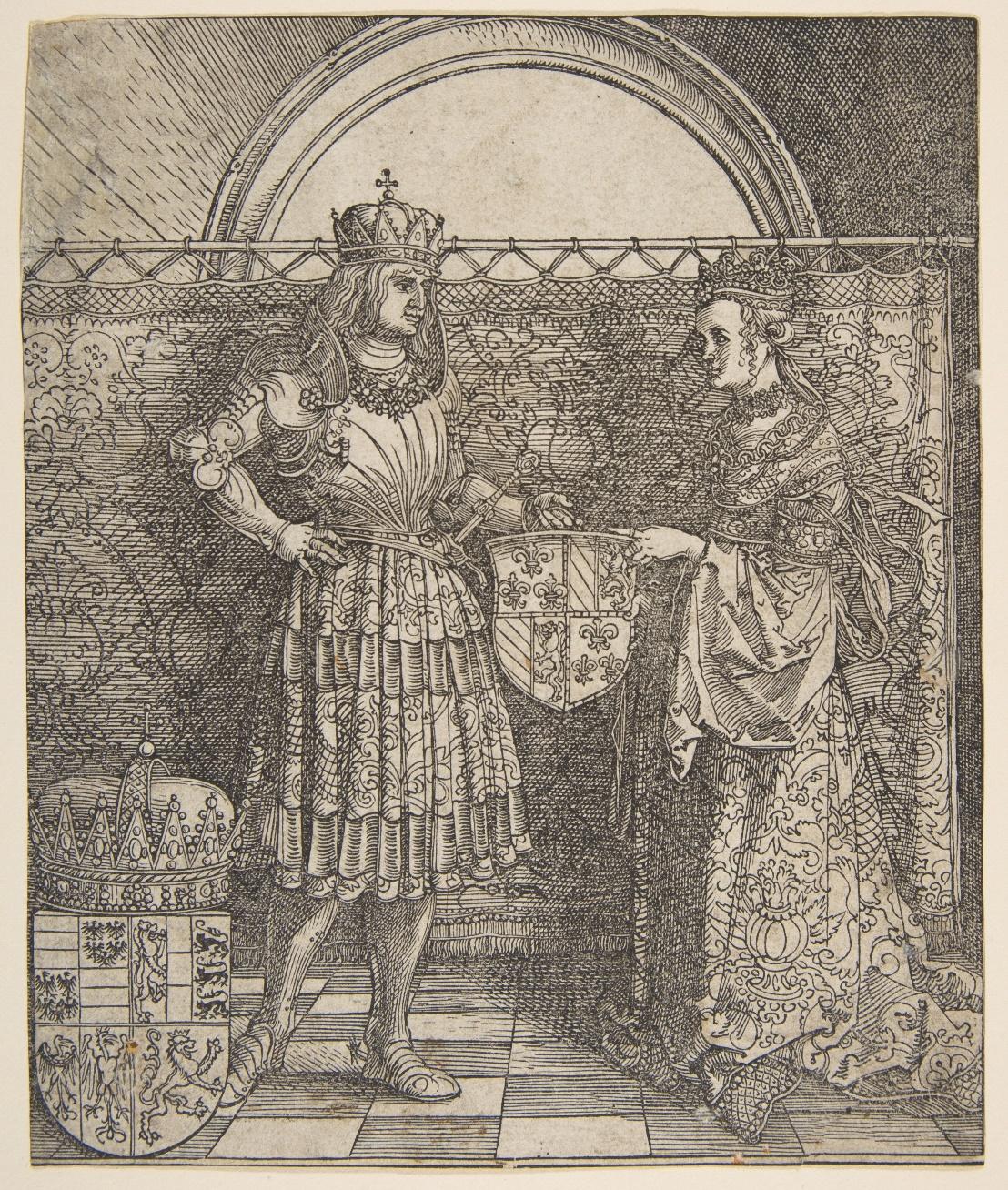
Except for exceptions mentioned, such as Juan II in Navarre, queen proprietors usually have their own heirs who will occupy power after them. When a king's wife becomes a widow, she retains the title of consort, but this is not always the case with men out of fear it may indicate territorial ambitions. For example, Maximilian of Austria retained the title of Duke of Burgundy after his wife Maria's death, while Fernando the Catholic stopped referring to himself as King of Castile upon Isabel I of Castile's death (Segura Graíño, 1989, pp. 212-214).
In conclusion, one of the difficulties a medieval woman faces to govern is determining what position her husband should hold, whom she likely depends on for leading troops and who may even exercise all royal powers as if he were the true owner. Consequently, the figure of the king's consort is both necessary and dangerous. Ultimately, each territory will reach a conclusion about the roles men and women must occupy at the throne, although as seen in the next article, ideas and trends will evolve over time and cross borders.
Bibliography
Alfonso X of Castile (1555). The Seven Partidas vol. 1. Gregorio López.
Barton, S. (2011). Noblewomen and Power in the Kingdoms of León and Castile in the Twelfth Century: A Preliminary Study. Studia histórica, Historia medieval, 29, 51-71.
Cazaux, Y. (1972). Maria of Burgundy. Espasa-Calpe.
Earenfight, T. (2013). Queenship in Medieval Europe. Palgrave Macmillan.
Fernández Guisasola, L. F. (2022a). The Queen and the Master: Political Propaganda Through Coins of the First Portuguese Interregnum (Part I). Arqueo Times, 1, 18-20.
Fernández Guisasola, L. F. (2022b). A Forgotten Claimant: The Reclamation of Constance of Castile. ArqueoTimes, 3, 34-37.
Fernández Guisasola, L. F. (2023). «Reginality»: A Concept for the Study of Female Power. ArqueoTimes, 4, 68-73.
Francisco Olmos, J. M. (1995). Juan II of Aragon and the Birth of Prince John: Political Advice to Fernando the Catholic. In Medieval Spain, 18, 241-256.
Francisco Olmos, J. M. (2016). Emblematic and Historical Study of the Seals of the Last Queens of Aragon, Isabel the Catholic and Germana de Foix. Anales de la Real Academia Matritense de Heráldica y Genealogía, 19, 7-64.
Francisco Olmos, J. M. (2020). The Kingdom of Sicily-Naples and the Holy See: Problems of a Feudalization (XI-XVI Centuries). In F. Barrios Pintado and J. Alvarado Planas (eds.), Rite, Ceremony and Protocol. Spaces of Sociability, Legitimization, and Transcendence (pp. 123-167). Dykinson.
Francisco Olmos, J. M. and Novoa Portela, F. (2016). The History and Evolution of the Lead Seal. The Sigillographic Collection of the Museo Cerralbo. Real Academia Matritense de Heráldica y Genealogía.
García Gallo, Alfonso (1966). “The Succession to the Throne in the Crown of Aragon”. Anuario de Historia del Derecho Español, 88-89, 5-187.
Lehfeldt, E. A. (2008). The Queen at War. In B. F. Wisberger, Queen Isabel I of Castile: Power, Patronage, Persona (pp. 108-119). Tamesis.
Pelaz Flores, D. (2017). The Queens Consorts. The Queens of Castile between the XI and XIV Centuries. Sílex.
Segura Graíño, C. (1989). Women and Succession to the Crown in Castile during the Late Middle Ages. In Medieval Spain, 12, 205 – 214.
Taylor, C. (2001). The Salic Law and the Valois Succession to the French Crown. French History, 14(4), 358-377.
Woodacre, E. (2012). Questionable Authority: Female Sovereigns and Their Consorts in Medieval and Renaissance Chronicles. In J. Dresvina and N. Sparks (eds.), Authority and Gender in Medieval and Renaissance Chronicles (pp. 376-406). Cambridge Scholars Publishing.
Woodacre, E. (2013). The Queens Regnant of Navarre: Succession, Politics, and Partnership, 1274-1512. Cambridge Scholars Publishing.


Comments