


Birds that inhabit the region known as the Maya area were the subject of numerous pictorial representations throughout the development of this culture, occupying an important place within them as deities (García Barrios, 2009: 93). The variability of different species endowed the Mayan imagination with a rich pictorial content with artistic manifestations of all kinds. This is mainly due to the environment in which they developed, characterized by its richness and variety of flora and fauna.
The sacred quality that birds present stems from their ability to fly and move through the celestial vault (de La Garza, 1995: 7). Birds themselves are earthly animals but have the capacity to fly in the sky, where Mesoamerican deities mainly reside (de La Garza, 1995: 7). For the Maya, the most important birds are the quetzal, the royal turaco, the scarlet macaw, the eagle, the raven, and the hummingbird, primarily (de La Garza, 1998: 129). These birds form part of various aspects of Mayan society such as religion, rituals, and ball games, where clothing alludes to signs from the celestial world (Barrois and Tokovinine, 2005: 27).

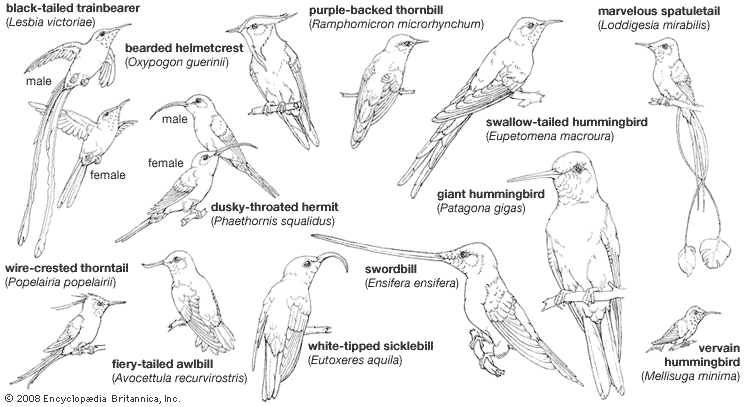

Specifically, the hummingbird is an animal associated with the character and sexual potency of the Sun, symbolizing sexuality (de La Garza, 1998: 129; Caja, 2012: 10). Similarly, this small bird is often associated with war and blood, as seen in Chichén Itzá, where its representations are linked to human sacrifice (de La Garza, 1998: 129; Caja, 2010: 10). This is due to one of the main characteristics of this bird, how it extracts nectar from flowers by inserting its long beak into them, comparing it with the spilling of blood (Caja. 2010: 10; Miller and Taube, 1993: 98). In some representations of the late Postclassic period in Chichén Itzá, the hummingbird is shown in a context of human sacrifice piercing through the heart of a person emerging from a flower (Miller and Taube, 1993: 98).


Figure 5. Some species of hummingbirds.
The hummingbird, known as tzunuun or dzunnuun by the Maya and uitzitzilin in some regions of Mexico, is one of the smallest and most fragile birds in Mesoamerica, also being among the fastest and most agile (Caja 2010: 9; Seller 1996: 230; de La Garza, 1995: 58). There are different varieties and types of hummingbirds throughout the Mesoamerican region, with various colors and sizes. On one hand, those that present a dark plumage with metallic green accents on their back and tail, called quetzaluitzilin; and on the other hand, tones more coppery and red, with a shiny appearance covering several parts of the body (Seller, 1996: 230). Despite its small size, they are very aggressive birds that lead them to confront larger species, hence their association with war and blood (Miller and Taube, 1993: 98).

There exists in Mesoamerica, generally speaking, a myth related to the sexual component of this bird. The myth depicts the story of a hero who transforms himself to try and seduce a woman (Chinchilla Mazariegos, 2010: 58). All variables of the myth culminate at one point, the creation of the Sun and Moon (Chinchilla Mazariegos, 2010: 58).
In contemporary times, this conception is still maintained in some places of Mesoamerica. According to certain studies of ethno-ornithology, several ritual forms have been shown where sacred animals are used; in this case, the hummingbird is used in love potions to foster desire in a loved woman and attract her.


Figure 7. Scene of a hummingbird or mosquito sucking from the breast of a woman. Taken from Chinchilla (2010: 46).
Conclusions
Studies related to the meaning of animals in Maya iconography are extensive, however, those specifically related to this bird are scarce and brief, with repetitive references. Therefore, it is complex to determine the depth of its significance. In other cultures such as Aztec, the hummingbird plays a more prominent role and the literature related to this bird is much broader. The landscape and environment in which these cultures develop significantly influence the creation of a specific imagery filled with animals and insects that inhabit that environment. At the same time, contemporary Maya societies still exist, helping to understand the symbolism of this bird, taking into account that concepts and beliefs evolve over time from being an animal of sex, blood, and war to one used for healing ailments, diseases, and awakening sexual desire.
Bibliography
Barrois, R. R. and Tokovinine, A. (2005). The Underworld and the Celestial World in Maya Ballgame. J. P. Laporte, B. Arroyo and H. Mejía (Eds.). XVIII Simposio de Investigaciones Arqueológicas en Guatemala, (2004), 27-38. Museo Nacional de Arqueología y Etnología, Guatemala.
Caja, A. (2010). Birds of the Prehispanic Maya. FLAAR Mesoamérica Association.
Chinchilla Mazariegos, O. (2010). Of birds and insects: the hummingbird myth in ancient Mesoamerica”. Ancient Mesoamerica, 21, pp. 45-61.
De La Garza, M. (1995). Sacred Birds of the Maya. Faculty of Philosophy and Letters and Center for Mayan Studies of the Institute of Philosophical Investigations of UNAM, Mexico.
De La Garza, M. (1998). Faces of the Sacred in the Maya World. Paidós, Mexico.
García Barrios, A. (2009). Chaahk and the Bird O’ in the Classic Period and Colonial Narratives. Estudios de Cultura Maya, 34 (1), 91-114.
Miller, M. and Taube, K. (1993). The Gods and Symbols of Ancient Mexico and the Maya. An Illustrated Dictionary of Mesoamerican Religion. Thames & Hudson, London.
Seller, E. (1996). The Animal Pictures of the Mexican and Maya Manuscript. Collected Works in Mesoamerican Linguistics and Archaeology, 5. Labyrinthos, California.
Taube, K. (1987). A Representation of the Principal Bird Deity in the Paris Codex. Research Reports on Ancient Maya Writing, 6. Center for Maya Research. www.mesoweb.com
West, G. C. and Butler, C. A. (2010). Do Hummingbirds Hum? Fascinating answers to questions about hummingbirds. Rutgers University Press, New Brunswick, New Jersey & London.


Comments