

The story of how the wreck was found and its archaeological and historical significance
Before discussing the discovery of the Nao San Juan, and recounting the history behind it, it is important to note that in the 16th century, the shipbuilding trade, like many others at the time, was passed down through families, and there was great competition among powers regarding naval technology, both military and commercial. These factors led to ship construction not relying on blueprints but rather on the knowledge of master craftsmen from various trades who collaborated in building a vessel.

Despite this being an advantage at the time as copying competitors' designs was much harder, today it poses a challenge because there is hardly any documentation about how these ships were built, their measurements, or construction techniques used. This is one of the main reasons why the discovery in Red Bay is so significant, as no better-preserved 16th-century wreck had been found until its discovery.
The story of the discovery itself deserves to be told, as it is one of those instances where what was found did not align with the initial objectives of who discovered it.
Selma Huxley-Barkham (born March 8, 1927 in London – died May 3, 2020 in Chichester), an English historian, traveled to Spain on behalf of the Canadian Public Archives with the goal of locating and making microfilm copies of any documents related to Canada's history. During her trip she visited several historical archives, including the Historical Archive of Guipúzcoa Protocols, in Oñate, where in 1971 she decided to settle down and begin an extensive study on the documents there.

It was this study that, in 1974, informed the Canadian archaeologist Robert Grenier of the existence of a wreck in Red Bay, information he made public in 1976 in his report to the Society for Historical Archaeology. In 1977 she would visit the site with James Tuck (director of the Memorial University archaeological team from St. John's), and in 1978 excavations finally began on Saddle Island, in Red Bay, resulting that same fall in the discovery of a wreck at 10 meters deep, which was ultimately identified almost with absolute certainty as the Nao San Juan, a whaler sunk there in 1565.
The resulting archaeological research would cover the summer periods from 1978 to 1985, all campaigns being funded by Parks Canada except for one exploration campaign in 1985, initiated by Selma Huxley-Barkham and financed by the Bilbao Chamber of Commerce and Navigation.
Excavation
Due to the low water temperatures in Red Bay, work at the site was limited exclusively to the summer season, with the use of a hot-water circulation system that circulated from the surface to divers' suits to prevent hypothermia.
In the 1979 campaign, sounding work began which allowed identifying the bow, stern and both sides of the ship, as well as recovering a large number of barrel fragments, a falconet and a capstan, along with other smaller objects.
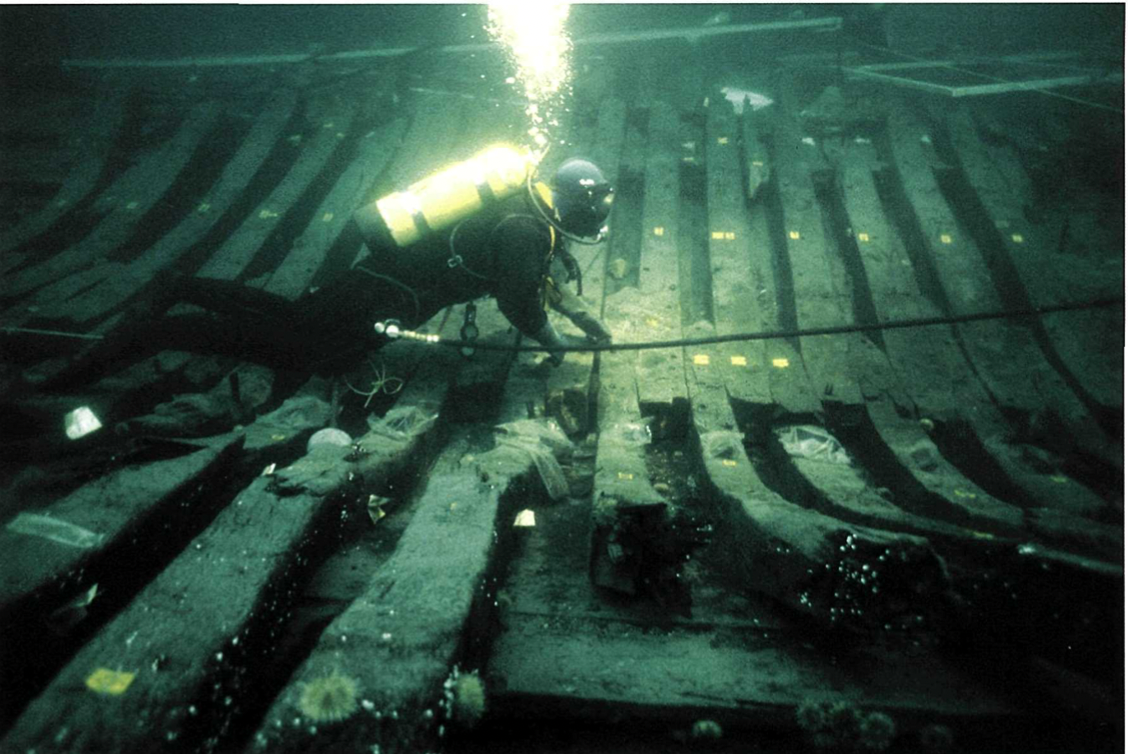
Subsequently, the 1980 campaign focused on delineating and drawing the vessel to later create a three-dimensional reconstruction. During this campaign and the next (1981), various aspects of the wreck were also studied such as barrel stowage in the hold, the pump system used for dewatering, rigging elements, and some crew items and tools.
Between 1982 and 1985, the wreck was meticulously dismantled to be later transported and studied on land, which allowed the creation of a scale model of the ship. Subsequently in 1985 all pieces were redeposited at the bottom of the sea, as archaeologists considered this the best way to preserve them.

During the six campaigns other wrecks scattered throughout Red Bay were also found, which have been partially analyzed, but not with the meticulousness applied to the San Juan.
The Nao
Thanks to all the information gathered by archaeological teams during these campaigns and other smaller-scale ones between 1985 and 1992, along with Selma Huxley-Barkham's archival studies, we now know that the Nao San Juan, built in Pasajes (Guipúzcoa) in 1563, was a medium-sized whaler measuring around 22 meters long and 7.5 meters wide with an estimated displacement of about 200 tons. It had a crew of 60 men, the capacity to carry nearly one thousand barrels of oil, and five whale boats. Its construction was mainly of oak, with a beech keel and spruce masts, and it is believed that the upper deck along with the highest part of the hull (the part not submerged in water) were made of pine.

Today we also know that building a ship like the San Juan generally took around six months, with master craftsmen from all trades collaborating on its construction along with a large amount of local labor.
These ships were built to make one or two voyages to Newfoundland in whaling expeditions, after which they would be sold and spend the rest of their useful life as merchant vessels on less demanding journeys.
Unfortunately for those involved in the whaling enterprise at the time, the Nao San Juan sank with all its cargo in Red Bay in 1565. However, due to the shallow depth of the sea floor where it sank, much of the cargo was recovered the following year.
Conclusions
As has happened in other instances, what was a tragedy or a hard blow for people at the time turns out to be a joy for archaeologists and historians. Thanks to the sinking of the Nao San Juan, and the conditions under which it sank, both physical (water temperature in the area, depth of the sea floor), as well as documentary (contemporary records mentioning the sinking and the cargo recovery operation), a lot was learned about shipbuilding at the time, as well as the 16th-century whaling industry.
It is worth noting that the project benefited greatly from support by several institutions both Canadian and European, along with meticulous work by researchers which allowed getting maximum use of a wreck in excellent condition and generating such an amount of data that even 30 years after excavation ended it was still being studied.
The magnitude of the project also resulted in a revolution in research on large ships built along the Cantabrian coast at the beginning and middle of the Early Modern period, leading to an increase in studies and articles published about a field that was largely unknown before the discovery of the Nao San Juan.
The discovery and subsequent investigation also had a significant impact on the Basque Country, where maritime heritage has been highlighted through various media. Perhaps the best example of this is in Pasajes itself, where almost five centuries later, a faithful replica of the Nao San Juan is being built at the Albaola shipyard-museum located in the same place where the original was constructed.
Bibliography
Government of Canada, P. S. and P. C. (2002). The underwater archaeology of Red Bay: Basque shipbuilding and whaling in the 16th century / Edited by Robert Grenier, Marc-André Bernier, Willis Stevens. : R62-389/2007E – Government of Canada Publications – Canada.ca. https://publications.gc.ca/site/eng/297479/publication.html
Barkham, M. (2018). Basque shipbuilding in the sixteenth century: The multi-purpose ship. Vasconia. Cuadernos de Historia-Geografía, 3, Art. 3. http://ojs.eusko-ikaskuntza.eus/index.php/vasconia/article/view/485
Garai-Olaun, A. A. (1990). Archaeological contributions and historiography on the Basque whaling phenomenon in American lands.
Vicente Maroto, M. I. (1998). Dialogue between a Biscayan and a Montañés about shipbuilding. https://iump.ucm.es/DialogycaBDDH/BDDH199/dialogo-entre-un-vizcaino-y-un-montanes-sobre-la-fabrica-de-navios/


Comments