

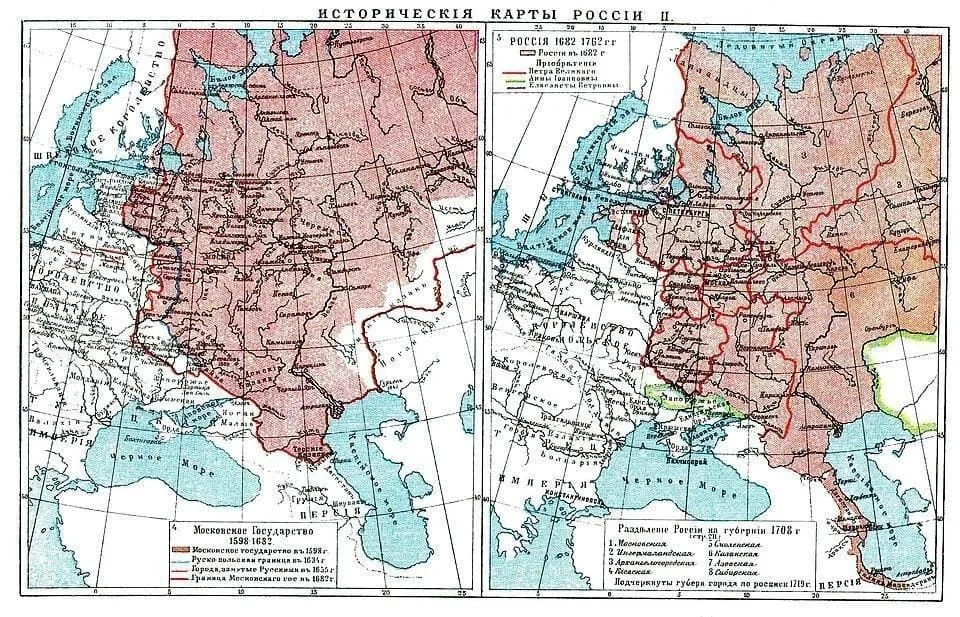
By the 15th century, what is now known as Russia was merely a principality with its capital in Moscow that controlled the area around its capital and its surroundings. This principality bordered the Golden Horde. Around the year 1430, this Great Horde disintegrated into various khanates: the Khanate of Kazan, the Crimean Khanate, and the Great Horde which controlled most of the Volga River until its mouth. By the year 1500, the Great Horde had split into two spaces: the Astrakhan Khanate and the Nogai Horde that controlled the Caspian Sea coast and various areas along the Volga River. Additionally, beyond the Urals lay the Siberian Khanate which controlled the plain between the Obi and Irtysh rivers (Bushkovitch et al., 2013, p. 55).
The Expansion
In 1547, Prince Ivan IV of Moscow, later known as "the Terrible," was crowned Tsar (a variant of Caesar). From this moment on, Russia began to expand its territory into neighboring regions and Asia. The first moves by the Tsar were mainly military. After a long conflict, Ivan IV conquered the Khanate of Kazan in 1552. Subsequently, after recovering from this campaign, he annexed the Khanate of Astrakhan and took control of the Volga River, which became its new natural border (Bushkovitch, Bevia Villalba, and Resines, 2013, p. 65-67). This territorial increase consolidated Russia as a major power that would gain more relevance in later times.
Decades after the conquest of the Khanate of Astrakhan, in 1581, the Cossack Yermak led 540 horsemen and 300 Russian mercenaries across the Urals and along river courses began the conquest of Siberia, where Tatars ruled. Yermak was funded by the Stroganovs, a wealthy family of merchants close to the Tsar. On July 26, 1582, Cossack Yermak triumphantly entered Qashliq (also called Tobolsk or Isker), the capital of Siberia, and took over the territory in the name of the Tsar. Thus, Russia's eastern border was extended to the location of present-day Krasnoyarsk (Bushkovitch et al., 2013, p. 70; Ruiz González, 2011).
After the conquest of the Siberian Khanate, colonization and conquest of territory east of the Urals began. Finally, around the 1640s, the territory expanded to the Pacific Ocean reaching the area of Khabarovsk. Years later, in 1689, during the reign of Peter I (and nominally Ivan V), the Treaty of Nerchinsk was signed between Russia and the Qing Empire. By this agreement, Russia renounced territories of present-day Primorsky Krai in exchange for a lasting peace with China. Additionally, the Yablonoi Mountains were set as the border between both empires. This treaty marked the first agreement between an European country and an Asian country (Ruiz González 2011, p. 1-2).
Bering's Explorations
At the beginning of the 18th century, various scientific research expeditions were funded to find out if Russia was connected with America. This was the main objective, but they also aimed at mapping and exploring the easternmost part of the Russian Empire. Of all the expeditions that took place, we will talk about the most important one: the one carried out by the Dane Vitus Jonassen Bering (known in Russia as Ivan Ivanovich Bering) to find out if Russia was connected with the American continent. This explorer undertook two major expeditions funded by the Tsars.
In December 1725, Peter I commissioned Vitus Bering to start a research project to find the limits between Asia and America. On January 5, 1725, Bering embarked on his journey to explore the Kamchatka Peninsula. He reached this peninsula in mid-1727 and explored it for three years. The following year, on August 17, Vitus Bering took a ship and sailed along the Asian coast until he arrived at the northeasternmost point of Asia and confirmed that both continents were not connected. After this discovery, in 1730, he returned to St Petersburg (Lauridsen, 2011).
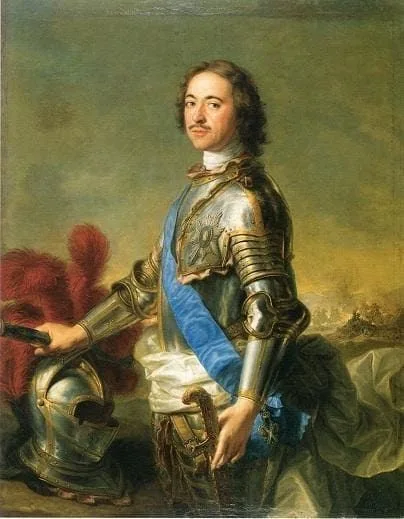
At the beginning of 1733, a second expedition began from St Petersburg to reach the Kamchatka Peninsula. Between 1736 and 1738, there were problems with the expedition due to disagreements with the Russian Senate over the excessive costs incurred by the expedition. In 1737, in the midst of conflict with the Russian Senate, the expedition reached the coast of the Kamchatka Peninsula. Over the next few years, the expedition prepared supplies for three ships. The plan was that one ship would head to Japan while the other two ships would sail towards American shores (Lauridsen, 2011, missing page).
After four years of preparation, in May 1741 they could set sail after breaking up the ice floating in the ocean. While one ship sailed for Japan, the other two ships headed towards American shores. On board one of them, the St Peter, was Vitus Bering. After months at sea without finding land, on July 18, 1741 they finally found land and arrived two days later. Over several months, the expedition traveled around these coasts discovering the fauna and geography of the place. In October of the same year, the expedition discovered the Aleutian Islands. Finally, at the end of that year, the expedition made its return journey. During the voyage back, Vitus Bering died and the expedition returned to Russia's capital in 1742 (Lauridsen, 2011, missing page).
Occupation of Alaska
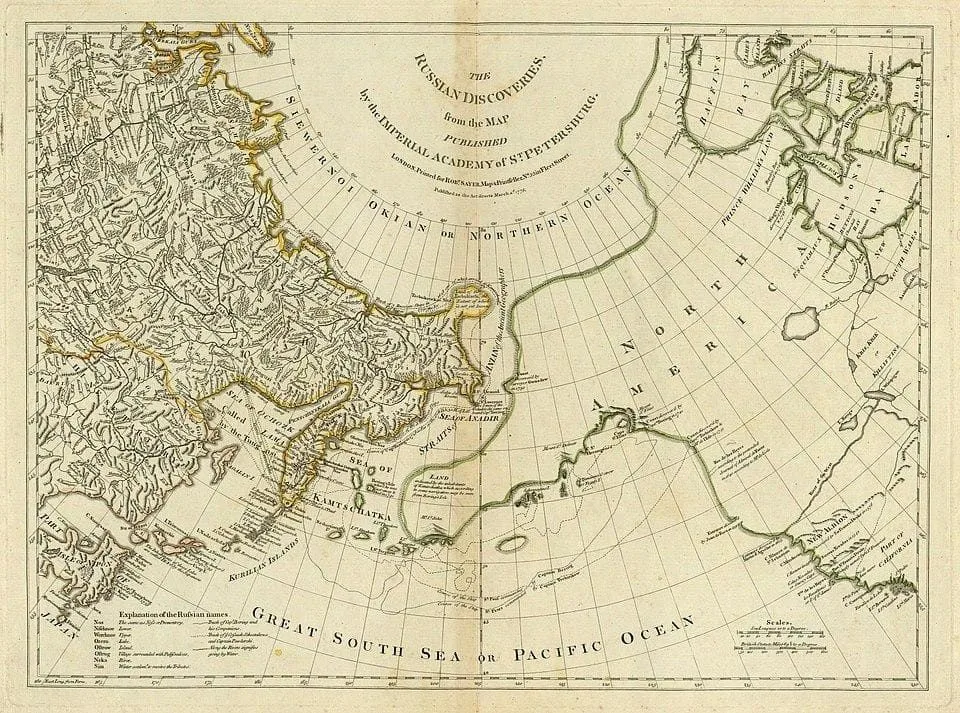
After discovering Alaska's coast in the middle of the 18th century, during the following decades and especially from the 19th century onwards, the Russian government funded various scientific expeditions to American shores and Pacific islands.
Towards the end of the 18th century, Russia extended its domains in North America from Alaska to Bodega Bay in California, coming into conflict with Spanish possessions in California (Owens, 2015, p. 9). For commercial and administrative control over these territories, the Russian government created the Russo-American Company which was mainly engaged in hunting and selling skins of various animals such as seals and foxes. This company also funded inland expeditions within these American territories and contact with tribes inhabiting these places on behalf of the government (Barratt, 1985; Owens, 2015). At the end of the 18th century, in 1799, Tsar Paul I granted a monopoly over the North Pacific to the Russo-American Company. This company attempted in the following century to create a powerful fleet with which it could control the area (Barratt, 1985, p. 100).
Finally, from the second half of the 19th century onwards, Russia entered an economically turbulent period and began to lose interest in its colonial possessions in North America. Thus, in 1857, some politicians recommended ceding Alaska territory to the United States of America. In 1867, ten years after these recommendations, Russia sold Alaska to the U.S. for $7.2 million (Owens, 2015, p. 275; Ziegler, 2009, p. 57).
Conclusion
Throughout this text, it has been observed how Russia expanded across the Asian continent, crossing the Pacific to occupy territory on America's northwestern coast. This was an incremental expansion, a result of territorial policy carried out over a long period, linked with the elevation of the Moscow principality to a Tsardom or empire. It is also worth noting the involvement of some individuals such as Vitus Bering. Maintaining this policy even during times of political turmoil may have been a factor that triggered the severe economic crisis faced by the Russian Empire in the mid-19th century, leading to the sale of Alaska and establishing its border at the Pacific Ocean.
Bibliography
Barratt, G. (1981). Russia in Pacific Waters, 1715-1825: A Survey of the Origins of Russia's Naval Presence in the North and South Pacific. University of British Columbia Press.
Bushkovitch, P.; Bevia Villalba, H. & Resines, A. (2013). History of Russia. Akal.
Lauridsen, P. (2011). Vitus Bering: The Discoverer of Bering Strait. Cambridge University Press.
Owens, K.N. (2015). Empire Maker: Aleksandr Baranov and Russian Colonial Expansion into Alaska and Northern California. University of Washington Press.
Ruiz González, F.J. (2011). The Far Eastern Russia: A Strength or Weakness for the Federation?, Instituto Español de Estudios Estratégicos, 7. http://www.ieee.es/Galerias/fichero/docs_analisis/2011/DIEEEA07_2011LejanoOrienteRuso.pdf
Ziegler, C.W. (2009). The History of Russia. Greenwood.


.jpg)

Comments