
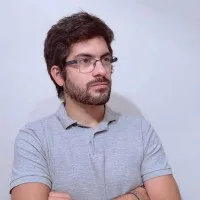

Josep R. Casals is an industrial designer and digital artist dedicated to historical 3D recreation. He may be one of the most recognized historical illustrators in Spain's national sphere. Among his works, we can highlight his collaborations with National Geographic Archaeology, English Heritage, or the recent virtual reconstructions of the Turuñuelo sacrifice within the "Last Days of Tartessos" exhibition at the Community of Madrid Archaeological Museum.
- The first thing we have to ask you is how did you get motivated to work in digital historical illustration?
First and foremost, thank you very much for your interest in my work and the way I approach this discipline. I've always been a history enthusiast but am not a professional in the field like many specialized disseminators, historians, and archaeologists who have taken the path of virtual reconstruction; I come from the industrial sector, but my proximity to architecture (also professionally) and my experience working with all types of 3D software during my career made me interested in this emerging sector at the beginning of the 2000s, which had some interesting yet little-known initiatives by the general public. I wanted to apply my technical and creative knowledge to something that was entirely new, especially in our country.
- As a designer and digital artist dedicated to historical illustration, what is your process or workflow for capturing the essence and authenticity of past sites and monuments in your virtual reconstructions?
The essential thing is having good documentation. I've done all kinds of work but lean more towards the type that allows a scientific approach, working closely with experts in each area, whether archaeologists or researchers on the site, or the top experts who, to be honest, I have had as directors and supervisors of my projects. It's important for me to visit the site whenever possible. Not always can it happen, but it is interesting to try to capture what the site conveys, see its topography and characteristics of the environment, etc., despite having to pay attention to the major changes that sites have undergone over the centuries in this regard.
- You've worked on a wide range of projects, from representing ancient cities to reconstructing specific buildings. Do you have any project that presented unique challenges and how did you overcome them?
The first large cities I reconstructed were real technical challenges; for example, when I worked on Babylon, I didn't yet have a well-developed method of work, and in the end, tools have their limitations and one has to find strategies that allow working on something so big. Over the years, I developed a system of work that I haven't stopped perfecting. Another major technical challenge was when I decided to work with Unreal; it offered great advantages but also significant problems to solve both technical and artistic issues because it represents a radical change in workflow. Working with real-time software is another world, and I launched two projects simultaneously which allowed me to experiment and develop a new system of work adapted to my new needs. These were the reconstruction of Turuñuelo, a pioneering project in Spain as a live archaeological site reconstruction, and La Garriga 1716 (Barcelona), where working along a road made it possible for me to work like in a video game with a closed space at street level. On another level, small-scale projects present another great challenge due to their high complexity and required detail; while reconstructing a city works on a more general level, but when reconstructing an archaeological piece such as those from Cancho Roano, one has to work very finely and precisely.
- In your opinion, what is the role of historical illustration and virtual reconstruction in preserving and disseminating cultural and archaeological heritage?
It's essential for dissemination to the public as a means by which people can value the past and develop an extended awareness that our history needs protection because we can learn so much from it. But also, working closely with researchers contributes to shedding light on aspects that would rarely be considered if not approached through reconstructive hypotheses. Often archaeological sites change their interpretation when their configuration is raised in height; I believe you don't fully understand a site until you think about the disappeared parts because they provide clues that were previously hidden.
- Historical dissemination is a powerful way to bring the past closer to contemporary audiences. What inspires you to continue working in this field and what do you consider the most rewarding part of your work?
My work with experts from all fields allows them better tools for disseminating their historical, archaeological or scientific work, and indeed it is very gratifying to see that it has a great impact on the public, both in terms of knowledge transfer between professionals of the same sector, or as general dissemination. One of the things that inspires me most is seeing people excited because they have seen for the first time what their own village looked like in the past, or an old building about which they had heard from their grandparents; often it has survived in living memory but no one could see or imagine how it was at its moment, and creating an image that can be internalized, even if only as an approximation, is very exciting.
- Advances in technology have allowed greater precision and detail in virtual reconstructions. What technological advancement has most impacted your way of working and why?
Without a doubt, Real-Time Rendering is what has had the greatest impact on my way of working and approaching the immediate future. Up until now, I had been evolving in how to work but step by step, always looking to improve details, do more extensive and complex works, etc. But it was an evolution at a slow pace. Working with a video game engine (Unreal Engine) has changed everything because it means another way of approaching world creation. Now it's a dynamic world, not a model that takes ages to build only to finally put cameras and render for excessively long calculation times. And this dynamic world is limitless; just as we interact in a video game, we can make this virtual environment more complex and reactive over time. As with everything, one has to advance step by step and not lose sight of the path taken at each decision because technology evolves very quickly and it's important to be attentive to the direction you take at every decision; but according to project goals and for reasons of time, this system of work cannot be applied to all cases, so I'm still in a transitional phase.

- Based on the different historical era-related projects you've worked on, do you have any particular period or site that attracts you especially and which you would like to explore further in the future?
I've been lucky enough to jump around a lot between eras from Tartessos to the Spanish Civil War passing through the Middle Ages, but due to the great profusion of Roman sites and cities, and their more precise knowledge, that period is what fills our work calendar today in our country. I would love to explore the Neolithic and generally continue delving into protohistoric societies where there's still a lot of work to be done.
- The representation of historical heritage also has significant educational impact. What strategies do you use to ensure that your reconstructions are informative and reliable from a historical perspective?
I always work under the direction and supervision of experts since I don't work on my own research projects; in virtual reconstruction, I always work by commission and logically no project is free of all doubts because everything evolves and is subject to new interpretations. We are always working in the realm of hypothesis, and not all experts agree 100% on everything, so there may be opinions that differ from solutions adopted in a work because decision-making itself is an assumption. Sometimes not taking a stance on a specific topic due to being risky can also be right or wrong; but we strive always for maximum historical rigor. On the other hand, there's the educational aspect: sometimes those of us working in 3D get lost in this search for hyper-realism and it's a mistake because realism is good up to a point as it immerses the observer into an environment that could have been real; but hyper-realism isn't the goal, we're not making movie special effects (nor do we have the budget for them), so we must seek a point where this reconstruction is attractive and plausible, but also explanatory and easy to understand visually.
- In your experience, how has public perception towards history and cultural heritage changed with the use of virtual representations and new technologies?
There's a noticeable demand for digital experiences. In my opinion, good illustrations and even traditional models still enjoy great acceptance because they have that artistic touch that digital reconstructions don't transmit; they have something more human about them. But increasingly the public is asking for technologies used in their daily lives: new generations have grown up with video games and more recently virtual reality and augmented or extended reality, and logically these are other communication channels to explain history and heritage as traditional techniques and media were before. If we can better explain what we want through technology and also attract a younger audience because we speak their language, we come out ahead. The problem of new technologies is that they have other barriers at the level of investment and hardware maintenance which make it difficult for them to be incorporated into museums due to constant updates and costs.
- Currently, artificial intelligence has revolutionized many industries including design and visual representation. How do you think AI could contribute to the dissemination and representation of historical heritage in the future?
AI has two sides: one is easy and direct creation with text generators, image generators, audio generators, video generators; there are no limits now. But we shouldn't be impressed by these tools that create out of nothing but without creating because an algorithm doesn't know what it's doing; it only responds to prompts and a stochastic process in which the user guides but does not control or use their creativity. Virtual Reconstruction is a complex process involving many factors, research, decision-making, and creation under certain premises; it's both creative and rigorously scientific at the same time, and an AI is very far from being able to do that. On the positive side, however, AI applied to work tools allows us to accelerate processes that were manual or tedious before, or even improve results of processes already more or less automated. So we are sure it will give us many working tools in the next few years which will allow us to work better and faster.
- Through social media, we've seen that you have experimented with AI tools as a digital designer and artist. Do you think AI can improve or speed up certain aspects of the creative process in virtual reconstruction of historical sites?
Yes, one has to forget about AI as a tool that will give you ready-made work without any effort; but there are multiple applications in many working processes where its potential is starting to be glimpsed. Perhaps it still needs some time, but already it can help with texture creation and other processes which have been assisted by AI for some time now and are currently improving greatly, such as automatic UV creation, retopology, etc. So we'll see how more and more processes will speed up or automate and become increasingly perfect; but more in the technical than artistic realm, I think.

- Virtual reality and augmented reality are technologies gaining popularity in historical dissemination. How do you see the role of AI in improving these immersive experiences for the public?
AI has applications in all areas, and it will likely have them in immersive experiences as well, improving aspects of interactivity that allow more realistic experiences; taking a step further than what we call gamification, which currently limits itself to extending information offered by the view and some limited interactive elements like video games. But one could imagine perfectly in the future an interaction deeper, for example with characters reacting intelligently to our questions.
- As AI becomes more advanced, there's concern it may be used to generate false or manipulated content, even in historical contexts. What measures do you think should be taken to ensure the integrity and authenticity of virtual representations of cultural heritage?
It's a complex issue; we're seeing technology always ahead of law, user protection, and ethics. AI has been developing for years but has recently exploded strongly, giving rise to a commercial war which is ultimately the mother of all problems. Whatever entertainment companies put in users' hands and long-term benefits that technological development may bring to the industry, we must not forget it's a power struggle between big companies to be the most powerful. We've seen how Nvidia became a giant, and its motivations go beyond making us happy with their graphics cards. I allow myself some sarcasm because beneath all this is a great commercial and technological war that if at any point finds a better field of play to focus on, will leave users who hope to develop a profession with these technological tools behind. Returning to the topic, I don't see an applicable response to ensure AI-based tools are used correctly to avoid fraud or falsification in heritage fields. There's no body that can prohibit or limit their use for certain applications if it doesn't infringe any law because it's an ethical issue beyond well-known debates on copyright over images with which AIs are trained, another topic.
- In your experience, have you seen any example of AI used for conservation and protection of historical heritage? How do you think these technologies can contribute to the preservation of archaeological sites and cultural artifacts?
So far I haven't seen anything in terms of creating virtual reconstructions or images that would help disseminate culture and heritage without falling into falsehood and perpetuating myths or a distorted image by cinema. On the contrary, I'm sure tools are being created which will be applicable to conservation of archaeological sites and pieces from a technical point of view. We should think of AI as a great tool for analyzing, categorizing, ordering, classifying, and aiding decision-making more than as something to create beautiful images.
- As AI advances, some people fear virtual representations may replace or devalue physical visits to historical sites. What's your opinion on this? How would you balance the digital experience and the physical one?
More than devaluing I believe they do the opposite; we see wonderful things every day in social media and want to go there, and technology may help preserve them if it offers sufficiently realistic visits. We live in a globalized world with tremendous human mobility; just look at the limitations that have had to be applied to places like Machu Picchu because annual visitor numbers could end up destroying an archaeological site. The ethical debate is evident: we often think there are too many tourists everywhere, but everyone is a tourist when they go somewhere else. The digital experience offers the possibility of visiting a place who wouldn't otherwise have resources to do so for whatever reason; that's a benefit for cultural dissemination and also a source of economic revenue. Traveling virtually? It's already possible with current technology limitations, but it will improve by leaps and bounds. I'm a firm defender of physical visits to sites, obviously nothing beats feeling the breeze and smell of local vegetation or absorbing what stones convey which were carved by someone 2000 years ago; but if in the future technology allows for such immersive experiences that they start resembling reality? Would it allow preserving sites reducing visitor numbers to a minimum? It may be what saves them because, in my opinion, put simply, there are too many people on earth and everyone has the right to culture and travel, no one can decide who is fit and who isn't; nor should prices and limits be set to limit visitor numbers because it would result in classism whichever way you look at it.

- To wrap up, how do you envision the future of historical heritage representation with continuous AI advancement? Do you believe this technology will open new creative and educational possibilities for historical dissemination?
Well, I think the future won't be dominated by senseless creation artifice that we're seeing currently; at least I hope it passes a bit out of fashion and applications are more practical and well-focused. There's an actual problem currently with uncontrolled proliferation of images created with AI, obviously not labeled, filling social media and starting to retroactively train new AIs with images created by other older (and thus worse) AIs, leading to a kind of corruption of image banks. So the challenge now is in education where we have to give valid tools to students so they don't fall into indiscriminate use of uncontrolled images or create their own without rigor. But it's obvious that creative possibilities at an educational level opened up with technology are currently unimaginable; only time will tell what we're capable of doing positively.
- And lastly, do you have any advice or message for young people interested in pursuing a career in design and historical heritage representation?
I won't get philosophical. To those young ones who want to start, first of all, they should keep learning and accept that technological change is vertiginous; we'll live more and more in uncertainty and changing direction constantly. Perhaps I'm already talking about a significant generational leap here but can say changes around 3D technologies have been greater in five years than the previous twenty-five. We know technological development follows an exponential curve according to Moore's Law and Kurzweil's accelerating performance law, but the pace of novelty we need to absorb and incorporate is coming at a rate that surpasses the rhythms proper to work between teams, institutions, companies, etc. I've worked on projects with rhythms not their own industry; where four versions of Unreal Engine could have passed from start to finish, with all their changes, improvements, and uncertainties in development of technology which always seems to be experimental state. Adaptability and understanding technology are the keys for the future, indeed in all professions but especially in our field where we're at the mercy not only of industry turns but also that these will obey more macroeconomic interests than market direction that theoretically should mark users' interests. But I encourage them to embark on this profession because if the present, in terms of technology applied to heritage, is exciting, years and decades are coming when we'll see things we can't even imagine at that moment.
You can find more information about Josep R. Casals through his profiles and projects:
LinkedIn: https://www.linkedin.com/in/jrcasals/
Instagram: https://www.instagram.com/jr.casals/
Behance: https://www.behance.net/jrcasals
Facebook: https://www.facebook.com/jrcasalsart


Comments