


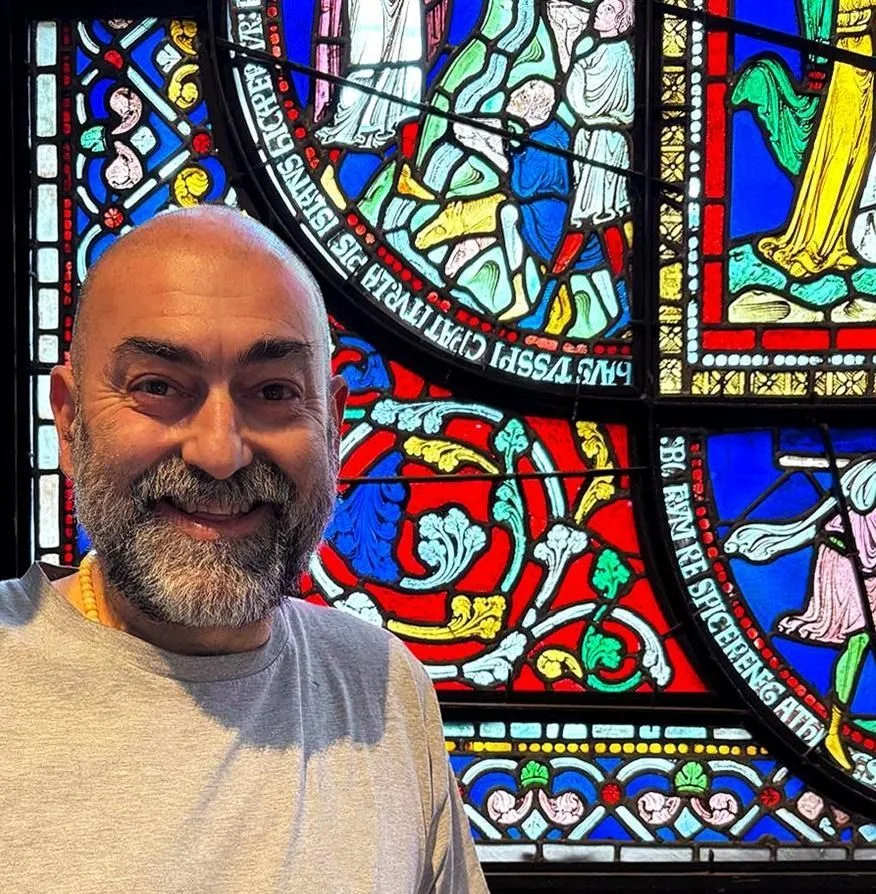
Fernando Cortés Pizano is a graduate in Geography and History (specializing in Art History) from the Universidad Complutense de Madrid, and he holds a Master's degree in Fine Arts (with specialization in Conservation and Restoration of stained glass windows, from the Royal Academy of BB.AA. in Antwerp, Belgium).
Since 1994, he has participated in various projects for the conservation and restoration of historical stained glass windows both in Spain and abroad. In 2012, he moved to England where he worked on the cathedrals of Lincoln, York, and since 2015 until now, Canterbury Cathedral. In 2018, along with other professionals specializing in stained glass windows, he founded ARCOVE, an association for the restoration and conservation of stained glass windows in Spain, of which he is currently president.
- To begin with, we would like to know more about the person behind the professional. Where does this interest in conservation and restoration come from, and specifically why stained glass windows?
To understand my interest in conservation and restoration, I need to go back to my undergraduate years studying Geography and History with a specialization in Art History at the Universidad Complutense de Madrid. During that time, I befriended two classmates who had previously studied Conservation and Restoration of Cultural Assets, and it was there where my orientation towards a more practical profession began, one in which I could have direct contact with works of art while also contributing to their conservation. My attraction to stained glass windows and their conservation emerged a few years later, between 1993-1994, during the time I spent (as a conscientious objector) at the ICRBC (Institute for Conservation and Restoration of Cultural Assets) in Madrid, which was later renamed IPCE (Spanish Institute of Cultural Heritage). There I met biologist Nieves Valentín, who at that time was organizing the international seminar "Conservation of Historical Stained Glass Windows," held at the Universidad Internacional Menéndez Pelayo (UIMP) in Santander from July 4 to 8, 1994. This was my first encounter with stained glass windows. And it was love at first sight. As secretary of this seminar, I established a good relationship with Professor Joost Caen, who encouraged me to pursue studies in Conservation and Restoration, specializing in stained glass windows, which he directed at the Royal Academy of BB.AA., University of Antwerp (Belgium). So, as said and done, I followed his advice and studied from 1994 to 1998. Since then, stained glass windows have been my passion and profession.
2. Could you tell our readers about the restoration process of a stained glass window? What criteria are followed to decide when intervention is necessary?
The restoration process of a stained glass window can be more or less complex, depending on the general pathologies encountered in each work and its materials such as glass, lead cames, pictorial layers, supporting metal elements (ferramenta), and sealing materials. In general, every intervention begins and ends with a detailed documentation process for each panel of the stained glass window, its state of conservation, and all processes and actions carried out. The most common interventions are restoration of fractures, bulging or loss in the lead cames network, cleaning, and repair of fractures or losses of glass pieces. We also face issues such as consolidation of pictorial elements with adhesion problems and recovery of general readability in the work. Other frequent interventions include treatment of oxidation and corrosion of ferramenta or replacement of mortars and putties. All this without forgetting preventive conservation of the stained glass window, for which we resort to methods such as installing meshes or protective glazing.
Each intervention must be preceded by a rigorous study process during which, based on the condition of the work, it is decided what are the most advisable treatments. In general, the criteria followed in every intervention could be summarized, without exhaustive intent, as follows: interdisciplinary teamwork; rigorous study and documentation of the work, its state of conservation, and each process, material or product used; respect for the values of the work; minimal intervention; reversibility of applied treatments (recently this concept has been replaced by "retratability" and "eliminability"); discernibility of additions; prioritization of conservation over restoration; avoidance of hypotheses and speculation.
3. How do you balance historical conservation with the need for structural stability? To what extent do you use scientific or digital analysis in the process?
As happens with most supports, especially immovable property, during the conservation and restoration of stained glass windows we seek a balance between preserving original materials as much as possible and ensuring maximum stability of the work. On occasions, these two objectives can conflict and concessions must be made. This is particularly true with the lead cames network of stained glass windows, which acts as the real support for the glass pieces. The general rule is not to re-came panels, that is, not to replace the lead cames unless it is strictly necessary. However, there are situations in which a complete or partial recamming of a panel is the most recommended option to ensure stability of the work. In this regard, we must not forget that stained glass windows constitute the fine barrier separating the interior from the exterior of a building and that they stop and absorb all elements and agents coming from the outside. Considering that the thickness of the glass pieces usually ranges between 2 and 4 mm, it is essential for the lead cames to be in good condition and able to act as support for the glass pieces. Unfortunately, the practice of recamming stained glass panels has been very frequent among glaziers, often without real reasons for doing so, and thus emplacement is undoubtedly the original material of stained glass windows that least has reached us.
Regarding the second part of your question, on occasions during the intervention process in stained glass windows, scientific or digital analysis is indeed resorted to, although its use is not as frequent as it could be for other supports, at least in Spain. In countries with a greater tradition in the study and conservation of stained glass windows such as the United Kingdom, France, Germany, Netherlands, Belgium, etc., it is more common to resort to scientific studies of works before, during or after an intervention. The use of these technologies often depends on various factors such as characteristics of the work, project execution instructions, public valuation of this, type of contracting entity, available budget and execution deadline.
4. Since 1994 you have been involved in various projects both in Spain and abroad. Is there any that has marked you particularly?
It is very difficult to highlight a single project that has marked me especially during the 32 years I have been practicing this profession. Since I finished my studies in Antwerp in 1998, there have been several projects where I worked and which, for one reason or another, had special significance for me. If I were to highlight some of them chronologically, perhaps the first would be related to my stay at Glasmalerei Peters (Paderborn, Germany) between 1999 and 2001, during which I had the opportunity to work on two stained glass windows from the 15th century by Enrique Alemán in Seville Cathedral, and the two rose windows from the 15th century at Girona Cathedral. The second would be the famous Dean’s Eye rose window from the early 13th century in Lincoln Cathedral (England), where I worked for the first time between 2004 and 2005. The third must undoubtedly be the restoration of all the stained glass windows on the main facade (from the 15th, 19th, and 20th centuries) of Barcelona Cathedral in collaboration with Adfort company from Valencia in 2010. And finally, I cannot leave out of this selection the large south window of Canterbury Cathedral (England), dating back to the 12th, 13th, and 15th centuries, which I worked on between 2015 and 2016. However, it should be noted that this selection does not include other very interesting projects in terms of study, technical direction, supervision, advice or teaching, which have also marked me deeply and helped shape my professional career.
5. What does working at a place with such spiritual and historical weight as Canterbury Cathedral mean to you?
Working in Canterbury has been, and continues to be, an enormous pride and milestone in my professional career, not only for its spiritual and historical weight but especially for the quality and quantity of its artistic legacy and the great importance of the stained glass workshop. From a historical and religious perspective, Canterbury Cathedral, founded by St Augustine in 597 AD, constitutes the most sacred temple in English history. It is much more than the seat of the Archbishop and the mother church of the Anglican communion: it is the spiritual epicenter of Christian faith in England. However, from an artistic, professional, and human perspective, working at this cathedral has been without a doubt a dream come true. I continue to learn and enjoy every day on the job, surrounded by an excellent team of colleagues, and for me, that is priceless.
6. We also have considerable stained glass heritage in Spain. Do you find differences between the development of this discipline in Spain and England?
In fact, we do have a considerable stained glass heritage in Spain, almost comparable to that of the three main countries in this regard: France, Germany, and England. However, this heritage is unfortunately little known and studied, and therefore undervalued, disseminated, and protected. The differences between both countries in this field are several and go beyond conservation-restoration. Perhaps the most important one lies in the greater appreciation "popular" that exists for stained glass art in England. In other words, stained glass as an artistic manifestation is much more known and valued by the general public. This stems from a greater presence of this art in society, from the grassroots to university education. In England there is a greater presence of stained glass in museums, exhibitions, schools, publications of general interest or dissemination, media, courses, guided tours, promotional activities, etc. Such greater presence translates into our profession as greater economic investment in conservation-restoration projects, much more sensible and generous deadlines for execution, greater control and supervision of interventions carried out, and greater visibility of these projects in the media. To reach this level in Spain and ensure the survival and transmission of this art, it would be necessary to encourage study and research at training centers and R&D institutions, as well as in companies and other public and private entities. Additionally, it would be advisable to promote meeting spaces such as congresses, conferences, seminars, debate forums, courses, specific publications, dissemination exhibitions, etc. Precisely, from ARCOVE, the Association for the Restoration and Conservation of Stained Glass Windows in Spain, which I have the honor of presiding over, we have been working intensively for several years to make visible the need to study, inventory, and conserve our country's stained glass heritage.
7. What are currently the greatest threats to historical stained glass windows? The flow of tourists can modify the interior microclimate of buildings. To what extent does daily visitor presence alter the environmental conditions that stained glass windows need to be preserved?
All these circumstances, such as human presence, climatic conditions, or building's internal microclimate are indeed important factors of deterioration. Nevertheless, in my opinion, curiously enough, the greatest threat for stained glass windows in Spain lies more in the lack of knowledge about this art and the apathy on the part of authorities and custodians of our heritage. Stained glass windows often go unnoticed by most visitors to our major monuments. When I started in this profession in the 1990s, I traveled a lot through Spain and Europe visiting the main monuments with stained glass windows, and seeing the lamentable state of some of our most important complexes such as the cathedrals of Segovia, Salamanca, Astorga, Toledo, Granada, Oviedo, Huesca, Girona, Tarragona, or the Monastery of Santes Creus, among others, comparisons were inevitable. I often found myself saying with frustration: "Does no one notice, does no one look up, is nothing going to be done?" Looking back, I see myself reading with great fascination articles by Víctor Nieto Alcaide about Flemish, German or French artists who made numerous stained glass windows in Spain during the 15th and 16th centuries, unique in Europe, and thinking "what a pity and what shame, how have we allowed these incredible works of art to end up in such a state?" Quoting Leonardo da Vinci when he said that "one cannot love what one does not know, nor defend what one does not love," this maxim applies perfectly to cultural assets and, specifically, stained glass windows. Knowing, understanding, and valuing the different manifestations of our history, culture or heritage generates a sense of belonging, identity, and therefore a natural desire and impulse to care for it, preserve it, and disseminate it.
8. You are president and founder of ARCOVE, the Association for the Restoration and Conservation of Stained Glass Windows in Spain. Where did the idea come from to start this association? What are its main objectives?
ARCOVE was born in 2018 during a course on conservation and restoration of stained glass windows held at the School of Historical Heritage in Nájera (La Rioja), which I directed, and it is the result of the enthusiasm of a group of professionals interested in raising awareness about Spain's important stained glass heritage, its inventorying, valuation, protection, and conservation.
In ARCOVE we have a series of very specific objectives such as better promoting knowledge of Spain’s important stained glass heritage, improving legal protection, conservation, and the quality of restorations carried out, working for the creation of official higher education studies in this field, and achieving professional recognition for this group.
Among ARCOVE's main achievements over its eight years of existence, we must highlight the drafting of the "Nájera Charter on Stained Glass Windows" in 2023, a document of great importance to all those dedicated to the study and conservation of historical stained glass windows in Spanish-speaking countries, which can be read at this link: https://arcove.org/wp-content/uploads/2025/10/carta_najera.pdf
Another of ARCOVE's great achievements has been the creation of "ARCOVE The Magazine," a free online publication that already counts with 11 published issues. ARCOVE The Magazine is the only publication in Spanish dedicated to the study and dissemination of stained glass windows, both historical and contemporary, and can be accessed at this link: https://arcove.org/revistas-publicadas/.
Finally, in 2025 ARCOVE promoted the publication of a technical book titled "Historical Stained Glass Windows: Study, Cataloging and Conservation," edited by the University of Granada Press and directed by Teresa Palomar Sanz, which brings together the work of leading experts in this field in Spain, and is available at this link: https://editorial.ugr.es/libro/vidrieras-historicas_139656/
9. To conclude, what advice would you give to someone interested in dedicating themselves to conservation and restoration, specifically focused on stained glass windows?
The choice of a profession or specialty is a very personal matter, and I believe it should be the result of an attraction and passion for a specific topic, some kind of "call." That has been my case, and I believe it is also true for most people who dedicate themselves to conservation-restoration. It's a fascinating profession that gives us many satisfactions, but it's clear one doesn't enter into it with the aim of enriching oneself or achieving fame and prestige. My advice for someone interested in dedicating themselves to conservation and restoration, as well as for all those who have been working in this field for years would be: be humble and generous, share your knowledge however you can with those just starting out because much of the wisdom and skills are based on collective rather than individual efforts. Also, never think that you know everything or that you can face anything alone. The materials and situations we encounter are very diverse and we must adapt ourselves, we need to be open to accepting our limitations, seeking help when necessary, being willing to correct if needed, and especially continuing to learn day by day, year after year. And of course, always advise being curious, learning languages, visiting other workshops, and keeping an open mind so as not to close yourself off from solutions and approaches that at first might seem foreign to you. And above all, surround yourself with a good human team. The work will be much more pleasant and fun.
In the case of stained glass windows, I suppose something different attracts each person. It's a profession where mastering the "craft" is very important, that is, all the traditional and modern techniques that allow us to understand how each work was made and restore it taking well-reasoned decisions. And then there's an artisanal part, almost organic or bodily, which makes this task unique. Fortunately, in this field, AI still cannot replace most of what we do with our hands. In my case, as the years go by, I enjoy more and more the physical work on scaffolding, disassembling a stained glass window and reinstalling it once restored. It's at the connection with the window and the building where everything makes sense and where I find greater satisfaction, where I feel closer to the glazier who created that work years or centuries ago. And I can assure you that this feeling is absolutely fascinating, almost mystical, and I fear only those of us dedicated to what for me is one of the most beautiful professions in the world can experience it.
You can find more information about Fernando Cortés Pizano through his profiles and projects at:
LinkedIn: https://www.linkedin.com/in/fernando-cort%C3%A9s-pizano-17b8783ba/
Facebook: https://www.facebook.com/vidrierasfernando.cortespizano
Academia.edu: https://independent.academia.edu/VidrierasFernandoCort%C3%A9sPizano
Interviewed by:
María José Minuesa Grau
Director of Arqueo Times
Design Area
Mª Dolores Rodas Romero
Communication Area


Comments