

In recent years, historiography has taken significant strides in studying the role of royal women in Western Europe during the Middle Ages. Their importance, both politically and culturally, is increasingly being recognized. In the Hispanic context, and more specifically for Castile, until a few years ago, there were only a few female figures from the royal family that had been subjects of study. However, in recent years, more studies have emerged analyzing their roles, renewing the view of the almost secondary and limited part they played.
For this reason, following the same line of thought, it seems necessary to go back to Castile in the second half of the 12th century and analyze one of its great figures: Leonor de Plantagenet.
CHILDHOOD AND EDUCATION
The beginnings of Leonor de Plantagenet's journey in the earthly world must be placed in September 1161, when her mother, Eleanor of Aquitaine, gave birth to the young princess. The birth took place in Domfort, a town located in the Duchy of Normandy, north of France, territory that belonged to the Plantagenet family and which her father Henry II had consolidated during his expansion phase over Capetian France. Leonor was the sixth of the siblings and the second daughter of the aforementioned Henry II and Eleanor of Aquitaine, probably the two most powerful people at the time, thus being born in the midst of the great ruling families of Western Europe.
Although chroniclers from that era and some historians today are more concerned with studying adulthood, it is indeed difficult to understand the personality and actions of individuals without considering their childhood. In this way, and delving into this matter, it should be noted that the first years of life of our protagonist took place between France and England. It's worth noting that at the time, the Plantagenet family, also known as the House of Anjou, which ruled in the Kingdom of England, was at war with the Capetian family, ruling in the Kingdom of France, over continental territories that the former held on French soil. The fact that Leonor, being a child, traveled through her parents' various domains was very important because it helped her acquire a formation that she would later embody as Queen of Castile.
The travels that Leonor made as a child were accompanied by her mother and her elder sister Matilda. Both exerted great influence over her, forging a unique personality that was to be demonstrated in the future. Without going into details, we know that in January 1163 they undertook a journey to England. They stayed there for nearly two and a half years, visiting practically all of the territories of the kingdom, although it is also known that they spent certain moments in Winchester, south of England, where the royal family had one of their residences. After her tour through England, Leonor returned with her sister and mother to France, specifically to Rouen, where negotiations were being finalized by her parents for Matilda's marriage to Henry the Lion, Duke of Saxony and Bavaria. Once the agreement was sealed, Leonor returned to England in autumn 1166, celebrating Christmas with family in Oxford. Our protagonist would remain in English territory throughout all of 1167. During this period, the future Queen of Castile witnessed her mother meticulously preparing the nuptials for her elder sister. Although at that time she was a mere six-year-old girl, this event marked her profoundly, not only emotionally as she was going to "lose" one of her main supports but also because the preparations were to be of immense influence on her subsequent marriage with King Alfonso VIII of Castile.
After her stay in England at the end of 1167, the royal family returned to continental territory, spending Christmas that year as a family in Argentan, a town located in Normandy. From there she traveled to the county of Poitou, where she practically settled for the next two years, residing almost constantly in Poitiers, the capital of the county, although it is known that Leonor traveled with her mother throughout the county, learning the administrative duties her mother carried out in these territories. This period was also crucial in Leonor's life because at that time, the lands of said county were renowned for being among the richest in Western Europe, both economically and culturally speaking. Furthermore, the similarities between these territories in terms of climate and culture with northern Spain made it easier for her adaptation once she arrived in Castile.
During her stay in Poitiers, young Leonor completed her education, an aspect that had concerned her parents from the very beginning. There is no doubt that our protagonist received a high level of education with the aim, like the rest of her siblings, to prepare them for the roles they were destined to play upon reaching adulthood, always within the upper echelons of society. Based on a moral and religious education, Leonor completed her formation through various intellectual activities, especially reading, narration, and recitation, in which the Plantagenets had a great reputation. This was aided by the fact that life at court in Poitou transpired joyfully, at a pace of feasts and tournaments, to the sound of the viola, lute, and cittern giving importance to other activities such as music, always associated with those mentioned.
The education of Queen Leonor in court was an undeniable fact; however, there are certain doubts about whether it was the only place where she ultimately formed. In this sense, it is likely that our protagonist, like some of her siblings did, also received formation at the Abbey of Fontevrault, located in the county of Anjou. There is no documentary evidence to confirm this, so lacking studies that prove otherwise, such association is based solely on Leonor's patronage towards the abbey once she became Queen of Castile and the similarities between the abbey and the great project of the kings of Castile: the monastery of Santa María la Real de las Huelgas in Burgos.
MARRIAGE AGREEMENT AND ARRIVAL IN CASTILE
After a little more than two years, in June 1170, the young Leonor traveled to Bordeaux, where negotiations were finalized for her marriage with King Alfonso VIII of Castile. The meetings reached a successful conclusion, thus committing her future to the Castilian king.
Once the terms were settled, Leonor was entrusted to the care of the envoys sent by Alfonso VIII. The royal delegation that King Alfonso had sent for the marriage was extensive, a large roster of clerics and nobles, among whom stood out Don Cerebruno, Archbishop of Toledo or Count Nuño Pérez de Lara, who served as regent in Castile during the king's minority. It is clear that the marriage was arranged for political and dynastic reasons and that the Anglo-Castilian alliance was beneficial to both parties.
Leonor, along with her entourage, arrived on the peninsula in September 1170. She could have made the journey through the Aragonese border via Jaca and Somport since at that time Castile and Aragón were experiencing a period of peace and friendship. She was received in Tarazona by her future husband and immediately preparations for the ceremony and wedding festivities began, details of which we will not delve into.
Castilian chronicles from that era reflected Leonor's qualities upon her arrival. The Latin Chronicle describes how Leonor was "of noble lineage, chaste, pure, and very wise." The Chronicle of Twenty Kings portrays Leonor as a woman "very sensitive and wise, knowledgeable, good, eloquent." Meanwhile, the First General Chronicle reflects that Leonor was "educated in an exquisite manner, she was calm and tranquil, singularly beautiful, very charitable, very good with her husband, and very respectable in all relationships she maintained with people of her sphere, treating each one according to their class." All this shows that Leonor could fulfill the roles of queen, which in Castile, as well as in other peninsular kingdoms at the time, not only entailed bearing an heir but also directing the household and protecting religious institutions, as well as influencing various members of the royal family and getting involved in political affairs, whether they affected her personally or not. Therefore, it is no surprise that from her first moments in Castile, Leonor had a desire to assert her power and influence not only on the political and economic stage but also culturally.
THE LEGACY OF QUEEN LEONOR
Unintentionally, our protagonist began to leave her mark upon becoming Queen of Castile. How? The name Leonor, unknown until then in Castile, was introduced this way into the Castilian royal house and today forms part of the Hispanic onomastic heritage more so than that of other countries. For instance, the future successor to the Spanish throne bears the name Leonor due to this tradition of naming heirs with their ancestors' names, being in the future the first queen by right of blood to be called by this name.
But if we are to analyze the imprint left by our protagonist in the Hispanic world, we must focus on two examples: the expansion of devotion to Thomas Becket, a deceased archbishop of Canterbury, and the foundation and subsequent promotion, alongside her husband Alfonso, of the monastery of Santa María la Real de las Huelgas in Burgos.
To understand the role of the queen, it is important to note that during the 12th and 13th centuries, practices of patronage by queens and nobles began to generalize, expressing their power and authority. In essence, a vehicle through which they could make themselves heard and noticed. Furthermore, these practices had an important spiritual component if we consider the various foundations and religious endowments that members of royalty and the noble class projected throughout this era and subsequent centuries, in which Queen Leonor undoubtedly played a prominent role.
The young queen patronized the chapel of Toledo Cathedral dedicated to Thomas Becket, Archbishop of Canterbury, whose murder was blamed on her father Henry II. It is worth noting that this act was carried out under the direction of the queen herself since, as reflected in the founding document given in Toledo on April 30, 1179, the establishment and endowment of the chapel were granted by Leonor "by grace of God, Queen of Castile, alongside my husband, King Alfonso." The document also presents the queen's own seal, engraved with the legend SIGNUM ALIENORIS REGINA TOLETI, CASTELLE ET EXTREMATURE. This singularity highlights the leadership and personality of Queen Leonor since in Spanish documentation from that era, it was customary to see the king alongside his wife rather than this way around. Far from analyzing artistically the space, what is truly important is that the foundation of the chapel initiated devotion to Becket in Castile, spreading throughout the peninsula during the 13th century, although it's possible there were certain vestiges prior to Leonor's arrival in the kingdoms of Aragon and Navarre.
This initiative towards the deceased archbishop of Canterbury was a brilliant move by Leonor, whose practice consolidated her family. Thus, paradoxically yet skillfully, the Plantagenets turned the martyr of English Church liberties into their protector. They spread devotion to him through various territories in Western Europe and in the Iberian Peninsula, his cult became very popular.

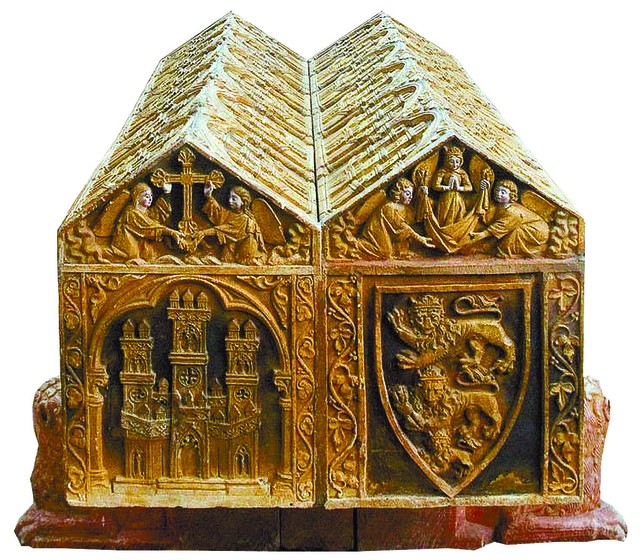
On the other hand, the construction of the monastery at Las Huelgas, on the outskirts of Burgos, represented another step in Queen Leonor's patronage efforts. The founding document, dated June 1187, states that the foundation was made jointly and with a family character as evidenced by the fact that both Alfonso and Leonor, along with their daughters Berenguela and Urraca, appear in it. The king's own testament, dated 1204, corroborates that the foundation was a joint enterprise between him and Queen Leonor. However, there is controversy over whether this monastery became from the outset a dynastic mausoleum, being the preferred place of burial for various members of the royal family. The first documentary evidence to this effect dates back to December 1199. In that document, King Alfonso VIII swore that members of the royal family would be buried there. Nonetheless, archaeological evidence, with the discovery of three tombs, one dated in 1194 by its inscription, seems to indicate that from its inception, the monastery was conceived as a dynastic mausoleum, although studies have yet to determine if some of those tombs belong to any of the king's children who died before the document.
A significant aspect are the parallels that can be drawn between Fontevrault Abbey and the Burgales cenobium. Both spaces were conceived as dynastic mausoleums, places of royal memory perpetuation. Regarding Fontevrault, the abbey enjoyed the sympathy of Leonor's parents, both Henry II and Eleanor of Aquitaine being its main benefactors until it became a Plantagenet dynasty mausoleum with the burial of the first and some members of the royal family afterward. It is more than likely that Leonor sought to project this model of patronage in Castile, making Las Huelgas the ideal place. Furthermore, the fact that the French abbey turned into a royal pantheon during the same period, along with the well-established tradition of the English royalty of establishing a preferred burial and dynastic continuity site such as Westminster Abbey, indicates that Queen Leonor's role was not only crucial in the foundation and development of the Burgales cenobium but also in its conception as a dynastic mausoleum, consolidating a practice already established on the peninsula, as well evidenced by San Isidoro de León and members of the Leonese royalty.
From an artistic standpoint, there is no doubt that French influence in the construction of Las Huelgas was due to Queen Leonor's intervention. Its Gothic architecture was inspired by what was then developing in the Anjou region, from where she likely contracted architects and artists for its construction. The main nave, arches, external reinforcements, as well as vaults in the transept chapels, are of clear Plantagenet influence, bearing close similarities with Fontevrault's construction. This orientation towards a "purely Plantagenet" style was maintained for some years under her daughter Constance, who was abbess of the Burgales monastery. This fact corroborates two things: on one hand, the cultural influence of Castilian royal women; on the other, Leonor's almost constant contact with her native family.
The role of Queen Leonor did not end there. At the end of the 12th century, Castile was one of the most important cultural centers in Western Europe. The presence of troubadours, minstrels, musicians, and artists at court sessions presided over by Alfonso and Leonor constitutes further proof of her cultural patronage and influence. To this is added a constant flow of intellectuals from Plantagenet domains to emerging Castilian schools such as that of Palencia. This intellectual influx also occurred in the opposite direction, allowing for the development of cathedral schools in Castile thanks to the education some members of the ecclesiastical estate received in Plantagenet territories.
Logically, Leonor's presence and actions alone did not intensify the intellectual life that developed during the second half of the 12th century, but they certainly contributed significantly to a renewed impulse for certain cultural aspects in Castile.

CONCLUSION
We must consider Leonor de Plantagenet as one of the great figures of the Middle Ages. The fact that she was the daughter of Henry II and Eleanor of Aquitaine forged her personality. Her education, to which her parents devoted all their efforts, allowed our protagonist to play a prominent role in Castilian culture throughout her life, largely due to her immense initiative. Her legacy is undeniable, putting both Castile and the Plantagenet dynasty at the top of the political-cultural scene of the time.
BIBLIOGRAPHY
Aurell, M. (2012). The Plantagenet Empire (1154-1224). Madrid: Sílex.
Bowie, C. (2020). Leonor Plantagenet. Queen of Castile; Lioness of England. Madrid: Sílex.
Cerda Costabal, J.M. (2021). Leonor de Inglaterra. The Plantagenet Queen of Castile (1161-1214). Gijón: Ediciones Trea.
González, J. (1960). The Kingdom of Castile in the Time of Alfonso VIII. Vols. I and II. Madrid: CSIC.
Pernoud, R. (1969). Eleanor of Aquitaine. Madrid: Espasa-Calpe.
Romero Saiz, M. (2014). Leonor de Inglaterra. Queen of Castile. Madrid: Nowtilus, D.L.
Valdez del Álamo, E. (2017). Leonor de Plantagenet: queen and patroness. In M. Poza Yagüe and D. Olivares Martínez (eds.), Alfonso VIII and Leonor of England: artistic convergences around 1200. Madrid: Editorial Complutense.


Comments