

In the second part of this series of articles, we left pending an analysis of why some of these towers lack chronological and poliorcetic coherence. We will therefore dedicate this final installment to analyzing, delving into the end of the Wars of Parties, the symbolic component of these towers.

The end of the Wars of Parties:
To better understand the paradigm shift that these towers underwent, we will review the context of the end of the war of parties. In the words of Fernández de Larrea, just as the dissolution of public power led to feudalism—being a consequence thereof the wars of parties—the slow and long restoration of said power during the Late Middle Ages brought an end to this conflict (2009: 85). During this process, the municipal powers, already oligarchized by the most powerful merchants, surpassed the lordly power and the aspirations of the peasantry, relying on royal support to reform the councils, thereby limiting access to power for the more favored strata (Díaz de Durana, 2002: 25-26). The towns, with the intention of countering the disorder caused by these struggles and reinforcing their own power, created the Hermandades at the beginning of the 15th century, which were constituted and reinforced by Henry IV in 1463. The urban elites sought through this not only their primacy but also the normalization of artisanal and commercial activities via the reinforcement of town justice (Díaz de Durana, 1999: 164-166).

Dacosta, avoiding the simplistic explanation that only pits towns against the greater relatives, arguing that the effect of the aforementioned anti-lord reaction was limited and that old lineages maintained their power, cites a generational change as one cause for the end of the wars of parties. This coincides with the death of many of the fiercest greater relatives. He also mentions an initiative to pacify themselves, which many took through marital strategies, and even the governmental skill of the kings who placed old lineages in charge of the expansion policies of their kingdoms (2003: 372-377). This pacification led to a redistribution of power, leaving thus the reins of towns and councils in the hands of the bourgeoisie while old banderizo lineages redirected their gaze towards court and military orbit, leading wars and overseas explorations. Nonetheless, this author also warns that each territory had its own variation; whereas in Bizkaia the process was as described, in Gipuzkoa the Hermandad played a greater role and there was a more marked fusion between town bourgeoisie and greater relatives (2003: 380).
The symbolic component of tower houses
According to Yrizar, from the 15th century onwards, especially after the demolition order of towers in 1457, the antiquity of the towers began to be appreciated: those that were spared destruction were conserved and adapted as we know them for more peaceful times to provide better living conditions, but retaining certain military characteristics to certify the lineage's antiquity and power. In the case of destroyed towers, old stones were reused in the construction of new palaces to give them an ancient appearance (1946: 304). Yrizar’s text analyzes the history and architecture of the tower of the Legazpi family. What is striking here is that according to the author, this lineage had neither part nor say in the Wars of Parties, as it had from the start a more political than military facet (1946: 301). This fact suggests that the aesthetics of the tower house were important regarding status representation, even if they were never used or later did not have a functional military purpose or lacked lineage antiquity and prestige.
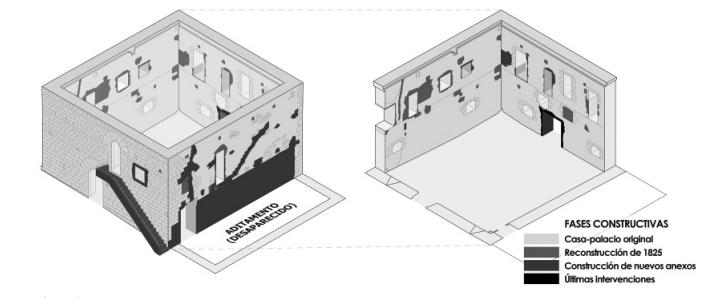
Construction phases of the Fagoaga House (Luengas, 2017: 928).
An example supporting this hypothesis would be the trend followed by towers built in the 15th century. The best example of one of these "false" towers could be the Fagoaga tower. This lineage did not actively participate in the Wars of Parties, but mid-15th century, thanks to their enrichment through iron production—being owners of many forges in the area—they had great influence over Oiartzun's inhabitants (Luengas, 2017: 925). It is most likely that the building was commissioned by Juan de Fagoaga at the end of the 15th century using the earnings from the forges to show their superiority in social hierarchy. The facade has a clear hierarchy and the front elevation stands out due to its use of finely worked ashlar stone, more typical of palaces from the 15th-16th centuries than tower houses. Other similar characteristics are seen in the quality of the scissor arches inside the entrance and in the type of embrasures, as they have a more aesthetic rather than practical purpose; another evident detail is the existence of a direct entry door to the ground floor, which conveys that this tower never had an authentic military character (Luengas, 2017: 929).
The Fagoaga palace is a good example of the transition from tower house to palace after the end of the Wars of Parties, using more complex and comfortable solutions than those typically used in tower houses (Luengas, 2017: 933). In the same measure, similarities with old towers are utilized to aristocratize its appearance and enhance the fame and prestige of the lineage, which is understandable given the context of the Fagoaga family.
According to Azkarate and García, the construction of a tower house generated significant movement and use of resources, though they were generally modest fortifications built with local materials: large wooden beams, vast quantities of stone, many paid workers, the knowledge and organization of building works... This gave lineages an opportunity to demonstrate their wealth and power through the construction of these buildings; perhaps in cases where such wealth and power were not so great, help from allied banderizo lineages was sought, which also gives an idea of the close collaboration and relationship between lineages (2004: 23). In summary, the tower house was a material manifestation of the greater relative's power but also symbolized the lineage’s relation to the territory, its antiquity, and prestige.
Conclusions
To understand the historical and patrimonial value of these tower houses, it is essential to understand their interaction with the environment as described by Azkarate and García's Banderizo Architectural System theory, which explains the relationship between lineages and society and feudal assets, accurately explaining the power this conferred upon them. Considering the military role of the tower and adding its component of local production organization and the material and visual importance of the structure itself, one can explain the symbolic role it acquired for greater relatives: while the pacification of the Late Middle Ages stripped away their military function, it endowed them with a prestige they had to leverage in their integration into the court sphere or to justify their nobility against the generalization of universal hidalguía in the case of more humble lineages. The subject matter is very interesting and interdisciplinary, which despite hindering research development for many decades has enriched the final results; nonetheless, historiography and documentary gaps show that there is still much to learn about these structures.
Bibliography:
Azkarate Garai Olaun, A. & García Gómez, I. (2004). “The medieval tower houses: systemic analysis of a spatial/territorial restructuring process”. Arqueología de la Arquitectura 3, 7-37. Retrieved from: https://arqarqt.revistas.csic.es/index.php/arqarqt/article/view/59/56
Dacosta Martínez, A. (2003). The lineages of Bizkaia in the Middle Ages: power, kinship and conflict. Bilbao, UPV-EHU, Servicio Editorial. Retrieved from: https://addi.ehu.es/bitstream/handle/10810/15617/UHWEB045555.pdf?sequence=1&isAllowed=y
Díaz de Durana Ortiz de Urbina, J. R. (1999). Social struggles and banderizo wars in the Basque Country during the Late Middle Ages. Historiar: revista trimestral de historia 3, 154-171. Retrieved from: https://addi.ehu.es/handle/10810/22005
Díaz de Durana Ortiz de Urbina, J. R. (2002). The banderizo wars in the Basque Country during the Late Middle Ages, in Díaz de Durana Ortiz de Urbina, J. R. & Reguera Acedo, I. (Eds.), Lope García de Salazar: banderizo and chronicler. Retrieved from: https://addi.ehu.es/bitstream/handle/10810/23547/Las_luchas_de_bandos_en_el_Pais_Vasco_en_la_Baja_Edad_Media.pdf?sequence=1
Fernández de Larrea Rojas, J.A. (2009). The private wars: the example of Oñacino and Gamboino bands in the Basque Country. Clío & Crímen: Revista del Centro de Historia del Crimen de Durango 6, 85-109. Retrieved from: https://drive.google.com/file/d/12dpEfqxkE_IFlE9IDs_GZNaGVrLtIr6X/view
Luengas Carreño, D. (2017). The Fagoaga palace-house in Oiartzun (Gipuzkoa): analysis of the construction system and original architectural elements of a Medieval Seigniorial Residence. Actas Vol. 2.indb, Madrid, Sociedad Española de Historia de la Construcción, 925-934. Retrieved from: http://www.sedhc.es/biblioteca/actas/Luengas-Carre__o_.pdf
Yrizar Barnoya, J. (1946). The Legazpi family house. Boletín de la Real Sociedad Bascongada de Amigos del País, II, 3, 299-309. Retrieved from: https://www.rsbap.org/ojs/index.php/boletin/article/view/254/241


Comments