En la anterior parte de este artículo, analizamos el valor propagandístico de la moneda, y el uso que le daban los gobernantes. Nos centramos en el caso del Primer Interregno portugués, donde se cuestiona el derecho al trono portugués de Beatriz, hija del rey Fernando I de Portugal y segunda esposa de Juan I de Castilla. Su principal rival es el medio hermano de su padre, Juan de Castro, que es apresado por los castellanos. Mientras tanto, Portugal es regido por la madre de Beatriz, la reina viuda Leonor, carente de apoyo popular dentro de Portugal, y por tanto necesitada de las fuerzas de su yerno.
Es entonces cuando entra en juego otro tío de Beatriz, João, maestre de Avís, hijo ilegítimo de Pedro I de Portugal y Teresa Lourenço. Dos meses después de la muerte del rey Fernando, el maestre entra en Lisboa y asesina al amante de Leonor. Esto inicia un motín popular con numerosas víctimas, incluido el obispo de la ciudad. La reina Leonor se marcha de la ciudad, y João queda al mando. Técnicamente, Beatriz aún mantiene su posición de reina, aunque por poco tiempo.
Ilustración de la entrevista de Juan I y Beatriz con Leonor (Pinheiro Chagas 1899, 577)
Al mismo tiempo, Juan I de Castilla rompe los acuerdos y decide entrar en Portugal junto a su esposa para ejercer como rey en nombre de ambos. Se reúne con su suegra Leonor en Santarém y decide exiliarla a Tordesillas. El rey de Castilla se niega a que haya un regente en Portugal al que no controle, lo que deriva en el enfrentamiento con el maestre de Avís. Este se proclama como defensor y regidor de Portugal en nombre de Juan de Castro, considerado legítimo heredero. Seguramente no tenga intención de ceder el poder a su medio hermano y solo esté haciendo tiempo mientras construye su camino al trono. De hecho, Juan sigue siendo tratado como infante, pues no se le reconocerá la sucesión hasta que deje de ser cautivo de Castilla. Por tanto, los contrarios a Beatriz consideran que el trono permanece vacante, de ahí la palabra Interregno.
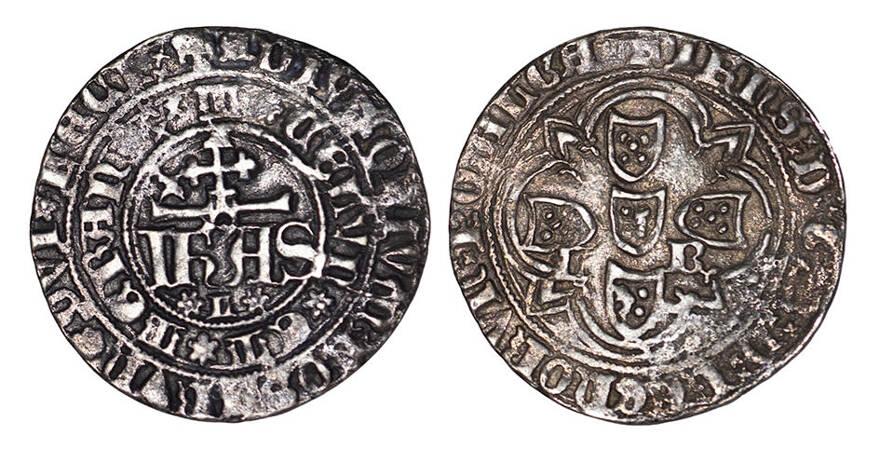
João también decide hacer una nueva moneda para informar al pueblo del cambio de gobierno. En realidad, dos, pues hace piezas muy similares con valor de real y de medio real (Gomes 2003, 105). Sin embargo, no hace la moneda a nombre de su sobrina, ni de su medio hermano. Esto puede ser una pista de que no aspiraba a guardar el asiento a otro familiar.
Real del João (Portuscalle Numismática, subasta 3, lote 18, 15 de mayo de 2022)
La primera diferencia es el tipo del anverso. Mientras que la moneda de Beatriz utilizaba su retrato, João introduce una abreviatura de su nombre IHAS (del latín Iohannes). Es una práctica común el uso de iniciales o abreviaturas para representar al emisor de la moneda. Estas letras suelen estar coronadas, pero João no es rey, y no tiene derecho a usar esa distinción. En su lugar, coloca la Cruz de Avís, en referencia a la orden militar a la que pertenece.
También dispone de leyenda en doble orla (en el real, siendo una orla simple en la mitad). Al igual que la anterior, es una leyenda religiosa (Salmos 123, versículo 8): ADIVTIRUM NOSTRVM QUI FECIT CELVM ET TERAM. Se puede traducir como «nuestra ayuda es el Señor, que hizo el cielo y la tierra». Una vez más, se recurre a la legitimidad a través de Dios.
En el reverso, aparecen las quinas portuguesas sin escudo. La leyenda recoge los títulos de João como regidory defensor de Portugal y los Algarves: IHNS DG R D REGNORVM PO ALGA.
Como se ha mencionado al inicio, el derecho a acuñar moneda siempre queda a disposición de la máxima autoridad política. Nada de lo que aparece en la moneda es accidental, pues siempre se ha sabido el poder propagandístico de la misma. João está iniciando un rápido ascenso de prestigio.
Frente a él ya no está el bando de Beatriz, sino el del rey de Castilla. Ya fuera por deseo o por incapacidad, no se vuelve a acuñar moneda a nombre de Beatriz, ni en Portugal, ni en Castilla. Al contrario, Juan I emitirá una serie de blancas con el título de rey de León y Portugal (Orol Pernas 1974: 65-72). Esta pieza no tiene la misma trascendencia que la de su mujer o las de su rival. Los tipos son los clásicos de Castilla, un león y un castillo, y la referencia a la pretensión se limita al título.
Signo rodado facsímil de Juan I (Fernández de Córdova Miralles, 235)
El uso del título de rey de Portugal será más habitual en los documentos y los sellos. En ellos, Juan asumirá la heráldica portuguesa, pero en un partido donde queda relegada a izquierda, lo cual es más humillante que de hacerlo un cuartelado, como Beatriz (Fernández de Córdova Miralles 2013, 232-235; Francisco Olmos y Novoa Portela 2008, 92-93).
Juan tiene una concepción del poder femenino similar a la navarra, donde una mujer puede heredar, pero es su marido el que ejerce el papel de rey. Durante el resto de sus días, defenderá la campaña portuguesa como propia, llegando a plantearse abdicar la corona de Castilla para centrarse en ella, e intentar ser más aceptado en el reino vecino.
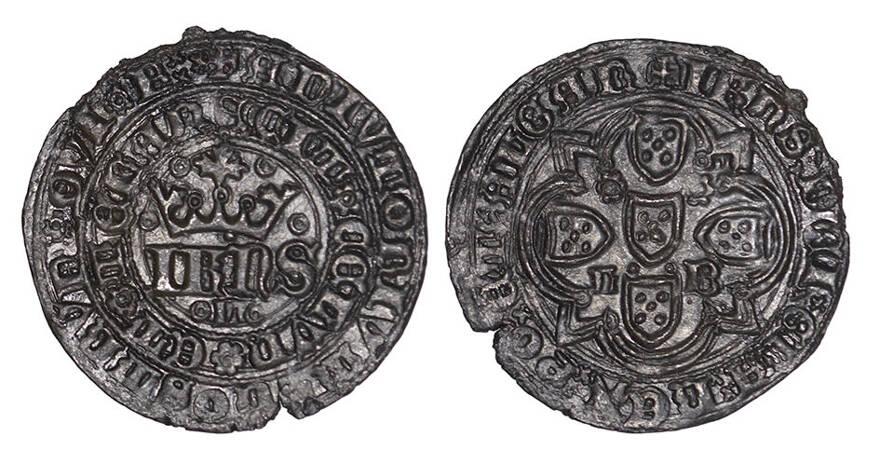
Real del João I (Portuscalle Numismática, subasta 3, lote 22, 15 de mayo de 2022)
El 14 de agosto de 1385, João consigue una victoria decisiva en la batalla de Aljubarrota, y poco después se proclama rey de Portugal con apoyo popular en las Cortes de Coímbra. Este cambio se aprecia en su moneda, donde la Cruz de Avís es sustituida por la corona real.
Por si fuera poco, llama a los principales adversarios de los Trastámara, los duques de Lancaster. El rey de Castilla no tiene fuerzas para una segunda guerra, por lo que firma la tregua con Portugal, y promete a su hijo Enrique con la heredera de los Lancaster, Catalina. Para este tiempo, la medio hermana de Catalina, Felipa, se ha casado con João.
Beatriz, que ya ha pasado a un segundo plano, se ve más opacada tras enviudar en 1390. Al no ser madre del nuevo rey, no se la tendrá en cuenta para las grandes decisiones de la regencia. En los años posteriores, la reina Catalina de Lancaster mantendrá buenas relaciones con su cuñado João. Esto dificulta el reclamo de Beatriz, que se mantiene políticamente activa hasta su muerte en torno a 1420.
Las monedas del Periodo de Interregno cuentan la historia de una reina legítima, manejada por una madre y un esposo demasiados ambiciosos, y la de un pariente ilegítimo, que aprovecha su oportunidad para instaurar una nueva dinastía. Sus piezas son el mejor ejemplo del uso que se da a estas como medio de difusión política. Las monedas son imágenes instantáneas, que cuentan lo que está ocurriendo en ese mismo momento. Son el rastro de una breve pero intensa campaña propagandística, dentro de un conflicto armado. Beatriz se representa como reina mediante el uso de su corona y es respaldada por el poder castellano, representado en su heráldica. Mientras tanto, João aparecerá con los elementos propios del maestre de Avís y defensor de Portugal, pero no podrá usar los atributos regios hasta 1385.
BIBLIOGRAFÍA
Fernández de Córdova Miralles, A (2013). “Los emblemas de la conquista: armas y divisas de Juan I de Trastámara ante la sucesión portuguesa”. Armas e Troféus. Revista de Históriria, Heráldica, Genealogia e Arte, 229-268.
Francisco Olmos, J. M. de y Novoa Portela, F. (2008): Historia y evolución del sello de plomo. La colección sifilográfica del Museo Cerralbo. Madrid: Real Academia Matritense de Heráldica y Genealogía.
Gomes, A. (2003): Moedas portuguesas e do territorio que hoje é Portugal. Lisboa: Asociación Numismática de Portugal.
Olivera Serrano, C. (2005): Beatriz de Portugal. La pugna dinástica Avís-Trastámara. Santiago de Compostela: CSIC e Instituto de Estudios Gallegos “Padre Sarmiento”.
Orol Pernas, A. (1974): “Acuñación de Juan I de Castilla como rey de Portugal”. Nummus 33, 65-72.
This translation was generated automatically using qwen2.5:14b-instruct and has not been reviewed by a human editor. It may contain errors, omissions or awkward phrasing — for the authoritative version, please read the original in Spanish. Found a mistake? Let us know at info@arqueotimes.es.
In the previous part of this article, we analyzed the propaganda value of the coin, and its use by rulers. We focused on the case of the First Interregnum in Portugal, where Beatriz's right to the Portuguese throne is questioned. Beatriz was the daughter of King Fernando I of Portugal and the second wife of Juan I of Castile. Her main rival is her father’s half-brother, Juan de Castro, who is captured by the Castilians. Meanwhile, Portugal is governed by Beatriz's mother, Queen Dowager Leonor, lacking popular support within Portugal and thus in need of her son-in-law's forces.
It was then that another uncle of Beatriz, João, Master of Avís, the illegitimate son of Pedro I of Portugal and Teresa Lourenço, enters the scene. Two months after King Fernando’s death, the master enters Lisbon and kills Leonor's lover. This sparks a popular uprising with numerous casualties, including the bishop of the city. Queen Leonor leaves the city, and João takes command. Technically, Beatriz still maintains her position as queen, though for a short time.
Illustration of the interview between Juan I and Beatriz with Leonor (Pinheiro Chagas 1899, 577)
At the same time, Juan I of Castile breaks agreements and decides to enter Portugal alongside his wife to rule in her name. He meets with his mother-in-law Leonor in Santarém and decides to exile her to Tordesillas. The King of Castile refuses to have a regent in Portugal whom he does not control, leading to conflict with the Master of Avís. This man proclaims himself as defender and governor of Portugal on behalf of Juan de Castro, considered the legitimate heir. He likely has no intention of ceding power to his half-brother and is merely buying time while building a path to the throne. In fact, Juan continues to be treated as an infante since he will not be recognized as successor until he ceases to be a Castilian captive. Therefore, those opposed to Beatriz consider that the throne remains vacant, hence the term Interregnum.
João also decides to mint new coins to inform the people of the change in government. In reality, two, as he makes pieces very similar with values of real and half real (Gomes 2003, 105). However, he does not make coins in his niece's or half-brother’s name. This may be a clue that he did not intend to keep the seat for another family member.
Real of João (Portuscalle Numismática, auction 3, lot 18, May 15, 2022)
The first difference is the type on the obverse. While Beatriz's coin used her portrait, João introduces an abbreviation of his name IHAS (from Latin Iohannes). It is a common practice to use initials or abbreviations to represent the issuer of the coin. These letters are usually crowned, but João is not king and has no right to use that distinction. Instead, he places the Cross of Avís, in reference to the military order to which he belongs.
He also provides a legend in double border (in the real, being a single border on the half). Similar to the previous one, it is a religious legend (Psalm 123, verse 8): ADIVTIRUM NOSTRVM QUI FECIT CELVM ET TERAM. It can be translated as "our help is the Lord who made heaven and earth." Once again, legitimacy through God is sought.
On the reverse, appear the Portuguese quinas without shield. The legend recites João's titles as regentand defender of Portugal and the Algarves: IHNS DG R D REGNORVM PO ALGA.
As mentioned at the beginning, the right to mint coins always remains with the highest political authority. Nothing on a coin is accidental, as it has always been known for its propaganda power. João is starting a rapid rise in prestige.
Facing him now is not Beatriz's side but that of the King of Castile. Whether by desire or incapacity, no more coins are minted in Beatriz’s name, neither in Portugal nor in Castile. On the contrary, Juan I will issue a series of blancas with the title of king of León and Portugal (Orol Pernas 1974: 65-72). This piece does not have the same significance as that of his wife or his rival. The types are the classic ones from Castile, a lion and a castle, and the reference to the claim is limited to the title.
Rolling sign facsimile of Juan I (Fernández de Córdova Miralles, 235)
The use of the title king of Portugal will be more common in documents and seals. In them, Juan assumes Portuguese heraldry, but in a partition where it is relegated to left, which is more humiliating than if done as a quartering, like Beatriz (Fernández de Córdova Miralles 2013, 232-235; Francisco Olmos y Novoa Portela 2008, 92-93).
Juan has a conception of female power similar to that in Navarre, where a woman can inherit but it is her husband who plays the role of king. For the rest of his days, he will defend the Portuguese campaign as his own and even consider abdicating the crown of Castile to focus on it, and try to be more accepted in the neighboring kingdom.
Real of João I (Portuscalle Numismática, auction 3, lot 22, May 15, 2022)
On August 14, 1385, João achieves a decisive victory at the Battle of Aljubarrota, and shortly after proclaims himself king of Portugal with popular support in the Cortes of Coimbra. This change is evident in his coinage, where the Cross of Avís is replaced by a royal crown.
To make matters worse, he calls on the principal adversaries of the Trastámara, the Dukes of Lancaster. The King of Castile does not have forces for a second war and signs a truce with Portugal, promising his son Enrique to Catherine, the daughter of the Lancasters. By this time, Catherine's half-sister Felipa has married João.
Beatriz, who had already moved into the background, is further overshadowed after becoming a widow in 1390. As she was not the mother of the new king, she would no longer be considered for major decisions during the regency. In subsequent years, Queen Catherine of Lancaster maintains good relations with her brother-in-law João. This complicates Beatriz's claim, which remains politically active until her death around 1420.
The coins from the Interregnum period tell the story of a legitimate queen managed by an overly ambitious mother and husband, and that of a illegitimate relative who takes advantage of his opportunity to establish a new dynasty. Their pieces are the best example of how these coins were used as a means of political dissemination. The coins are instant images that tell what is happening at that very moment. They are traces of a brief but intense propaganda campaign, within an armed conflict. Beatriz is represented as queen through the use of her crown and supported by Castilian power, represented in its heraldry. Meanwhile, João appears with elements specific to the Master of Avís, and defender of Portugal, but cannot use royal attributes until 1385.
BIBLIOGRAPHY
Fernández de Córdova Miralles, A (2013). “The emblems of the conquest: arms and devices of Juan I of Trastámara in the Portuguese succession.” Armas e Troféus. Revista de História, Heráldica, Genealogia e Arte, 229-268.
Francisco Olmos, J. M. de and Novoa Portela, F. (2008): History and Evolution of the Lead Seal. The Sifilographic Collection of the Museo Cerralbo. Madrid: Real Academia Matritense de Heráldica y Genealogía.
Gomes, A. (2003): Portuguese Coins and Territory that is Portugal Today. Lisbon: Asociación Numismática de Portugal.
Olivera Serrano, C. (2005): Beatriz of Portugal. The Dynastic Struggle Avís-Trastámara. Santiago de Compostela: CSIC e Instituto de Estudios Gallegos “Padre Sarmiento”.
Orol Pernas, A. (1974): “Minting of Juan I of Castile as King of Portugal”. Nummus 33, 65-72.
Fernandez Guisasola, L. F. (2022, 3 de octubre). La reina y el maestre. Propaganda política a través de las monedas del Primer Interregno portugués Parte II. ArqueoTimes. https://arqueotimes.com/articulos/la-reina-y-el-maestre-propaganda-politica-a-traves-de-las-monedas-del-primer-interregno-portugues-parte-ii/






Comentarios