

Joaquín Sorolla y Bastida (Valencia, 1863- Cercedilla, 1923) emerges as a pivotal figure in the transition and modernization of Spanish genre painting. His work redefined the relationship between Spanish art and European aesthetic currents such as naturalism, impressionism, and post-impressionism. Sorolla's most significant contribution lies in the development of Luminism, a style based on the scientific study of Mediterranean light through his brushwork.
The Valencian painter demonstrated technical mastery that allowed him to tackle the social genre, bourgeois portraiture, and outdoor landscape painting, or plain air. His career is known for his command of loose brushwork and the chromatic vibration of sunlight so characteristic of his works (Pons-Sorolla, 2001, p.78).
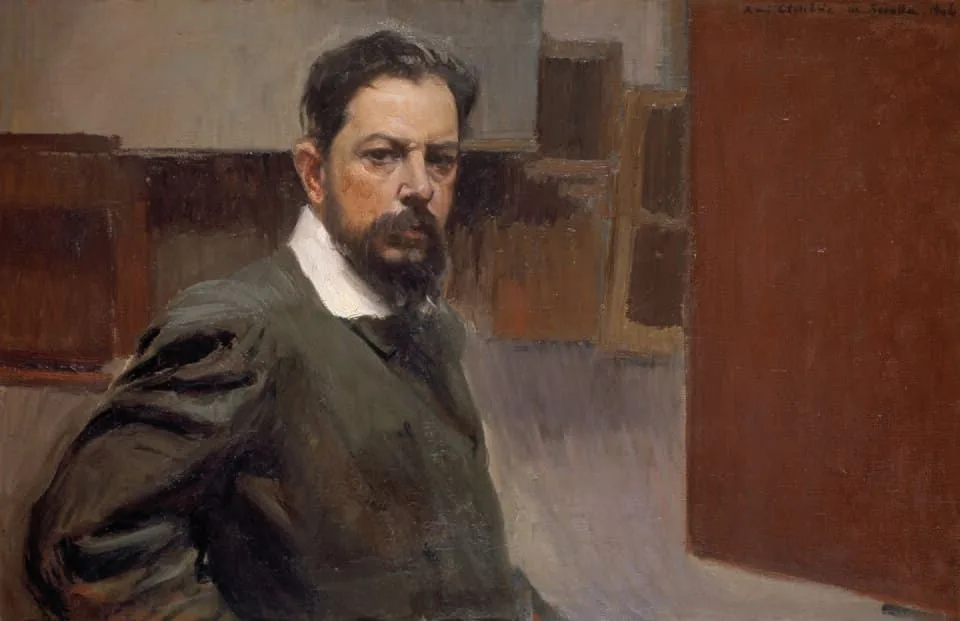
This article will pay special attention to the monumental commission of a «vision of Spain» for the Hispanic Society of America, a visual and ethnographic synthesis that culminated his career through Sorolla's technical and formal analysis (Muller & Burke, 2004, p.15).
Sorolla’s journey across Spanish geography was not merely a tourist trip but an immersion into the cultural and luminous diversity. While his base was in the bright white light of the Levant, the South, particularly Andalusia, required a completely different palette (Garín Ortíz de Tarraco, 1973, pp. 45-46).
The documentary route of the painter took him to places such as Ayamonte (Huelva), where he recorded the «fisherman’s customs», and led him towards one of the most important stops on the national artistic itinerary: Granada. This city and its territory had established themselves, especially since the Romantic era, as a constant center of interest for various painters (Martínez Carreño, 2023, p. 164).
Thus, Sorolla’s journey culminated at the monument that encapsulates the historical and aesthetic soul of the South and its mysticism: the Alhambra.
Sorolla cultivated an inherently dynamic method: painting en plein air. As a true practitioner of «pleinairism,» his work required the artist to be tirelessly mobile. His practice was based on traveling and seeking scenes, then setting up his improvised studio, with easel and canvas, right where light and scene developed. He rejected the stillness of the studio; his art was a direct expression of action and immediacy captured (Varela Agüí, 2024, p. 3).

Precisely this need to paint reality in situ made his passage through Andalusia a milestone in his evolution. The artist, accustomed to mastering light en plein air (the Valencian plein air), found himself in the south facing a warmer, more dramatic, and often filtered light.
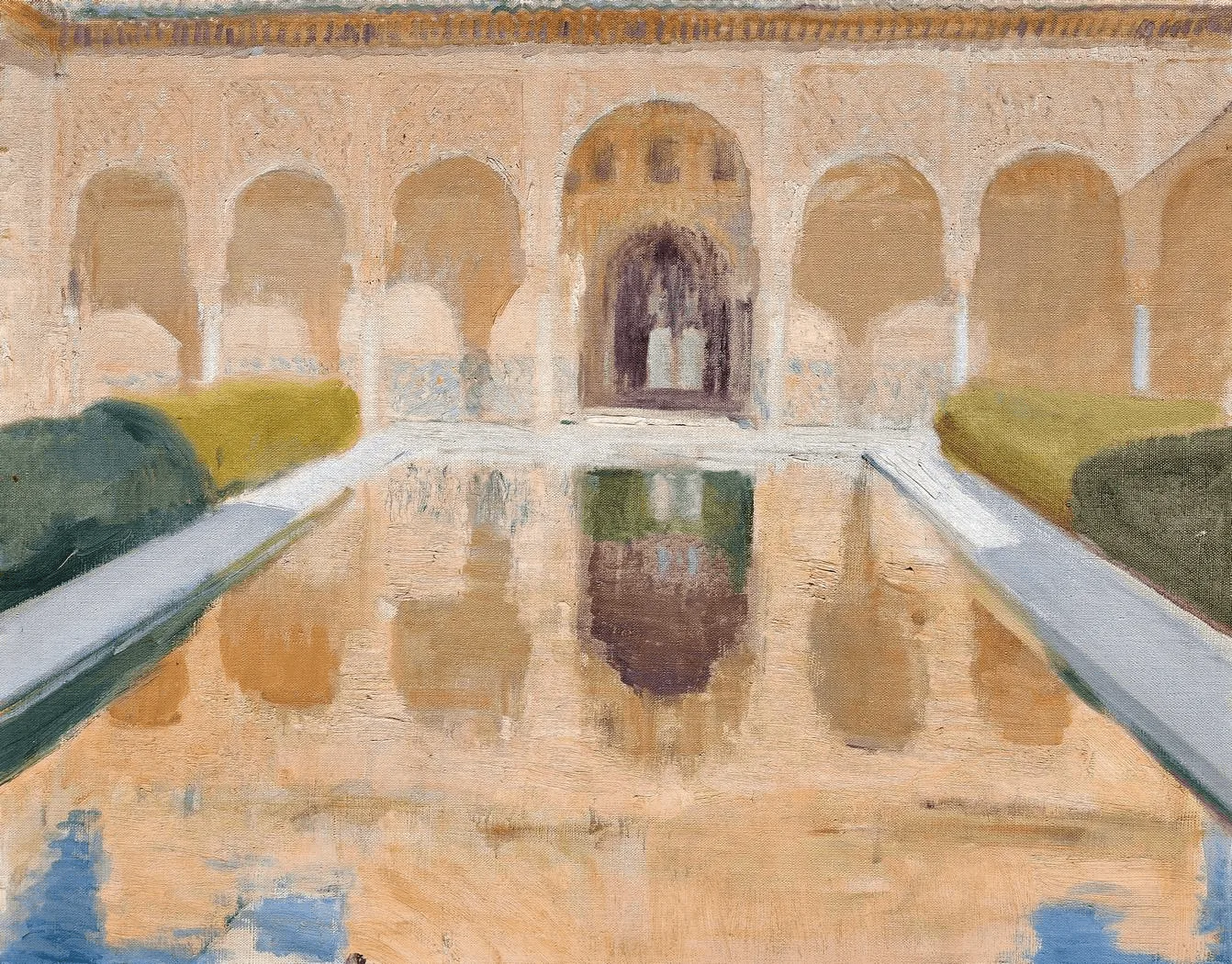
The light of the Alhambra does not project; it tamizes. It penetrates through lattices and horseshoe arches, bounces off gypsum walls and water, forcing Sorolla to redefine the concept of shadow. This was no longer a simple absence of light but a space filled with color and nuances. This challenge, directly faced with his easel planted before the monument, not only influenced the treatment of interiors and gardens but enriched his entire conception of color.
The Alhambra, more than a palace, is a sensory complex that has sparked in the sensitivity of contemporary man attraction and interest (Borrás Gualis, 1991, p.4). The reddish walls of the fortress, the delicate geometry of Nasrid plasterwork, and above all, the omnipresent element of water, created a unique scene Sorolla had to confront the exuberance of the Generalife, where vegetation shadows (cypresses, myrtles) dominate, and the serenity of patios.
In the Patio de los Myrtles, the central pond becomes a mirror that duplicates architecture and sky, introducing intense blue light into the heart of stone (Sánchez & Sánchez, 2014, p. 100). In the gardens, running water in ditches and fountains not only provides freshness but acts as a natural lighting device, fracturing light and creating a constant play of reflections.
Conclusions
As a conclusion to this initial synthesis, Sorolla's immersion in the Alhambra transcended far beyond the original ethnographic commission, as it marked the true apogee of his landscape painting by liberating him from purely descriptive narrative. Although his arrival in Granada was tied to the need to document regional identity for the Hispanic Society, contact with the Nasrid compound prompted an introspective turn that forced him to reinterpret light and shadow in a refined manner. In this setting, the power of Mediterranean sunlight that had defined his previous work transformed into filtered light contained by architecture and multiplied by water reflections, demanding much more subtle chromatic sensitivity.
This Granada phase reveals a Sorolla who distances himself from vibrant naturalism to embrace an almost abstract synthesis where garden geometry structures a new way of understanding space. Thus, his monumental «vision of Spain» not only stands as a fundamental record for Andalusian culture and heritage but also testifies to his own true pictorial evolution. Lastly, the Alhambra was no mere backdrop for the Valencian master but the catalyst for an artistic maturity where silence, architecture, and color fused into one of the peaks of Spanish modernity.
Bibliography
Borrás Gualis, G. M. (1991). The Alhambra (Cuadernos de Arte Español, No. 17). Historia 16.
Garín Ortíz de Tarraco, F.M. (1973). Sorolla's Vision of Spain. Instituto Alfonso el Magnánimo.
Martínez Carreño, F. (2023). The Sierra Nevada in Joaquín Sorolla’s Art: A New Perspective from the Adarves Garden. Revista del Centro de Estudios Históricos de Granada y su Reino, 35.
Muller, P.E, & Burke, M.B. (2004). Sorolla: The Hispanic Society of America. The Hispanic Society of America.
Pons-Sorolla, B. (1970). Joaquín Sorolla y Bastida: Life and Work. Fundación arte hispánico.
Sánchez, A., & Sánchez, Á. (2014). The Alhambra: Architecture, History, Plans, Legends. Ediciones Miguel Sánchez.
Varela Agüí, E. (2024). Sorolla in Andalusia [Exhibition Brochure]. Museo Carmen Thyssen Málaga.


Comments