
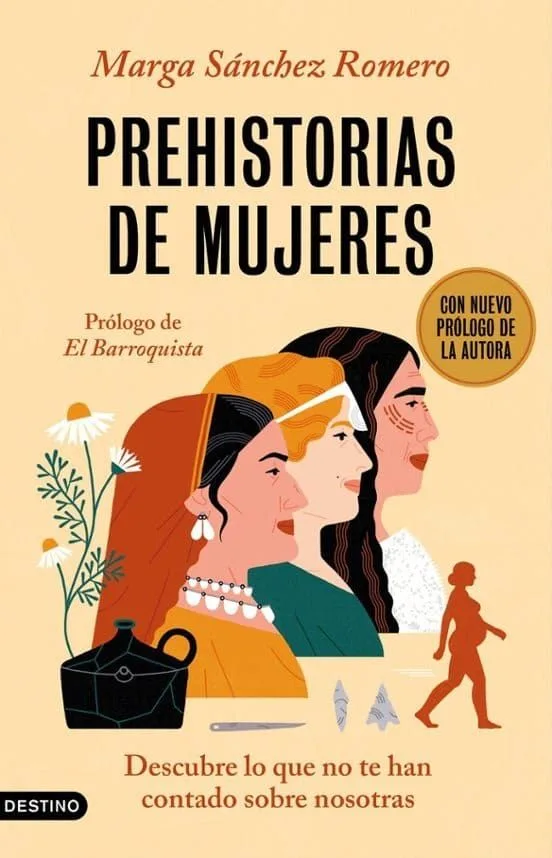
"Discover what hasn't been told about us>>". With this phrase, the book "Prehistory of Women" by Marga Sánchez Romero is introduced. Published in 2022 by Editorial Planeta and Ediciones Destino in Barcelona, it spans 294 pages discussing women in prehistoric times - not just about women in prehistory.
Marga Sánchez Romero (Madrid, 1971) is a professor of Prehistory, science communicator and member of the Board of Trustees at the National Archaeological Museum. Her work has focused on advocating for the importance of women's and children's roles in prehistoric societies. As such, she is part of the PastWomen project which aims to highlight scientific advances in archaeology and history related to material remains from these societal sectors. In addition to this, she collaborates with La 2 of RTVE’s program "El Condensador de fluzo", as well as being a recipient of the Carmen de Burgos award among many other recognitions.
The book "Prehistory of Women" narrates the role women have had in their communities, from traditionally attributed activities to those considered more masculine, through a critical analysis on how history has been constructed and the biased narrative of past events. Thus, it questions the generic male term and the marginalization of female protagonism.
The structure of this writing consists of an author's preface, another preface by El Barroquista (Miguel Ángel Cajigal), an introduction, 19 chapters, acknowledgments, a section on bibliography and finally the credits for the images. Returning to the chapters, each one focuses on a specific aspect, such as the work performed, inequality, activities excluded from this gender, what was considered they did not do, should not have done, and where they should not have been.
The author explains how the image of women in prehistory has been reduced to the domestic sphere, as child carer and partner to man, always in a secondary and submissive position. Through everyday examples and pop culture, such as the famous animated series The Flintstones, she presents her critique towards this. Additionally, she provides information on archaeological remains and material culture associated with the female gender - which is defined by the maternal or sexed body -. The link between the body and objects has become increasingly strong because the meaning of both cannot be understood without each other. Sánchez Romero argues that it is necessary to question how we have made history, dismantling stereotypes that, from our current perspective, we have attributed to prehistoric societies. This historical reconstruction must be done through science, free from moral norms that continue to stereotype biases.
In addition to what has been mentioned, the author highlights the importance of activities that have been devalued such as nurturing, breastfeeding, caring, feeding and healing. All these allowed for group survival and continuity over generations.
Among many aspects to highlight, it is necessary to emphasize how the author uses ethnographic parallels from tribal societies and current traditions to clarify women's participation in hunting - such as the aboriginal Chipewyan (Canada) - or war. The dissemination and valorization of certain archaeological findings show that women were indeed protagonists of a more or less complex, violent and evolutionary past. Thanks to disciplines like Physical Anthropology and DNA analysis, precise information has been obtained about family relationships, labor performed (determined through bone wear produced by specific mobility, causes ante and post mortem), learning processes (the author illustrates this with dental marks found on infant and adult female bodies, resulting from the thread used in textile industry in Castellón Alto (Granada) and Cabezo Redondo (Villena). As they grow older, the use mark becomes more pronounced), among others.
In this review, not all of the questions that Romero Sánchez raises about women's knowledge have been addressed. The immense variability of cultural changes that has shaped women spans an unimaginable extent. Nonetheless, the author manages to make it a pleasant, close and entertaining read, offering necessary tools for further exploration into Gender Archaeology or Feminist Archaeology. Explanatory inequality in museums, temporary exhibitions and research causes a certain disconnection from past events, reflecting that women were not part of them. "Prehistory of Women" constitutes one of the pillars on which we must rely to achieve an objective, scientific, critical and just historiography.


Comments