

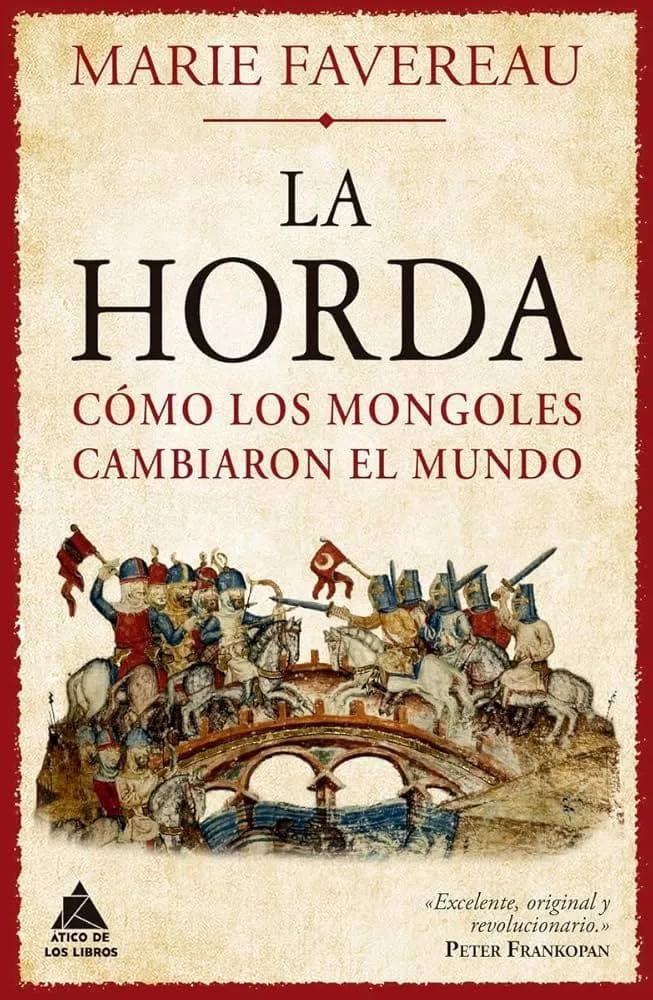
Most people know the Mongol Empire for its destructive capabilities. Cruel conquerors who exerted their rule over Eurasia through a regime of terror, chaos, and violence. It is curious how little we actually know about one of the most extensive empires in our history. For this reason, authors like Marie Favereau become so necessary. Currently, she is a professor at Paris Nanterre University and has published multiple works centered on the Mongol Empire. However, we can confidently say that "The Horde," published in Spanish on June 25, 2024 by Atico de los Libros, could be her most famous book. It has received several nominations for different awards (Cundill) and acclaim as the "book of the year" from media outlets like Financial Times, Spectator or Five Books. Its great reception was due to three thematic lines that demonstrated the complexity, legacy, and relevance held by the Mongols: an admirable administrative capacity, a constant evolution, and an effect that unified modern peoples in Eastern Europe.
To reflect each of these points, the author has centered her research on what is called the "Golden Horde," a nomadic regime that emerged from the division of the Mongol Empire in 1240 and occupied areas in Ukraine, Bulgaria, Moldova, Azerbaijan, Kazakhstan, Turkmenistan, and Russia. Her study is divided into 8 chapters following a chronological structure, from the rise of the Mongols and the creation of their empire to the "dissolution" of the power of the Horde. It's also important to note that it has an extensive introduction sufficient to orient readers, synthesize historiographical debates, explain concepts, and bolster the goals of the work.
In this way, we dive into the first chapter of this great journey: The resistance of the Yurt Dwellers (the original name for the Mongols). It presents the different nomadic groups that inhabit the Eastern Asian Steppe in the 12th century. She delves into their relationships, institutions, and dynamics through various primary sources (Persian, Chinese, Russian...). Additionally, she introduces and documents the rise of Genghis Khan, a figure who unified steppe nomads under the Mongol banner.
The second chapter addresses the division of Genghis Khan's empire among his sons, a crucial moment when they collect their own traditions and sociopolitical structures to adapt them to circumstances. It will be a decision that marks the future of the Horde, the territory given to Jochi, son of Genghis, and his successors in their expansion into Eastern Europe. The third chapter deals with the consolidation and adaptation of the Jochid regime after Jochi's death, creating the Blue Horde and White Horde. From the fourth chapter onwards, we see an evident transformation. The Golden Horde officially separates from the Mongol Empire and adapts again to threats through commercial alliances and events such as its conversion to Islam.
The result can be seen in the fifth chapter: the creation of a lucrative trading network that provided power and stability to the regime. The figure of Temür knew how to take advantage of rivalries among other Mongols to increase his prestige and political role in the empire, securing important advantages in long-distance trade. Chapter six analyzes the consequences of "Mongol globalization" on European powers through merchants, urban initiatives, infrastructure, religious spaces... However, instability among rivals and the arrival of the Black Death brought about the end of its power.
Chapter seven recounts the period of anarchy (bulqaq), a moment where the plague devastated the prosperous trading network of the Horde and ushered in a period of internal instability dominated by the beys (nomadic chiefs). Additionally, control over their vassals was severely compromised. Finally, in chapter 8 we see how once again the solution is to reinvent themselves, this time under the figure of Toqtamish, who managed to unify the Blue and White Hordes. His end came at the hands of Temür or Tamerlane, a nomadic chief with whom he had established an alliance that oscillated between cooperation and rivalry. Although the end of the Horde is often associated with the fall of Toqtamish, the author argues for its presence and power until well into the 15th century. In other words, the beys took control, fragmenting it as a consequence. It was necessary for the khan to have their support to govern.
The result is a balanced reading that provides greater understanding of the Mongol Empire. Part of this success lies in the use of a wider variety of sources, since traditional historiography relies on testimonies from sedentary populations under subjugation. If we understand the bias of these sources, combined with documents such as imperial orders, letters, coins, trade manuals, archaeology or qari söz (steppe epics from the 16th to 17th centuries), we have a detailed portrait of the Golden Horde, an immense nomadic power that had nothing to envy from sedentary empires and with exceptional adaptability. The author is not only capable of changing our perception of the Mongols but also has brought to light their legacy, especially in the case of Russia.
Now, it's true that her arguments clearly demonstrate the power and commercial influence of the Mongol Empire; however, it would be debatable to assign them the concept of "globalization" or "first globalization." This term has been used by various popular works in order to gain greater dissemination and public appeal. Generally, this debate centers on modern history with the discovery and conquest of America, or contemporary history through late 19th-century capitalism.
As a conclusion, it would be appropriate to highlight the main points of the work before issuing the final evaluation. Marie Favereau has conducted an exhaustive investigation from social, political, and economic perspectives on the Golden Horde, demonstrating the importance that nomadic states had in history. Her methodology allowed connecting different events, inserting the history of the Horde alongside its neighbors, rivals or other nomadic groups, which helped understand its magnitude and reach. Therefore, this work should be considered a must-read for those interested in medieval Near Eastern history, as their past was lived under the shadow of the power of the Golden Horde. On the other hand, her language and clarity of expression have reduced comprehension difficulty, ideal for readers with little experience in this period of history. Additionally, this edition includes several maps, a glossary, and an onomastic index to guide us during reading. Undoubtedly, it is a work that has set an important precedent to question and dismantle the image we have of the Mongols.


Comments