

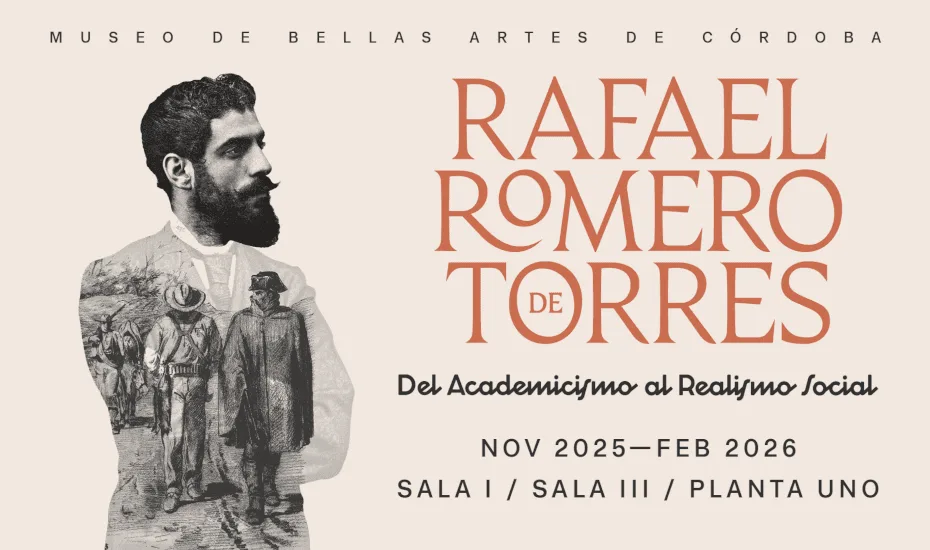
The temporary exhibition «Rafael Romero de Torres. From Academicism to Social Realism» has been organized by the Museum of Fine Arts in Córdoba on the occasion of the 160th anniversary of the artist's birth (figure 1). The show, which could be visited in rooms I and III of the museum until April 2026, has rescued the legacy of the eldest son of Rafael Romero Barros, a key figure for understanding the transition from nineteenth-century art to social commitment in Spain, but whose career was prematurely cut short and overshadowed by his brother Julio Romero de Torres's fame.
Room I
The exhibition begins in Room I (figure 2), where visitors are informed about the possession of an important art collection by the Museum of Fine Arts of Córdoba. These works, created on paper in various formats and techniques, constitute one of Spain's most significant collections. Among them are drawings and prints by Rafael Romero de Torres as well as other local, national, and international artists. Through donations, purchases, and deposits, two sections have been formed: a section for drawings dating from 1877 and another for prints starting in 1905, encompassing works from the 18th to the 20th centuries. The informational panel concludes with descriptions of conservation issues affecting these pieces.
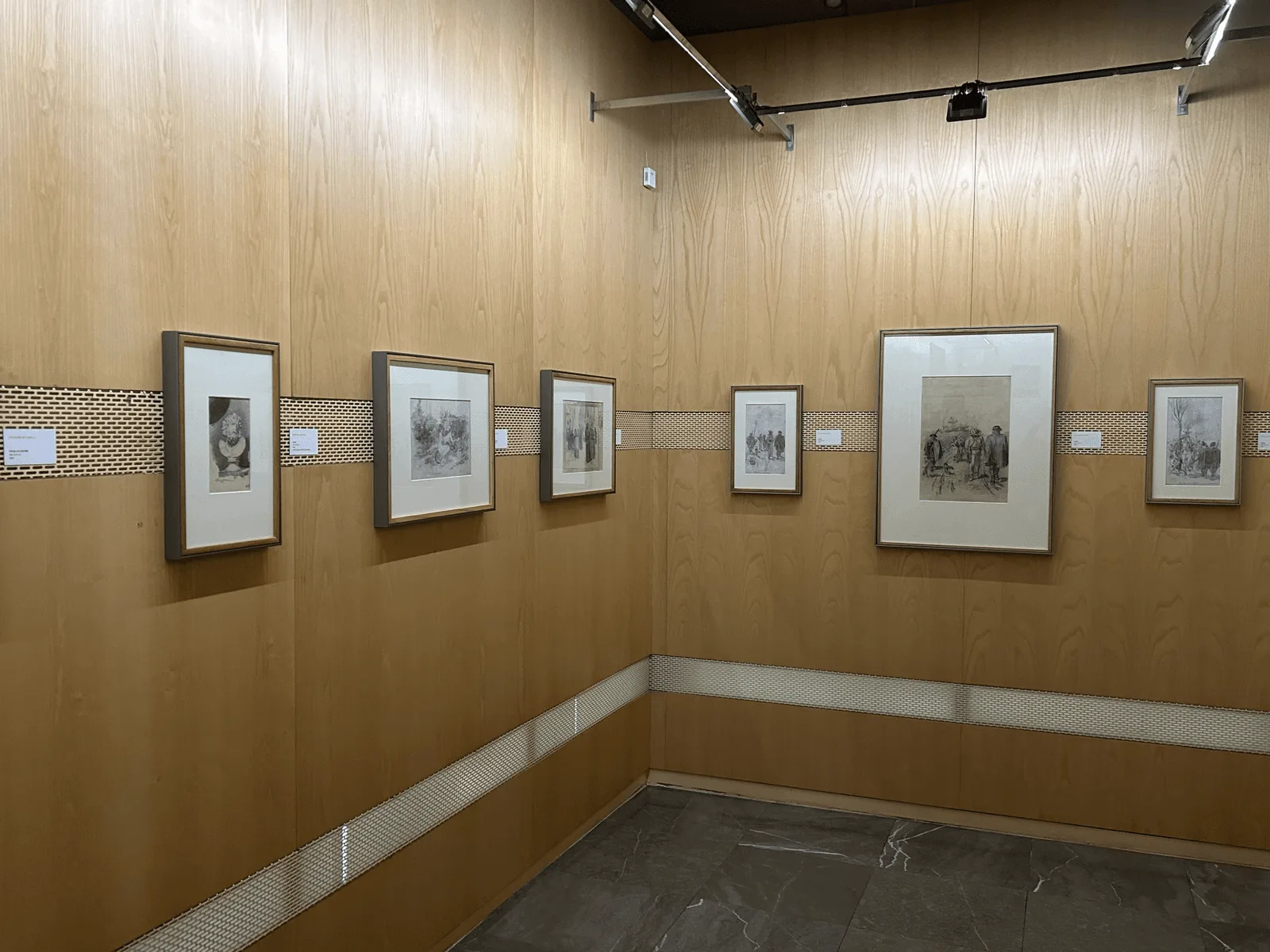
Next, visitors find a new panel with information about the artist's drawings. These cover various themes: architectural elements, historical subjects, biblical scenes, literary topics, portraits, genre scenes, social critiques, and preparatory sketches for his paintings. The exhibition places special emphasis on his formative years at the Royal Academy of San Fernando and his subsequent stay in Rome. A set of drawings inspired by medieval history and works by Shakespeare (such as Romeo and Juliet) demonstrate an unusual technical sophistication for his youth. Additionally, his architectural studies for the manuscript Córdoba Monumental y Artística (by his father, Rafael Romero Barros) showcase a masterful handling of pen-and-ink, graphite, and wash.
On the other hand, it is necessary to mention the illustrated letters, perhaps the most human element in the room. These missives sent to his family, filled with types of people and classical monuments captured with astonishing technical skill, earned him the nickname of «Cordoban Fortuny», a reference to painter Mariano Fortuny y Marsal.
Finally, the exhibition highlights his work as an illustrator for literary magazines such as La Gran Vía or the Almanaque del Diario Córdoba. This detail is crucial: Rafael was not just a museum artist but also a visual communicator who brought his aesthetic and social message to publications of great reach in the 19th century.
Room III
Once past Room II, which connects these two exhibition spaces, visitors arrive at Room III where they find drawing and oil paintings on canvas. This section leads through the artist's darkest years, yet also his most brilliant in terms of creativity.
An informational panel sets the context for the artist’s life, highlighting a crucial moment: the International Exhibition of Fine Arts of 1892. Rafael participated with his work In Search of Homeland or Emigrants Aboard, a piece that represents the pinnacle of his committed realism. However, despite recognition from the jury, intrigues and "great influences" in favor of other artists deprived him of the second prize medal he deserved, relegating him to third place. This professional disappointment, according to contemporary chronicles, deeply affected his health and spirits.
This was compounded by the deaths of his father (1895), his son Ángel —who was less than a year old—, and his wife Remedios Alcalde. After these losses, the artist returned to his family home, where he died of tuberculosis on July 29, 1898, leaving his daughter Julia in the care of relatives.
Throughout the rooms, visitors can view portraits, nudes, illustrated letters, historical scenes such as Colón Leaving the Mosque (1892), and scenes from his committed realism like The Last Sacraments or The Injured Mason (1890).
On the panel, visitors can read the wrenching poetry that Ricardo de Montis dedicated to him on the first anniversary of his death, which the exhibition reproduces with accuracy. He is described as a "gladiator... who fell in the end with mortal wounds."
Flyers
Regarding the exhibition flyers, visitors can purchase one at the museum entrance (figure 3). It offers information about Rafael Romero de Torres's life and work, images of his works, and a large-scale version of the exhibition poster. Through a folding system, the document gradually increases in size from A5 to A2.

Conclusion
In conclusion, Rafael Romero de Torres was a pioneer in his field. His premature death at 33 years old deprived art history of a career that pointed towards modernism and which decisively influenced the social phase of his brothers Enrique and Julio.
This exhibition rescues the life story of an artist whose early death and lack of preserved documents in the family archive have relegated him to a secondary role. The Museum of Fine Arts of Córdoba, with exquisite sensitivity, manages to make Rafael Romero de Torres no longer just "the brother of" but once again the genius of noble ideals who sought through his art a more just homeland.
In summary, this show reflects the work of recovering a figure who knew how to fuse Roman classicism with social denunciation, anticipating the concerns of the Generation of '98. Rescuing his artistic legacy allows us to understand the evolution of Spanish art towards modernity.
Bibliography
Museum of Fine Arts of Córdoba. (s.f.). Rafael Romero de Torres: From Academicism to Social Realism. Museum of Fine Arts of Córdoba. Junta de Andalucía. Retrieved from


Comments