
The book The Infinity in a Reed, published by the editorial Siruela, is written by author Irene Vallejo, who holds a degree in Classical Philology and a European Doctorate from the universities of Zaragoza and Florence. As for her publications, besides "The Infinity in a Reed," which has received numerous awards and recognitions, she is also an author of novels, anthologies, essays, and children's books, among others.
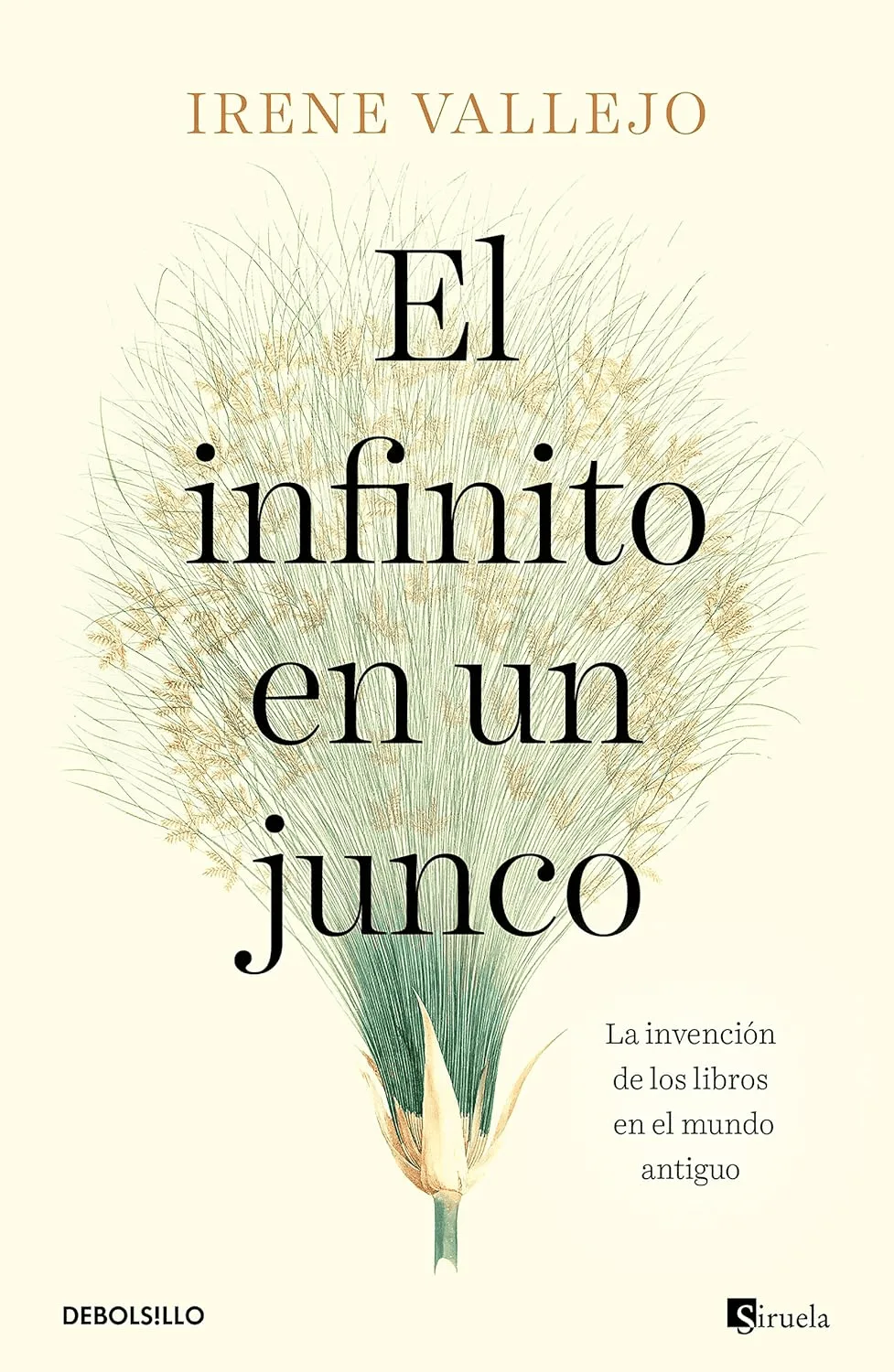
A marvelous account of letters and scents, a symbol of survival across millennia marked by change and censorship, where the power of words, in this case written, refuses to yield and abandon us. From reed and clay to electronic ink, the magic of letters never fails to captivate.
This is not just any book; the history of books is a direct reflection of our own history, full of turbulent times, historical ups and downs, uncertainty, where our very existence was (and always will be) in doubt. In the face of this, humanity has experienced brilliant moments worthy of entering history, with advancements in all fields, from medicine to Artificial Intelligence, passing through the invention of the printing press. The importance of each event is debatable, but they have all marked the course of human history over the centuries. We would not be who we are without these revolutions, and neither would I be writing this review without the invention and survival of some strange and complex symbols that we call letters, which form words.
Well, where am I going with this? The invention of books represents one of the most important events in our history, and it seems that not enough relevance is given to it. It's common to advocate for the Industrial Revolution or the current Technological Revolution, both of great significance. However, much of what we know today would not have been possible without a series of anonymous millennia-old individuals who decided to develop and evolve the writing system, making it possible for written documentation to be born: administrative documents, legal codes, speeches, and literature. As the reader will learn during their reading of this work, the survival of books has never been easy, and perhaps the chance or magic that letters exude and captivate us has enabled humanity, busy with its own survival and constant wars, to find time and strength to accompany the book on its journey to our days, a perilous and abrupt journey but also full of magic and adventure.
The book begins with an introduction where the author is honest with the reader about the great difficulty in tackling such an extensive topic as the origin and evolution of books. Our journey starts in Egypt, specifically in Alexandria, where we are told about the origins of books and their importance to the most powerful figures in Ancient Egypt. The work offers a historical context for each period we encounter, along with its key historical figures, which adds dynamism and interest to the narrative.
The author blends essay and novel styles with an engaging writing style. While narrating how life was in a given era, always focusing on books, she provides context to introduce important characters and their adventures. An example of this is Alexander the Great, founder of Alexandria, a city known for, among other things, the Alexandria Library. Another key figure is Ptolemy, who founded Ptolemaic Egypt, which lasted until 30 BC when Rome took control of the province of Egypt with the fall of Cleopatra and Mark Antony.
With elegant and human prose, the author transports us to the origins not only of books but also of writing, from primitive tablets to the magnificent parchment, all adorned with stories and characters around these lettered supports. Furthermore, the adventure of books throughout history is interwoven with personal stories and multiple references to books or films, creating a pleasant connection between writer and reader, making the reading more enjoyable in our journey through letters. The author's personal experiences enrich the reading immensely and bring us closer to her intimate side; in some way, we can feel reflected in her experiences because most of us have experienced similar situations.
The history of the emergence of the alphabet is also remarkable, giving special importance to the slow and gradual process necessary for prose to establish itself over orality, which was one of the most symbolic elements of human beings, being the principal medium for the transmission of knowledge and cultural legacy between generations.
From my humble platform, I extend my sincerest congratulations to Irene Vallejo for the wonderful adventure she has allowed me to experience. With elegant prose, a subtle but very pleasant touch of humor, and narration filled with emotion, the reader will empathize with Irene's experiences and our distant ancestors who have bequeathed us their infinite and eternal writings, survivors of the most hostile moments. Our literary parents.
Bibliography
Vallejo, I. (2019). The Infinity in a Reed: The Invention of Books in the Ancient World. Siruela.


Comments