
The temporary exhibition being reviewed is "Egypt of Eduard Toda. A Journey into 19th Century Collecting", presented by the National Archaeological Museum from June to October 2025, curated by Andrea Rodríguez Valls (CSIC) and Miguel Ángel Molinero Polo (University of La Laguna). This exhibition focuses on the figure of Vice Consul Eduard Toda i Güell (1855-1941) and his journey to Egypt between 1884 and 1886, through archaeological material from the museum itself that Eduard Toda donated to the state upon returning to Spain, as well as documentation brought from the Library-Museum Víctor Balaguer located in Vilanova i la Geltrú (Barcelona).
The exhibition begins with an introductory panel showing the precedents of Eduard Toda's expedition related to Egyptian culture. Following this, there is an introductory panel outlining the purposes and theme of the exhibition, featuring a well-known photograph of Eduard Toda dressed as a mummy. This small detail demonstrates Toda’s own enthusiasm for ancient Egyptian civilization. Accompanying these are some pieces brought from Egypt, such as an Isis nursing figure from the Hellenistic period and a sistrum from the 1st century BC. These objects perfectly illustrate the two years during which, as a diplomat, he traveled across the territory in company with local egyptologists and other regions. Next, there is a map highlighting the places visited by the diplomat during his stay in Egypt. This point is interesting because it helps visitors locate the geographical points that Eduard Toda attended to during his time in Egypt. Another notable aspect of this first part of the exhibition is the display of uniforms used by Toda during the expedition, as well as documents (also books) brought from the Víctor Balaguer Library archive which he donated upon returning to Spain.
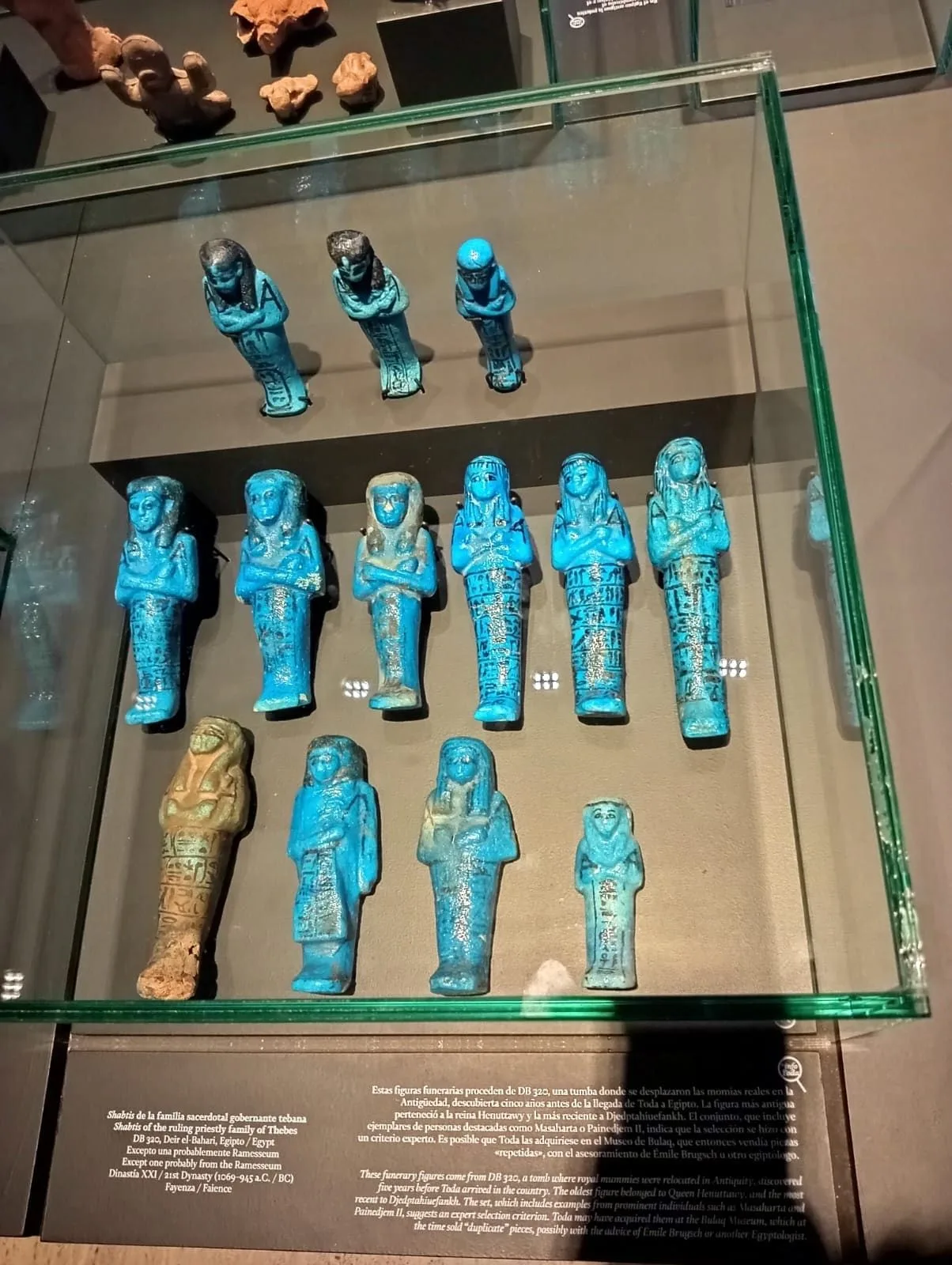
During the exhibition, other pieces brought from Egypt are displayed, including Ushebtis in lapis lazuli (Figure 1), and others belonging to Theban tombs as everyday materials, some made of linen and esparto. All this material is supported by explanatory panels that facilitate understanding for visitors. Other notable elements include projections showing archival images of locals photographed during his stay at each location where he stayed. These photographs illustrate the close relationship he maintained with local residents.
The tomb of Sennedjem (TT1) plays a significant role, as Toda himself participated in Gaston Maspero’s excavation in 1886 (Molinero Polo and Rodríguez Valls, 2022, p. 4). This tomb belonged to an artisan from the 19th dynasty, where numerous burial goods, sarcophagi, and paintings were found that accompanied the deceased into the afterlife.
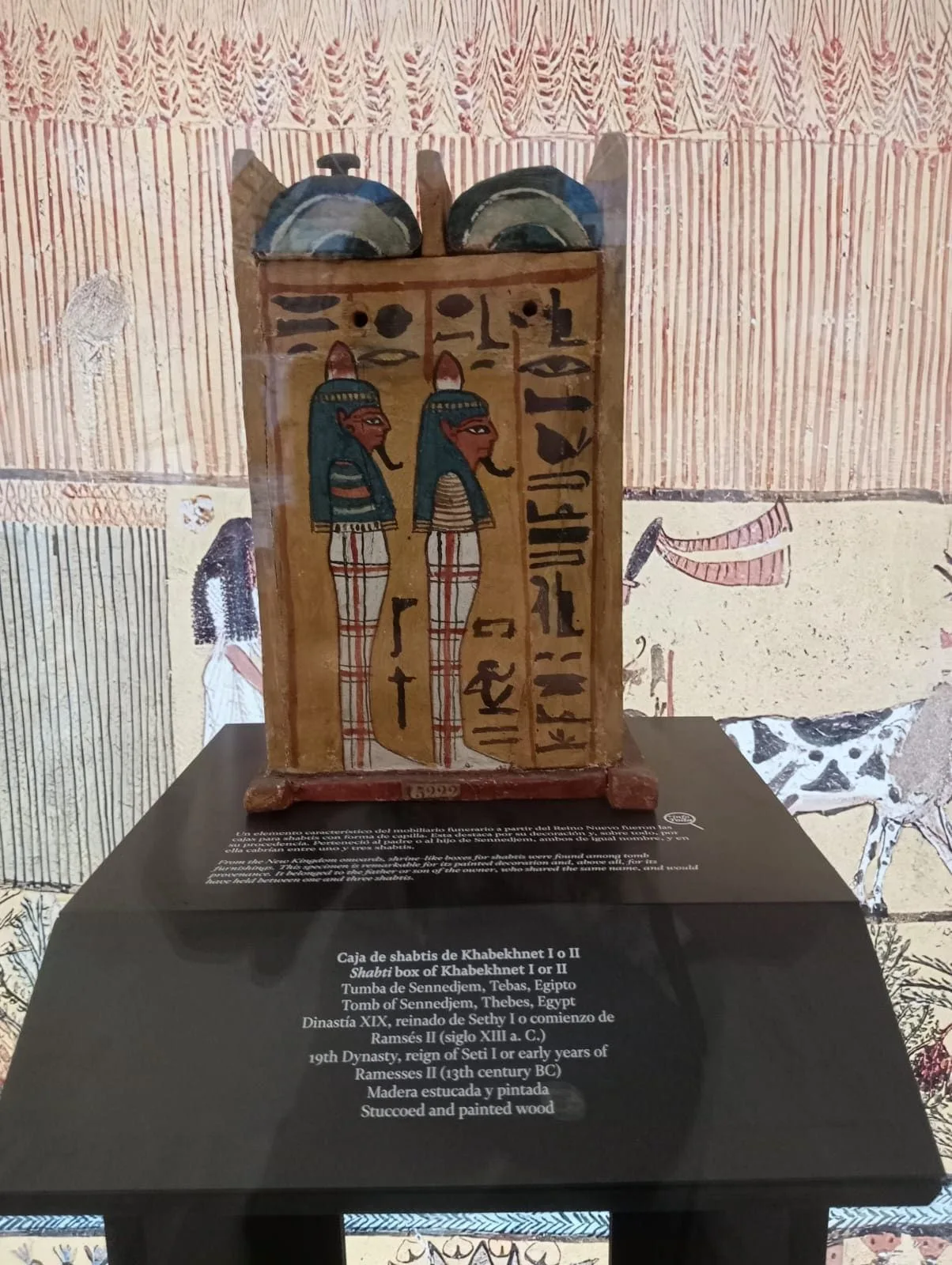
Next, we reference the room prepared for displaying the Ushebtis Box (Figure 2), a unique piece as it serves as a replica of the burial chamber where the item was deposited. This detail is significant because it allows visitors to understand Egyptian religious beliefs and funerary practices, as well as the concept of passing into the afterlife. This complements other archaeological objects such as sarcophagi, Ushebtis, Canopic jars, or everyday items belonging to the deceased that are displayed upon exiting the recreated tomb.
Lastly, it cannot be overlooked that photography plays a crucial role in this exhibition. As mentioned earlier, the decoration includes images such as Eduard Toda dressed as a mummy or locals from the places he visited. The early incorporation of photography even during archaeological fieldwork in the second half of the 19th century has made detailed photographic documentation of Toda’s journey possible, including photographs of the excavation of Sennedjem's tomb, using photography as a substitute for tracing (Molinero Polo, 2020, pp. 16-17), a method that served to document with greater precision and is now considered a key instrument in archaeological methodology.
The exhibition has made full use of all available resources from the museum as well as existing documentation on the diplomat, who, although not a historian himself, is regarded as a pioneer in Spanish Egyptology. In the words of Miguel Ángel Molinero Polo: "Although one of the precursors of Spanish Egyptology, it cannot be forgotten that his professional role was that of a diplomat and, more importantly, that he had to carry out this role with dedication and competence…" (Molinero Polo, 2017, p. 2).
With Miguel Ángel's words, corroborated by the displayed pieces and documents from the Víctor Balaguer Library, one can delve into a suggestive idea that is perfectly expressed in this exhibition: although Eduard Toda went to Egypt to carry out his diplomatic duties as vice consul, he cultivated an incipient passion for ancient Egyptian civilization with great care, carrying out excavation work – referring to the aforementioned tomb of Sennedjem – and cataloging the found pieces, along with writings about the excavation. It is therefore that we can consider Eduard Toda as the first Spanish Egyptologist per se (Pons Mellado, 2018, p. 12), in addition to leaving behind an invaluable legacy by donating these pieces to the Spanish state.
This exhibition is undoubtedly a reflection of Eduard Toda's work and effort to bring documented and cataloged pieces from Egypt to Spain, with the aim of exhibiting them and allowing visitors to understand ancient Egypt. Additionally, it provides – after being donated to the National Archaeological Museum – insight into the importance of Egyptian culture.
Finally, it is essential to thank the exhibition curators, the National Archaeological Museum's direction, participating departments, and all researchers for their contribution in recovering Eduard Toda’s figure and his work in Egypt. They have succeeded in reclaiming the significance of his journey to Egypt, which marked the foundational milestone of Egyptology as a discipline within Spanish academic institutions.
Bibliography
Molinero Polo, M. Á. (2017). Eduard Toda i Güell in Egypt (1884-1886), In Aula orientalis: journal of studies on Ancient Near East, Vol 35 (2), 291-318. https://dialnet.unirioja.es/servlet/articulo?codigo=6425630
Molinero Polo, M. Á. (2020). Eduard Toda i Güell and the discovery of Sennedjem's tomb, An alternative memory, In The Ancient Near East and Pharaonic Egypt in Spain and Portugal: travelers, pioneers, collectors, institutions and reception, Edicions de la Universitat de Barcelona 219-240. https://riull.ull.es/xmlui/handle/915/41262?show=full
Molinero Polo, M. Á., and Rodríguez Valls, A. (2022), The inspection trips to Upper Egypt and the archive of Eduard Toda, University of La Laguna. https://doi.org/10.25145/b.2023.08
Pons Mellado, E. (2018). The Egyptian collection of Eduard Toda i Güell at the National Archaeological Museum, In Archaeology of Museums. 150 years of creation of the National Archaeological Museum: proceedings of the V International Congress of History of Archaeology/IV Days of History SEHA-MAN, 1075-1090, Subdirector General of Documentation and Publications. https://dialnet.unirioja.es/servlet/articulo?codigo=6535380


Comments