
The Jōmon period (縄文時代, joumon jidai) is the prehistoric chronological period of part of the Japanese archipelago, which spans approximately from 17,000 to 2,300 BP (15,000 – 300 BCE). This is a broad chronological range that varies depending on the author, the relative or absolute dating method used, and even the geographical region, as the changes used to define its chronological limits do not start and end at the same time. Due to this, in this article, a synthesis of various proposals for periodization of Jōmon communities and those characteristics that best define them is presented. With this, it aims to identify a chronological framework that facilitates the study and understanding of these communities without diminishing the importance of the diversity of moments and groups in which these changes are produced.
From Rope to Pottery: The Meaning of "Jōmon"
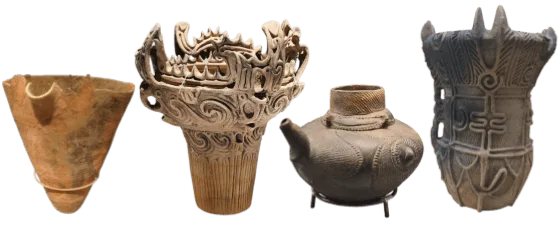
The term Jōmon (縄文, joumon) is written with two kanji: 縄 (jou) «rope» and 文 (mon) «phrase, style, art, decoration, composition», literally meaning «rope pattern pressed into clay/pottery», or more briefly, «marked/stamped with ropes», «decorated/composed with ropes», or «pottery impressed with/with rope» (e.g., Habu, 2004; Kobayashi and Nakamura, 2004). This term comes from the English expression «cord marked pottery», as the primary feature used to date this period and identify this “prehistoric culture” is pottery (Kobayashi and Nakamura, 2004). Additionally, Jōmon pottery stands out for being among the oldest ceramic evidence in the world and for presenting a great morphological, technical, decorative, and functional richness with few parallels within handmade ceramics (e.g., Habu, 2004; Kobayashi and Nakamura, 2004; Lana del Amo, 2024).
Jōmon Culture Periodization: Chronology and Archaeological Indicators
The chronological divisions made based on pottery have allowed gradual changes and innovations to be defined over time (Edward Kidder and Esaka, 1964; Kobayashi and Nakamura, 2004). Below is a synthesis and reformulation in six major phases that aim to homogenize these changes so as to facilitate the understanding and study of this period. It should be noted that although pottery has been used to divide the phases, it is absolute dating that defines their chronological range:
- Incipient/Initial (草創期, sousouki) (17,000/16,000/13,000 – 11,500/10,000 BP). Notable from this period are the AMS (Accelerator Mass Spectrometry) and Carbon-14 (C-14) dating of ceramics and wood at the Ōdai Yamamoto I site (Sotogahama, Aomori), which give approximate dates around 16,500 BP (14,500–14,000 BCE). This is a seasonal or short-term village located on a river terrace where semi-sedentary hunter-gatherer and fishing communities lived (Nakamura et al., 2001).
- Early (早期, souki) (11,500/10,000 – 7,000/6,000 BP). Notable are the C-14 dated plants such as fossil fruits of Cannabis sativa, from the coastal site of Okinoshima (Tateyama, Chiba), dating to around 8,955 + 45 cal BP. It appears that this plant species was used or managed as a medicinal remedy or psychoactive substance by these communities (Kudo et al., 2009).
- Late Early/Middle Early (前期, zenki) (7,000/6,000 – 5,500/5,000 BP). Notable are the radiocarbon dates of macrofossils and other organic materials found in the layers of the Torihama shell midden (Wakasa, Fukui), with dates between 6,500-5,655 cal BP. This is a shell midden with an occupation spanning from the Jōmon Incipient to the Jōmon Early Late period, crucial for understanding the diet of these communities (Noshiro et al., 2016).
- Middle (中期, chuuki) (5,500/5,000 – 4,400/4,000 BP). Notable are the C-14 and AMS dates of organic samples such as charcoal and residues adhered to ceramic vessels from the Sannai-Maruyama settlement (Aomori, Aomori), with a chronological range approximately between 5,900 and 4,400 BP. This is one of the largest and best-studied settlements in this period in northern Japan (Habu, 2008).
- Late (後期, kouki) (4,400/4,000 – 3,200/3,000 BP). Notable are the radiocarbon dates of plant and faunal remains from the Ubayama shell midden (Ichikawa, Chiba), dated between 4,500 and 3,000 BP. This is a site important for studying coastal habitats in marshes and forests, as well as one of the first archaeological contexts where absolute radiocarbon dating techniques were applied (Libby, 1951).
- Final (晩期, banki) (3,200/3,000 – 2,800/2,400/2,300 BP). Notable are the radiocarbon and AMS dates of human remains from the Ikawazu shell midden (Tahara, Aichi), with approximate dates between 3,230 and 2,140 BP. This is a shell midden that was also used as a ritual burial space, providing information on the diets and burial practices of these communities (Kusaka et al., 2015).

Conclusions
In summary, the Jōmon period (17,000 – 2,300 BP, 15,000 – 300 BCE) is a prehistoric period of part of the Japanese archipelago associated with communities that were predominantly hunter-gatherer and fisher-folk who are characterized by their use of distinctive rope-impressed pottery. The essence of this period lies in its variability and diversity, as changes occurring relative to preceding and following periods gradually developed in each region of the archipelago.
Bibliography
Habu, J. (2004). Ancient Jōmon of Japan. Cambridge University Press.
Habu, J. (2008). Growth and decline in complex hunter-gatherer societies: a case study from the Jōmon period Sannai Maruyama site, Japan. Antiquity, 82(317), pp. 571-584. https://doi.org/10.1017/S0003598X00097234
Kobayashi, T., Nakamura, O. (2004). Jōmon Reflections: Forager Life and Culture in the Prehistoric Japanese Archipelago. Oxbow Books.
Kudo, Y., Kobayashi, M., Momohara, A., Noshiro, S., Nakamura, T., Okitsu, S., Yanagisawa, S., Okamoto, T. (2009). Radiocarbon dating of fossil hemp fruits in the earliest Jōmon period excavated from the Okinoshima site, Chiba, Japan. Japanese Journal of Historical Botany, 17(1), pp. 27-31. https://doi.org/10.34596/hisbot.17.1_27
Kusaka, S., Saso, A., Yoneda, M. (2015). Radiocarbon dating and carbon and nitrogen isotope analysis on human skeletal remains from Koh and Ikawazu sites of the Jōmon period. Anthropological Science, 123, pp. 31-40. https://doi.org/10.1537/asj.150414
Lana del Amo, A. (2024). The Jōmon and Their Pottery [Bachelor's Thesis, University of Zaragoza]. Zaguan: Institutional Repository of Documents. https://zaguan.unizar.es/record/147341
Libby, W. F. (1951). Radiocarbon dates, II. Science, 114(2960), pp. 291-296. https://doi.org/10.1126/science.114.2960.291
Nakamura T, Taniguchi Y, Tsuji S, Oda H. (2001). Radiocarbon Dating of Charred Residues on the Earliest Pottery in Japan. Radiocarbon, 43(2B), pp. 1129-1138. https://doi.org/10.1017/S0033822200041783
Noshiro, S., Kudo, Y., Sasaski, Y. (2016). Emergence of prehistoric management of plant resources during the incipient to initial Jōmon periods in Japan. Quaternary International, 426, pp. 175-186. https://doi.org/10.1016/j.quaint.2016.04.004


_(%E5%9B%BD%E5%AE%9A%E6%8C%87%E5%AE%9A%E7%95%AA%E5%8F%B71).JPG)


Comments