


The Presence of Chinese Ceramics in al-Andalus
Ceramics serve archaeologists as an indicator of cultural and commercial exchanges in the past. The presence of Chinese ceramics in al-Andalus allows for analyzing the process of cultural exchange between the Islamic world and East Asia. This exchange was facilitated through various mechanisms, such as trade and diplomatic gifts that allowed Chinese ceramics to reach Islamic territories, including its westernmost extremity: al-Andalus.
Archaeological Evidence
When we talk about Chinese ceramics, we refer to fragments of both porcelain and celadon. These are highly durable ceramics made with kaolin, which is heated to 1100-1300 ºC until it reaches a semi-vitrified state. In the West, we differentiate between celadon, which has a greenish opaque color; and porcelain, which is white and translucent. Despite this distinction in the West, in Chinese, only one term ci (Gutiérrez et al., 2021, p. 1213) is used.
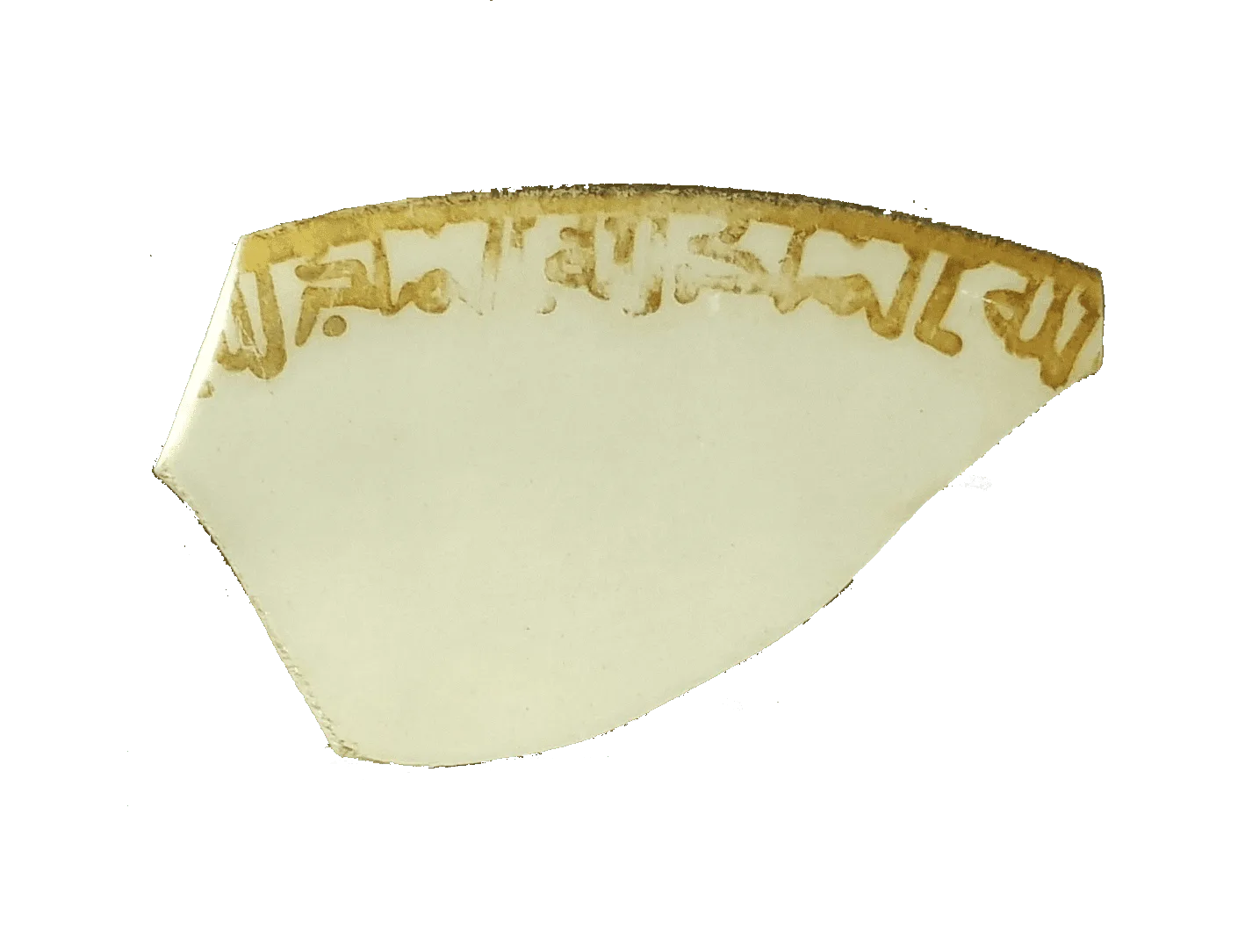
Currently, thirteen fragments of Chinese ceramics are known in Andalusian contexts, coming from six different archaeological sites (Zozaya Stabel-Hansen, 1969; Cabañero Subiza and Lasa Gracia, 2003; Rosselló Mesquida, 2006; Heidenreich, 2007; Hernández Pardos, 2018; Gutiérrez et al., 2021). The first identified set consists of four fragments of porcelain bowls from northern China found in the Almería alcazaba, produced between the 8th/9th and 11th centuries. Notable is a fragment of a bowl with an open lotus flower shape, decorated on the exterior by mold and featuring painted gold epigraphic decoration inside. It bears the inscription al-mulk li-llāh, which can be translated as "sovereignty belongs to God" but contains an error in its writing, presenting a dot under the kaf of the word mulk, interpreted as a result of the craftsman's lack of knowledge of Arabic (Zozaya Stabel-Hansen, 1969).

In the city of Valencia, another important set has been recovered, including two fragments of porcelain from northern China dating to the 11th century and two fragments of celadon from Yue in southern China, dated between the 11th and 12th centuries (Heidenreich, 2007, p. 256). About 40 km away from Valencia, excavations at the Torre Mayor de Cullera revealed two fragments of bowl rims, known as wan. These are likely porcelain produced during the Tang dynasty (618-907) in Xing kilns located in Neiqiu district but appeared in a context dating to the 11th century (Rosselló Mesquida, 2006, pp. 15-18).
Also documented at the Albarracín alcazaba are two fragments of Chinese ceramics. One fragment is part of a porcelain bowl with exterior mold decoration and interior incised floral and lotus leaf designs. It is Qingbai porcelain from Jingdezhen kilns in southern China, dated between the 11th century and the first half of the 12th century. The other fragment is celadon from Yue, possibly dating to the 11th century (Hernández Pardos, 2018, pp. 251-252).
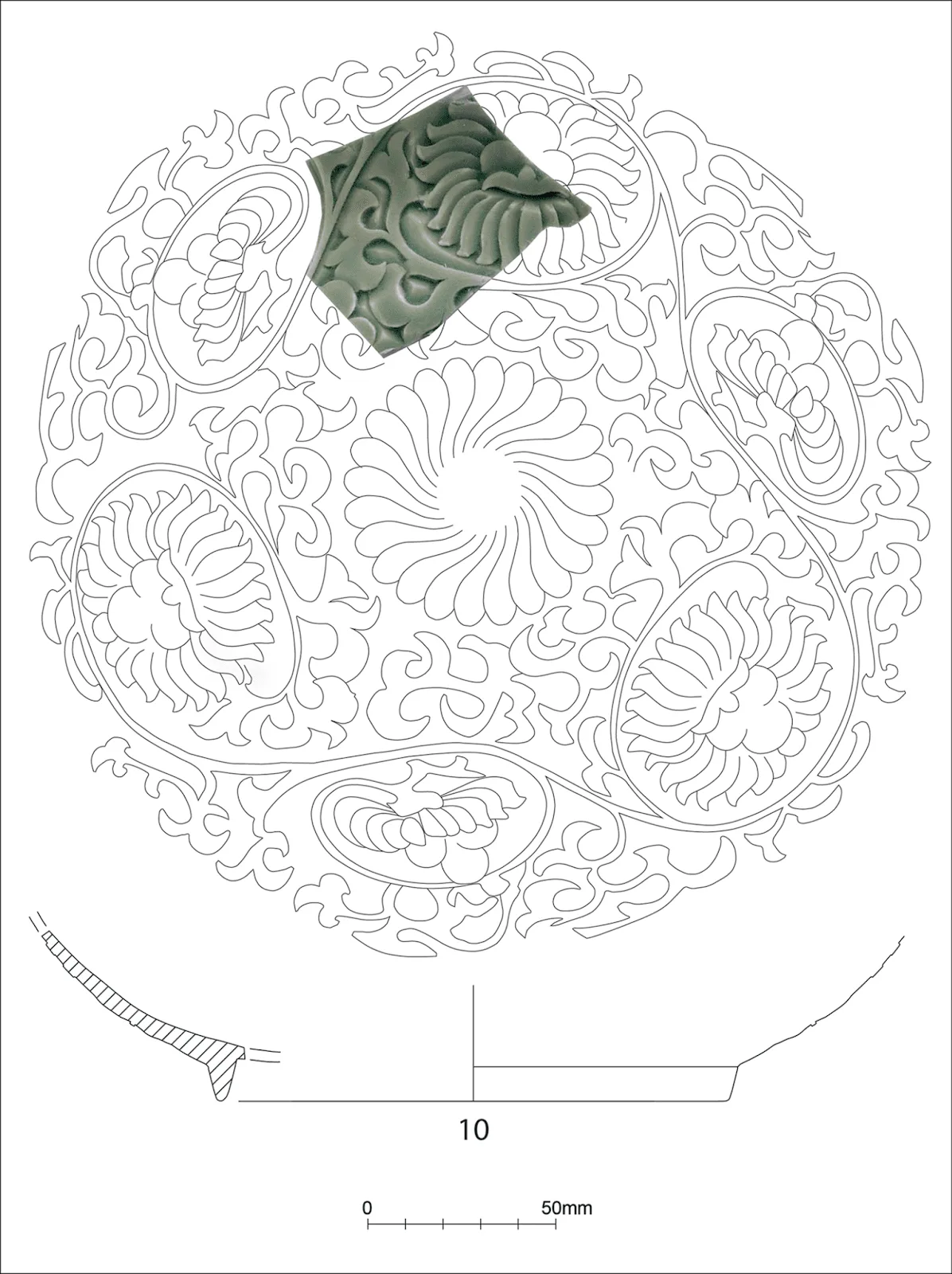
Another significant example comes from the Aljafería of Zaragoza, a palace built by the Hudid monarchs who ruled the Taifa Kingdom of Zaragoza between 1038 and 1110. Excavations yielded a fragment of a celadon plate made during the Northern Song dynasty (960-1127) with mold decoration on both sides representing a peony surrounded by a stem, possibly produced in Yaozhou (Cabañero Subiza and Lasa Gracia, 2003, pp. 258-264).

Mechanisms of Exchange
The presence of these pieces in al-Andalus was often the result of indirect trade between these two points, for which the development of important commercial routes connecting China with the Middle East and others departing from there to the Peninsula were crucial. They are not the result of continuous trade but exotic, singular, and luxury objects.
Although the caravan routes of the Silk Road may have played an important role, it seems increasingly likely that these pieces arrived by sea through the Indian Ocean, connecting the South China Sea with the Persian Gulf and the Red Sea, maritime routes already in operation during the 9th to 10th centuries (Gutiérrez et al., 2021, p. 1223).
For the earliest ceramics, during the Tang dynasty (618-907), it has been proposed that the ceramics would leave from Guangzhou in southern China, while the Abbasid caliphate and the Persian Gulf acted as the main consumer and redistribution center. This dynamic changed in the 10th century when the exchange center moved from Siraf in Iran to the south, to Kish and the Minab area, in line with the political and economic decline of the Abbasid Caliphate and the rise of the Fatimid Caliphate in Egypt. The Fatimid Caliphate then acted as a point of contact and encounter between the East (China, India, and Arabia) and the West (North Africa, Southern Europe, and Western Mediterranean), developing and expanding trade. Among the products were Chinese ceramics and these reached al-Andalus along with other luxury exports from Egypt such as gilded pottery, especially at major Mediterranean ports like Almería or Valencia (Gutiérrez et al., 2021, pp. 1224-1225).
The appearance of these pieces in high-status sites within the Peninsula, often in prominent political centers, indicates that their arrival was not solely dependent on Mediterranean trade accessibility but rather acquiring them was difficult and fell outside more general commercial channels.
Their presence becomes more abundant from the 11th century onwards and must be understood in the context of the taifa kingdoms, a period of greater political fragmentation within the Islamic Peninsula, but which also allowed more Mediterranean ports to trade and strengthen their relationships with the Islamic East, acting as redistributors and increasing their economic importance. This was an era of economic and cultural prosperity for cities like Zaragoza, Albarracín, Valencia, or Almería, where visual arts played a significant role in shaping palace spaces. Furthermore, being present in these representation spaces of rulers points to the transmission of these pieces through diplomatic gifts.
Conclusions
Various findings related to the presence of Chinese ceramics in al-Andalus have been reviewed, highlighting on one hand their strong connection with spaces of power and representation, particularly during the appearance of different ruling dynasties of taifa kingdoms, as a result of luxury trade and diplomatic exchanges. On the other hand, it is material evidence that reminds us of the importance reached by the Middle East and the dynasties, first Abbasid and then Fatimid, as receiving and redistributing centers for products ranging from the far east, China, to the far west, al-Andalus.
Bibliography
Cabañero Subiza, B., and Lasa Gracia, C. (2003). New data for the study of influences from the Middle and Far East in the Islamic palace of Aljafería de Zaragoza. Artigrama: Revista del Departamento de Historia del Arte de la Universidad de Zaragoza, 18, 253-270.
Gutiérrez, A., Gerrard, C., Zhang, R., and Guangyao, W. (2021). The earliest Chinese ceramics in Europe? Antiquity, 95 (383), 1213-1230. https://doi.org/10.15184/aqy.2021.95
Heidenreich, A. (2007). Islamische Importkeramik des hohen Mittelalters auf der Iberischen Halbinsel. Unter besonderer Berücksichtigung der frühen lokalen Goldlüsterproduktion im Untersuchungsraum. Verlag Philipp von Zabern.
Hernández Pardos, A. (2018). The daily life in the Andalusian alcazaba of Albarracín: The testimony of ceramics. In J. M. Ortega Ortega (Ed.), Reconstructing al-Andalus in Aragon: Proceedings II Medieval Archaeology Conference in Aragon, Museum of Teruel, May 26 and 27, 2016, 225-261. Museo de Teruel.
Rosselló Mesquida, M. (2006). Emirate and caliphate ceramics from the Celoquia Tower and the origins of the Castle of Cullera. Qulayra, 2, 7-34.
Zozaya Stabel-Hansen, J. (1969). Al-Andalus trade with the East: New data. Boletín de la Asociación Española de Orientalistas, 5, 191-200.


Comments