


Human childbirth is a process that we know very well when it comes to our own species. We understand the different stages of development and, of course, are aware of its difficulty. A difficulty that lies precisely in those characteristics that make us unique, mainly bipedalism and cranial capacity. Our evolutionary history began about 7 million years ago, and consists of numerous changes that led to the adaptation of various species to their environment. One of the most significant changes was the acquisition of bipedalism. A process that lasted thousands of years and resulted in numerous anatomical variations:
o The central position of the foramen magnum, compared to its posterior position in non-bipedal primates.
o The acquisition of an «S» shape in the spine, which allows for better weight distribution during bipedal locomotion.
o The inward tilt of the femur.
o The alignment of the big toe with respect to the other toes, allowing for greater surface area contact while walking.
o Variations in the pelvis, making it wider and shorter than that of non-bipedal primates.
Thanks to discoveries made so far, we know that these anatomical adaptations had very important consequences for human childbirth. The pelvises of prehistoric species preserved in the fossil record allow us to delve into some aspects of childbirth among those hominins. It is not just about the size and characteristics of the pelvis, as the size of the fetal skull also influences the birthing process. Unfortunately, it is very difficult to recover such remains, especially the further back we go in time. Therefore, many times complex mathematical calculations are necessary to determine what sizes the fetuses and neonates of australopithecines and early representatives of the genus Homo might have had.
What does the fossil record tell us about this fascinating process of childbirth? We will start with one of the best-preserved skeletons known to all: Lucy (individual AL-288-1). Lucy was an adult female of the species Australopithecus afarensis who lived in eastern Africa around 3.2 million years ago. Thanks to the preservation of about 40% of her skeleton, we know that she was a bipedal species, although she maintained certain characteristics that conferred great ability for moving through trees. Probably, this species would live in dense forest areas but with large open spaces between them. Therefore, they would move through the trees looking for food, but would be "forced" to walk from one wooded area to another. Lucy's pelvis indicates that it had an elongated pubis, very similar to ours. Considering that the cranial capacity of this species was around 450 cm3, similar to that of chimpanzees, we could think that her birth canal would be somewhat wider than today. As for the genus Homo, a nearly complete pelvis was discovered in Gona (Ethiopia) belonging to the species Homo ergaster/Homo erectus that lived 1.8 million years ago. This discovery reignited debate about childbirth among hominins. The researchers responsible for the study proposed that both australopithecines and early representatives of the genus Homo have pelvises that are moderately wide, so they probably would not have rotational births.

Within the world of Neanderthals, we are fortunate that numerous fossil remains have been recovered and generally in very good condition. However, in some cases like the pelvis of Kebara 2, sacral deformation led to the hypothesis (which was later rejected) that Neanderthals had a narrow birth canal and would therefore have difficulty giving birth. Thanks to the most innovative CT techniques today, it is possible to perform three-dimensional reconstructions with a high level of reliability. Studies conducted so far suggest that female Neanderthals would have a wider birth canal than those of our species, which could mean they had greater ease in childbirth. However, the Neanderthal species had an average cranial capacity larger than Homo sapiens. It would therefore be necessary to know the development of the fetal brain to establish the proportion between skull size and birth canal size at the time of birth. For this purpose, three-dimensional reconstructions were made of a newborn Neanderthal's (Mezmaiskaya, Russia) cranium, two neonates' (Dederiyeh, Syria), and the female pelvis of Tabun 1 (Israel). The researchers concluded that these hominins already had rotational births (like ours) and would have been difficult due to the narrowness of the pelvic canal compared to the baby's skull. However, another team of researchers proposed an opposing hypothesis suggesting that the birth canal was wide enough for a rotation not to be necessary during delivery.
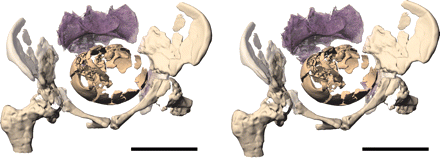
In conclusion, we can say that childbirth is an intriguing topic not without debate and one that continues to be researched. It is not only interesting to know this process in prehistoric species but also to focus on current primate species such as chimpanzees. All with the aim of shedding light on a question that still entails many uncertainties. As we have observed, the key to these studies lies in knowing both the size of the pelvis and the size of the baby's skull at birth, since their relationship will influence the greater or lesser difficulty of childbirth. Despite the lack of preservation of bone remains in the fossil record being a great obstacle, the hope for new scientific discoveries and analytical techniques is an excellent incentive for continuing research.
Bibliography:
- Huseynov, A., Zollikofer, C. P., Coudyzer, W., Gascho, D., Kellenberger, C., Hinzpeter, R., de León, M. S. P., 2016. Developmental evidence for obstetric adaptation of the human female pelvis. Proceedings of the National Academy of Sciences, 113(19), 5227-5232.
- Lovejoy, C. O., 2005. The natural history of human gait and posture: Part 1. Spine and pelvis. Gait & Posture, 21(1), 95-112.
- Ponce de León, M. S., Golovanova, L., Doronichev, V., Romanova, G., Akazawa, T., Kondo, O., Ishida, H., Zollikofer, C. P., 2008. Neanderthal brain size at birth provides insights into the evolution of human life history. Proceedings of the National Academy of Sciences, 105(37), 13764-13768.
- Ruff, C., 2010. Body size and body shape in early hominins–implications of the Gona pelvis. Journal of Human Evolution, 58(2), 166-178.
- Simpson, S. W., Quade, J., Levin, N. E., Butler, R., Dupont-Nivet, G., Everett, M., Semaw, S., 2008. A female Homo erectus pelvis from Gona, Ethiopia. Science, 322(5904), 1089-1092.
- Weaver, T. D., Hublin, J. J., 2009. Neandertal birth canal shape and the evolution of human childbirth. Proceedings of the National Academy of Sciences, 106(20), 8151-8156.
- Zollikofer, C. P., Ponce de Leon, M. S., 2010. Reconsidering Neanderthal birth: Tabun mom, Kebara dad, Mezmaiskaya baby, and the consequences. In: American Journal of Physical Anthropology (pp. 252), Volume 141, Issue S50 (April 2010).


Comments