


Everything is being affected by Machine Learning (ML), from appliances to vehicles, but what about archaeology?
In this article, we will break down the differences between artificial intelligence (AI), Machine Learning (ML) and deep learning (DL) to see how they are impacting society and their influence on archaeology. Let's begin!
Every day brings us more news about technology advancements. In recent years, this technology has been closely linked to concepts such as artificial intelligence (AI), Machine Learning (ML) and Deep Learning (DL). But what are they and how do they differ? Briefly put, we could say that AI is a machine capable of mimicking human thought while ML would be a subset of AI where machines, trained by people, learn to recognize patterns and make predictions. Lastly, deep learning would be a subset of ML where the machine can reason and draw conclusions on its own. However, these definitions are very superficial and do not delve into the complexity of their realities. Throughout this article, we will refer to Machine Learning as encompassing both itself and Deep Learning to avoid excessive complexity in reading.

Defined briefly, let's move on to 'why' they are used.
Little by little we understand that it is no longer about simple algorithms or recipes where instructions are chained together more simply. These systems can connect with the environment to make decisions. In very brief terms, and for what concerns us in this article, we can illustrate one of the noblest purposes this new intelligence can have: medicine and the search for cancer patterns. While an oncologist relies on their learned knowledge and experience to identify cancer through X-ray images, artificial intelligence may have had access to hundreds of thousands of past records to deduce a new clinical approach for the patient. But someone had to teach the robot in this case. In programming, this is called supervised Machine Learning since as we indicated, it needs a supervisor who classifies inputs beforehand so that the machine can generate outputs. A closer example is when we ourselves supervise by sending emails to Spam. Each time you send an email to Spam, your digital mail manager takes note for future occasions; in other words, we are training the algorithm.

Fields of application such as robotics, medicine, smart cars, security with video surveillance cameras and the recognition of people, among many others, are being greatly benefited by this new technological wave to the point where possibly many jobs will be replaced by robots that are faster, more precise, and without maternity leave or labor strikes, which could likely generate social crises as Yuval Noah Harari illustrates in his work Homo Deus when referring to the Useless Class, or that class of workers displaced by this new robotic reality. However, not all professions have the same probability of disappearing because not all labor processes follow the same patterns. The job of a warehouse stocker is easily replaceable by a robot, as already occurs with Machine Learning algorithms accessing global databases of cancer evidence. We must admit that there are things computers do much better and faster than us. However, it's not all like this.
There exist tasks, due to their creativity, a computer is still very far from being able to develop. Although science fiction exemplifies this recurrently and with apparent simplicity, the reality is that current robotics is far from matching the brain. Easily today a computer can compose a musical work in Bach's style based on his other works:
However, computational creativity in the arts is a topic of debate that moves beyond mathematics and delves into philosophy. In relation to this, and given that archaeology work combines delicate excavation levels to avoid breaking pieces with continuous relatively creative decision-making, could we say that an archaeologist's job is free from threats during this labor crisis? Would the archaeologist be outside of the aforementioned Useless Class?
Although Yuval Noah Harari suggests that jobs like an archaeologist's will not suffer as much, perhaps we should analyze in depth the parts of such work and see the possible impact of Machine Learning on each one.
The field archaeologist and artificial intelligence
One cannot understand a field excavation without an on-site archaeologist, at least for now. If we have been able to direct a robotic arm from Earth so that a robot like the Perseverance Rover can collect samples and make small excavations, what prevents excavations from being carried out from an office throughout the year while only robots or groups of them are at the site? If we've seen how years ago a small robotic arm was capable of picking up an egg or water balloon without breaking it, why couldn't a similar or more sophisticated one collect fragments of glass or bone found during an excavation? If we add to this a humidity control system, solar incidence monitoring, and soil condition and type recording while also capturing the appropriate photographic images for research and inventory, the field archaeologist's work would not be necessary; it could all be controlled from an office, though that would certainly be less romantic and Indiana Jones' hat wouldn't have much use indoors.
But everything mentioned above would be with an archaeologist behind the screen analyzing, deciding, probably moving various tools available to the robot but from another location. Now, could there come a time when it's directly the robot that excavates a site? If Google can identify a song based on my friends' humming, I find it hard to imagine that excavation processes cannot be developed by robots. It could recognize through thermography, much earlier than we can, if the soil moisture has changed or an object has appeared, avoiding visual fatigue. Colors are not perceived equally at first light compared to last light; familiarity with certain tones also influences and luminosity helps and complicates differentiation. All these aspects would be negligible for a well-calibrated camera.
This could greatly change emergency archaeology, which currently is limited to covering only a small percentage of the site's surface but with this new reality might cover it entirely in less time and who knows if at a lower cost. And here comes something very notable: despite the absence of an on-site archaeologist, the resulting information could be much greater and consequently, the need for more hours of work by the archaeologist from their office.
The laboratory archaeologist and artificial intelligence
But couldn't new tools be used in the lab to make a researcher's life easier?
Today, researchers almost unconsciously benefit from this new technological wave when documenting. Just by using Google, they are already utilizing intelligent algorithms that help the search engine provide better results. But also, if they use databases where searches can be made within text references (such as https://archive.org/), they would be using techniques for identifying texts, something akin to OCR (Optical Character Recognition) used in some home scanners but of higher quality.
Still, this is only what the majority of researchers probably already use. There are still many possibilities within tools that could be incorporated into an archaeological lab.
For starters, tasks like photographing and measuring can easily be replicated by a robot. It could be compared to a conveyor belt where different registration jobs would succeed each other associated with the label (something already used in many sites with barcodes or QR codes instead of the obsolete handwritten sigla, which had legibility issues).
Up until here, an archaeologist could have a list of all found objects identified by a code, with their measurements and basic characteristics. And from here comes one of the most important parts: identification. Recognizing what kind of pottery or bone fragment we are dealing with. And if today a surveillance camera can recognize a face in real-time using a vast database with minimal error, it will be a matter of time, money, and willingness for a system to identify with great precision which type of bone is from an animal or what typology of ceramic has.
After this identification, the next step would be a more detailed study of specific characteristics entering into the world of taphonomy for bone pieces or chemical studies and analyses of ceramic pastes, etc. This too could be greatly instrumentalized by artificial intelligence, providing more precise color scales, more accurate measurements, leaving the researcher with the most important task where intelligence may not play a predominant role: interpretation. The research team should here focus on standardizing and controlling these steps rather than carrying them out manually, but above all, focusing on what adds value to society and historical knowledge: interpreting the past from this vast amount of information that technology can offer in these times.
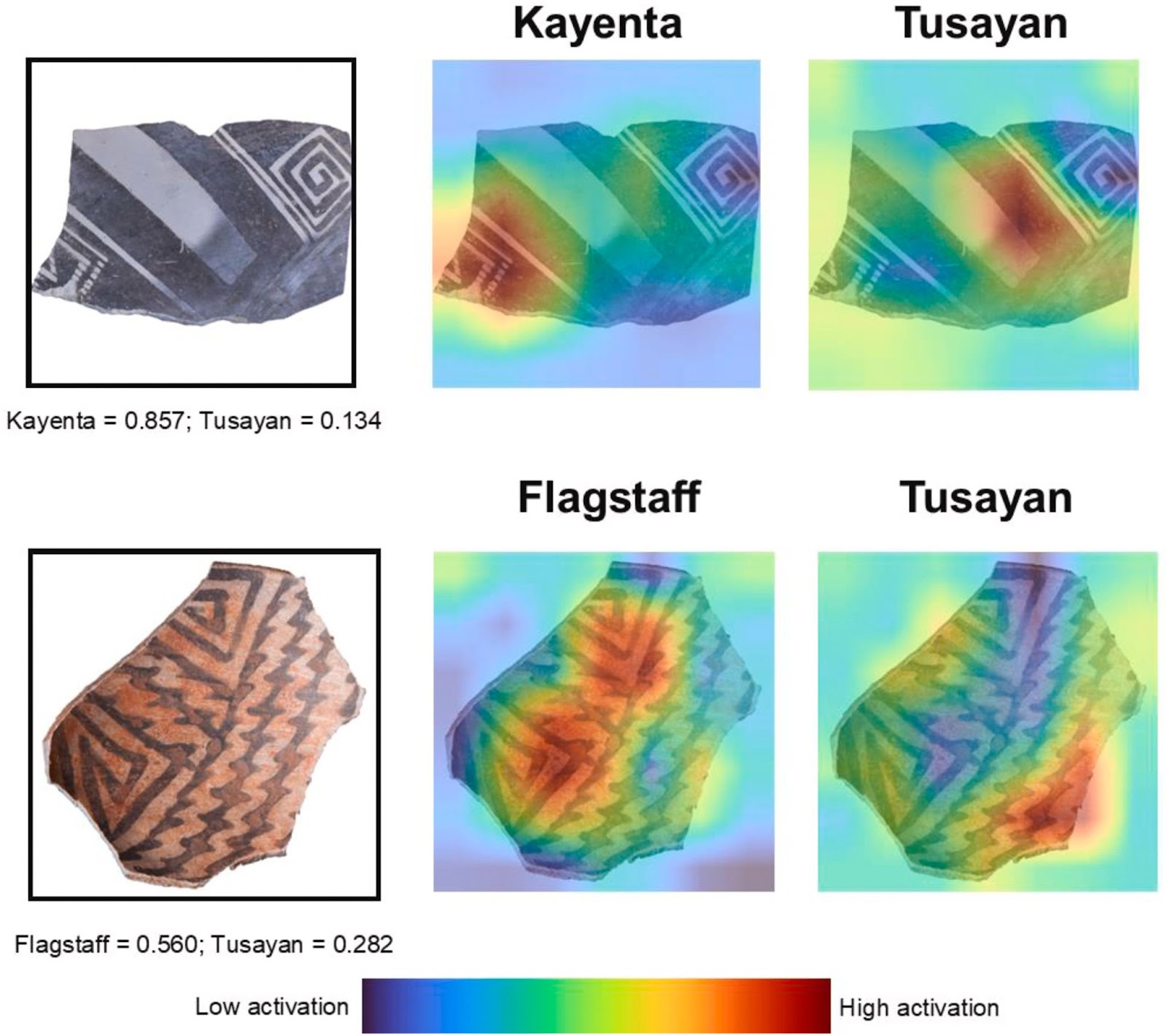
And finally, the question everyone is waiting for: why haven't all these advancements happened? Or when can they happen? Responding first to the second question, it's difficult to give dates, especially considering that archaeology's pace of development is very different from other disciplines. With such little investment, this discipline usually lags behind in technology, incorporating those that interest them but originally developed for other environments like architecture, engineering or video games. Regarding the first question, here the answer is quite simple and can be divided into two main reasons: the scarce funding for archaeology and even less for developing software programs and technologies to develop these AI models and secondly, and perhaps more importantly, the small and limited amount of useful databases for the community to develop recognition models. There's much reluctance in publicly sharing digital collections of scanned or photographed pieces which either have poor quality or their number and diversity is incompatible with any decent or useful classification model at a research level.
Today, anyone could work on a breed recognition model for dogs based on the vast amount of images circulating online, but classifying Roman ceramics, for example, becomes a monumental task.
Fortunately, this reluctance is slowly fading and networks are starting to accumulate more and more data that, when well organized, can make reading pottery as easy as identifying a flower (as already done by applications like PlantNet).
Bibliography:
- Leszek M. Pawlowicz, Christian E. Downum, Applications of deep learning to decorated ceramic typology and classification: A case study using Tusayan White Ware from Northeast Arizona, Journal of Archaeological Science, Volume 130, 2021, https://doi.org/10.1016/j.jas.2021.105375.
- https://g3a.es/inteligencia-artificial-y-arqueologia/


Comments