
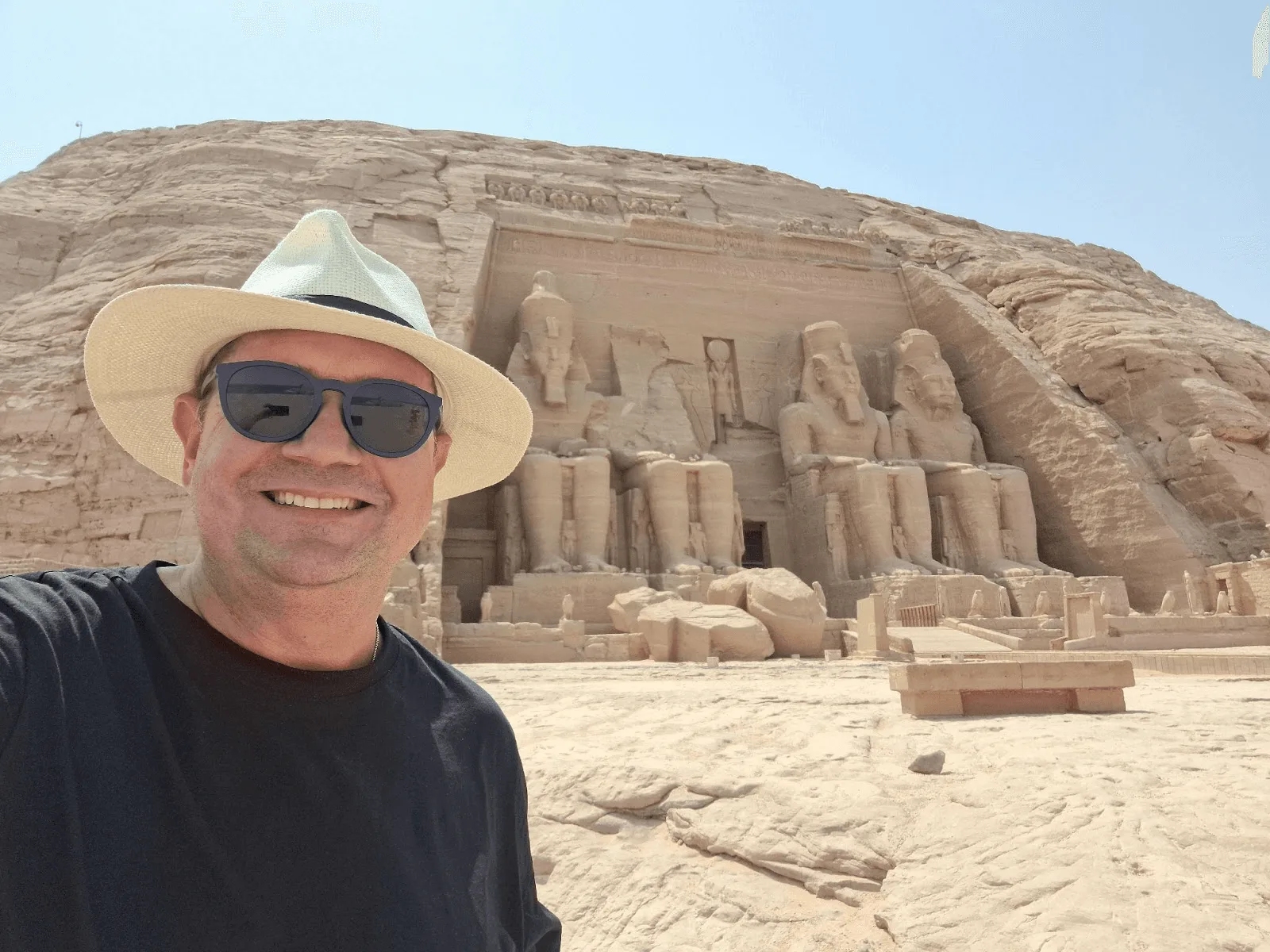
Nacho Ares is a Spanish historian, Egyptologist, and science communicator who earned his degree in Ancient History from the University of Valladolid and his diploma in Egyptology from the University of Manchester. He served as director for a decade at the Archaeology Review and has contributed to publications such as National Geographic History and Ancient Egypt Magazine, translating and publishing numerous books on ancient Egypt. Since 2009, he has led and hosted the SER Historia program on Cadena SER, following his involvement in shows like Milenio 3 and Cuarto Milenio, and currently develops the podcast and channel Inside the Pyramid.
He was commissioner for the exhibition Daughters of the Nile (2022) and for Tutankhamun: The Immersive Exhibition (2023) in Madrid. Currently, he holds the same role for Cleopatra: The Immersive Exhibition at Madrid Arts Digital (Matadero Madrid), a multisensory exhibit that aims to debunk myths about Egypt's last queen through digital technology, virtual reality, and holograms, solidifying his position as one of the most prominent voices in Egyptian science communication in Spain.
- Where does your passion for history and specifically Egyptology come from?
It all started when I was just 14 years old and read the book Gods, Tombs, and Scholars for a school project. I had to write about the discovery of Tutankhamun's tomb, which left me enamored with the world of pharaohs. This is one of the best history books on archaeology ever written and it continues to be reprinted. I recommend it to everyone.
- The history of ancient Egypt has always fascinated the general public, but there are controversies over historical inaccuracies in fictional series and documentaries. In some of your books, you combine rigorous history with narrative fiction. How do you decide what to present as an essay versus what to present as fiction?
Science communication needs to be flexible. The moment I put Tutankhamun speaking in Spanish is already a historical aberration. This type of work must adapt to the reality of each era so that everyone can understand it. In my novels, I always use or rather, always rely on elements that have their backing from an archaeological and historical perspective, but what wraps everything up, the novel itself, I am convinced would make someone from ancient Egypt laugh.
- In your role as a science communicator, you've experimented with various formats such as radio, books, or even conferences. What differences do you find between these media? Is there any in which you feel more at ease when developing content?
Each has its magic. In the end, it's about making something attractive with whatever means are available to you. The use of videos, audio, images, etc., makes information more accessible and appealing. I feel most comfortable writing. When I write a novel, I always imagine scenes as if they were in a movie. This has been developed at MAD through the scripts for all immersive experiences we've created. It's almost magical to write a script and suddenly see it come alive on a big screen. The latest technologies in sound attract me greatly. On the radio, I use many resources with effects, voices, music, etc. I love playing with AI and getting the most out of it; I find it an incredible tool. I don't understand why people demonize it. Some colleagues see it as the devil on the radio, and I usually respond that if looking to the future is so demonic, they should go home in a carriage or write with quill and parchment.
- Regarding your publications, are there any periods or topics you haven't covered yet but would like to explore in the future?
The period of ancient Egyptian history that I find most fascinating is the New Kingdom era, particularly Tutankhamun's reign. It's a captivating time full of enigmas and mysteries. I've written extensively about it. As for Cleopatra, I have only written scripts for MAD for the immersive exhibition, but I would like to delve deeper into her story. The Ptolemaic era is incredibly fascinating with many gaps in our knowledge. And you know that I particularly love mysteries such as pyramid construction, hidden chambers in tombs and temples, etc. We don't even know how Cleopatra died or where she's buried.
- For those readers who are getting to know you through this interview, which of your books would you recommend to someone who hasn't read anything by you and why?
I particularly like my first historical novel about Egypt, The Lost Tomb (Grijalbo 2012). It deals with Tutankhamun's life and the period after his tomb was discovered. Since I read as a child the book by Ceram on the discovery of the Pharaoh Boy's tomb, Carter, Lord Carnarvon, etc., have fascinated me. I've tried to follow in their footsteps wherever they walked and they've inspired many moments in my life.
- The Cleopatra exhibition you've curated at Madrid Arts Digital combines virtual reality, immersive projections, and other digital resources. How did you plan the design to reach both a general audience and those more familiar with history?
History is fascinating and sells itself. And Cleopatra has all the elements for telling an excellent story. She's a very popular character, almost a pop icon. But her story was told by her enemies, and that's what historiography has stuck to. In recent decades, new work has emerged revising old concepts that have nothing to do with who Cleopatra really was. We won't idealize her and say she was a saint, but we need to place her in a specific context to understand the things she did. If we don't know about the problems in her family, at court, in her country, in the Mediterranean, and in Rome, we'll never understand her personality.
- The figure of Cleopatra has reached us through classical sources and has been portrayed in popular culture through film, literature, comics, etc., which often emphasize her power of seduction, romantic role, or myth. What aspects of the historical Cleopatra does this exhibition aim to highlight that perhaps contradict these widespread representations?
Primarily, we want to break myths and present a much more realistic woman. She was an extraordinary strategist, diplomat, politician, a cultured woman who wrote books and left behind treatises on medicine and other fields of science such as weights and measures. Her physical appearance wasn't what films have made us believe. She wasn't ugly but neither was she beautiful. She would likely go unnoticed in any park or street walk. But her personality was overwhelming, making her very attractive due to the intelligence she possessed.
- Do you think digital museography can ever replace direct contemplation of original artifacts, or will it always be a complement?
It will always be complementary. It can never replace the real thing. A physical object takes you back in time in a tangible way. Virtual reality is just a momentary sensation, but the piece remains there. They complement each other perfectly because what's virtual contextualizes the real.
- How do you envision the dissemination of Egyptology within 20 years with the advent of artificial intelligence and new technologies?
It will be a marvel. Today we're already taking small steps to enjoy truly magical things on our phones or computers. When testing before the premiere, for example, the virtual reality of Cleopatra, creators sent us video files that we could enjoy at home with VR goggles... made of cardboard! To amaze. I'm sure in 20 years it will be much more advanced and sophisticated.
- Finally, what advice would you give to future Egyptologists who want to delve into research on the Egyptian world?
Thirty years ago, I was told to forget about Egyptology and study English, French, and German because all the work on Egypt was written in these languages. Today everything has changed, and we have tools at our fingertips with translators, online libraries where absolutely everything is available. No longer do you need to take a train to Madrid, go to the Archaeological Library or Complutense University library, and after 3-4 days, perhaps with luck, find some things. Today in less than one minute, AI finds the publication and page with the data you're looking for. But for all that to make sense, it's essential to love and enjoy history, specifically ancient Egyptian history. Otherwise, you won't achieve anything. You must know how to handle the tools we have at our disposal, and from there, any dream can be achieved.
You can find more information about Nacho Ares through his profiles and projects on the following links:
Instagram: @nachoaresoficial
Twitter (X): https://x.com/nachoares
Facebook: https://www.facebook.com/Nacho.Ares.Oficial
YouTube: https://www.youtube.com/user/dentrodelapiramide
Other: https://nachoares.com/
Interviewed by:
María José Minuesa Grau
Director of ArqueoTimes
Mª Dolores Rodas Romero
Communication Department
Interview conducted with the collaboration of:
Mónica Ferreiro Pérez
Review Area


Comments