
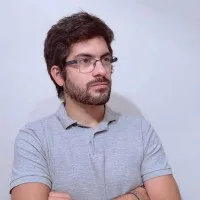
Miguel Ángel Cajigal (A Coruña, 1981), better known as El Barroquista, is an art historian, professor, and one of the most influential cultural communicators in the Spanish-speaking world. Trained in Art History at the University of Santiago de Compostela and with experience as a museum educator and heritage manager, he is a member of the International Council of Museums (ICOM) and the International Council on Monuments and Sites (ICOMOS). His professional activity has focused equally on research and bringing art to the general public.
Since 2015, he has developed an intense presence on social media, where his threads on Twitter/X and content on Instagram and YouTube have renewed the discourse about art from an accessible and critical perspective. Author of Otra historia del arte (2021) and Otra historia de la arquitectura (2023), Cajigal advocates for a bias-free view, where enjoyment of art does not depend on the academic canon. His work has been recognized with the Best Digital Educator Award in Spain in 2022 in the history category and the Zapping Prize as Best Communicator Online in 2025, consolidating his figure as a bridge between traditional artistic heritage and new forms of storytelling.

- Let's start at the beginning, where does your interest in Art History come from? And why El Barroquista?
I started to be interested in art history during high school. In different courses I had to face this discipline and I loved it because it serves better than any other to try to reconstruct how people thought in the past. Then, I took a specific course in college with an extraordinary professor, and my love for the subject stuck with me for life. As for El Barroquista, initially I focused my communication only on that period, very unknown despite its importance. But soon I realized it was important not to talk just about styles or periods but to introduce people to art history itself and cultural heritage, which is so important for our society and yet receives little educational attention.
- Your profile as El Barroquista has grown thanks to threads and publications on social media. What have these platforms meant for artistic communication, education, what limits do you find in them? And what future do they hold?
Until recently, social media allowed an unprecedented connection with people working in scientific or academic fields. That specialized individuals can chat directly with those interested in our areas of work has been a revolution. It also gave visibility to several generations of cultural communicators and that is something I value greatly. But in recent years this has changed a lot. Social media are currently promoting an anti-science wave that affects the dissemination of knowledge directly. They are a minority, but very noisy and organized, who have managed to make many professionals abandon communication on social networks because it obviously doesn't make sense to endure attacks just for sharing knowledge. This phenomenon affects more experimental sciences and in fact was triggered by vaccine hesitancy during the pandemic. But this type of attack has also reached the realm of cultural communication because history, archaeology, and art are susceptible to ideological manipulation as well. This hate is a serious problem and social media are at the core of its spread, even though they are minority, making it difficult for us to share knowledge. I believe tackling these attitudes is the main challenge for future communication channels in society.
- As an ICOM member, how do you value the current situation of museums? What should they change to remain significant spaces in the 21st century?
Museums have advanced a lot but society is always faster. First because social changes are increasingly rapid and second because museums are infrastructures with many guarantees for society, which also implies that they are not particularly agile to change, even legally. A lot of work has been done, but the main challenge remains converting museums into spaces where anyone feels represented and interested regardless of purchasing power or academic level. Of course, we have advanced a great deal, so much so that I'm not sure people appreciate it. But stagnation is not an option.
- On some occasions you mentioned the importance of art in the present. What role can art history play in today's world, marked by social and technological urgencies?
Before I talked about the pandemic. In that health crisis, which was also social as its grave consequences show us currently, art was a refuge for millions of people. Culture has many values but one of the most important is its ability to consolidate our identity and at the same time understand other peoples' identities. When you defend culture from this point of view, which is also very emotional, it seems that many people see you as naive, but it's a fact that this is one of its great values. Even for those who believe art doesn't interest them.
- In an interview on Voces del Patrimonio, you mentioned how the Notre Dame fire generated a global shock, while many other heritage elements with greater historical, symbolic or architectural value disappear without much social reaction. What role do you think an Art Historian should have in this context of selective indifference towards heritage?
On one hand, art history is key for society to understand the role of cultural heritage. In that work we obviously establish categories which can be a very dangerous weapon to use responsibly. Simply choosing what artworks you will use for an Art History course means being aware of the implications of including or leaving out a work, style, or certain languages. Exclusion is what causes this "selective indifference" you mention. That's why in recent decades we've worked so much on taking awareness that we have left aside, in a corner, women's art, or art from certain communities, collectives and cultures. And that discrimination was not due to reasons of quality or importance but simply because it favored a canon with ideological motivations. Every time we recall this from the perspective of art history there are people who roll their eyes, clench their fists and say they prefer when we talk "just about art." I fear they don't understand what art history consists of, because before recovering women's art we recovered, for example, Gothic, Romanesque and Baroque, which had also been in a corner. If someone finds it fine to recover Romanesque but doesn't like the recovery of women's art, the problem isn't with art history.
- In that same interview you said knowing Art History enriches our way of seeing the world and adds depth to our experiences. From a generational point of view, how do you value the interest of younger people towards cultural heritage?
I believe young people have great interest in art. The problem is that there's this millennial habit of blaming recent generations for lack of interest in everything, which isn't true at least in our cultural field. Cultural consumption statistics clearly show that younger people are not the problem and they consume culture including museums or literature more than older generations do. There are other more intense problems that don't alarm as much, such as men's disinterest towards culture: anyone who works in culture knows that the general profile of museum, art or literature consumers is predominantly female across all possible ages. It says a lot about our societal biases that we always worry about "the young" and culture when adult men barely consume it and there aren't so many headlines about that.
- You also commented that to avoid the saturation of major cultural destinations is key to offer alternatives and give visibility to less known spaces. Could you share any practical example or how do you think visits could be distributed better?
It's clear there are places everyone wants to visit if they have the chance. It doesn't make sense to criminalize tourism for wanting to visit Venice, the pyramids or the Louvre. Tourism isn't bad at all. But excessive flow is like a flood: water isn't bad but in excess and concentrated over time it's very destructive, just as mass tourism can be. Moreover, tourism will only increase so we have to take awareness of the management problem this implies. In all high-demand cultural spaces there must be visitation turns with prior reservation. Whether you like it or not, there is no alternative. This system shouldn't aim for profit: sites should not restrict themselves to those who pay most but to those who reserved in advance. It shouldn't be an economic barrier, yet that's what has happened recently: museums and monuments have become more expensive after the pandemic and besides, people with more resources make private visits outside regular hours, they don't enter the general schedule like we do, which is overcrowded. This must be combined with less promotion of saturated places and alternatives for those receiving few visitors but having equal or greater interest; legislation on tourism emphasizing that our behavior when traveling should respect both the places and people living there and punishing harshly those who don't respect it; and above all, focusing a lot on education so we become tourists who do not harm spaces visited nor people living in them. It's not difficult but slow and seems uninteresting for now. Only cities and countries react when the situation is traumatic and perhaps irreversible.
- In your books you defend that "it's okay if you don't like Las Meninas" and that our home can be better than Versailles. What goals did you set with these titles and how has the public reacted?
With a book title, you aim to provoke reading interest but also must relate to the main thesis of the work. Writing for dissemination is very complicated. In my experience, writing one page of popular science takes between double and triple the time than an equally long scientific text. It's much harder and I believe many people aren't aware of this. So you have to find formulas so that someone not initiated in a topic feels curious about the central theme of your book. A preview of content which at the same time motivates reading it. By the reception of both books, I'm very satisfied. The goal with both was no other than bringing general public closer to how art history works, which for me is the most important.
- To finish, what advice would you give someone considering developing a career in Art History or cultural communication?
Above all that it's a long-term career requiring much hard work over many years without immediate results. I believe many people aren't aware of the number of daily hours behind a dissemination project, like mine or those of many colleagues in this task. The important thing is to be clear you want to share knowledge with others and I have that very clear.
You can find more information about Miguel Ángel Cajigal through the following links to his profiles and projects:
LinkedIn: https://es.linkedin.com/in/miguelangelcajigal
Instagram: https://www.instagram.com/elbarroquista/
Twitter (X): https://x.com/elbarroquista
Facebook: https://www.facebook.com/elbarroquista/
Other: https://bsky.app/profile/elbarroquista.bsky.social
Interviewed by:
Francisco Javier Luengo Gutiérrez
Arqueotimes Board Member
Mª Dolores Rodas Romero
Communication Area
Sources consulted:


Comments