

This past 2024 marked the 50th anniversary of one of the most notable and peculiar milestones in Menorcan archaeology: the discovery, in an archaeological context, of a bronze statuette of Imhotep, the architect of Djoser's Step Pyramid, who was later elevated to god of medicine. Its discovery opened up new questions and hypotheses not only about Talayotic culture but also regarding the reach and expansion of Pharaonic Egypt in Western Mediterranean.
An Unexpected Discovery
In April 1974, the team led by Mallorcan historian Guillem Rosselló Bordoy undertook some work to prepare the Talayotic settlement of Torre d’En Galmés (occupied approximately between 1400 and 123 BCE) in the municipality of Alaior for a site plan. Their main interest was focused on what is known as the Taula Enclosure. These structures, identified as sanctuaries, have a characteristic layout divided into two spaces: an anterior space where ceramic and fauna remains are usually concentrated, and a sacred zone. Both zones are separated by the presence of the taula, which gives these enclosures their name and consists of two megalithic rocks superimposed to form a giant T. This sanctuary had already been excavated in works carried out in 1942 and 1943 by Joan Flaquer Fàbregues, publishing his findings in 1953. Therefore, initially, the structure was considered fully explored. However, in the work initiated by Rosselló Bordoy, areas were noticed that still retained some potential (Rosselló et al., 1974, p.2). One of those areas corresponded to what is known as the "iconostasis pilaster," generally located in the northwest corner of the enclosure, in the sacred zone, where most statuettes or figures associated with worship are usually found. The surprise was immense when, upon completing the excavation that had been left unfinished in this corner, the researchers came across an unexpected find: a bronze statuette made in Egyptian style depicting the god/architect Imhotep. The question that arose was obvious: How did an Egyptian deity end up in a Talayotic sanctuary?

Imhotep: From Architect to God
Imhotep was one of the most prominent figures in Ancient Egypt, known as the architect responsible for building Djoser's Step Pyramid during the Third Dynasty (2682-2663 BCE). This is the oldest pyramid preserved in Egypt and was constructed by stacking several mastabas to achieve a triangular shape. During his lifetime, he held the highest offices and titles: first after the king, belonging to the nobility, chief of the great house, the one who sees the Great One, chief sculptor, among others. His proximity to power was so significant that he was even mentioned in hieroglyphics dedicated to the pharaoh himself. However, his fame did not end there; it transcended beyond his time. Already during the Middle Kingdom, his figure, semi-deified, was associated with a great sage and magician of his era. Nonetheless, it was during the New Kingdom and Late Period (1600-1100 BCE and 1100-30 BCE) when his deification solidified amid a revival of ancient cults. His figure was paired with that of the god Ptah as his son, being considered a deity associated with medicine and thus with the Greek god Asclepius.
In the 6th to 5th centuries BCE, his worship was accompanied by mass production of figurines, generally made of bronze and varying in quality but recognizable iconographically: he is usually depicted seated wearing priestly attire and holding a papyrus scroll.

A Talayotic Culture Open to the Mediterranean
Across the Mediterranean, Mallorcan and Menorcan societies were immersed in changes marking their transition into the Iron Age, a period known as Post-Talayotic (600-123 BCE). These changes can be observed both architecturally (gradual abandonment of talayots, emergence of sanctuaries and taulas) and socially (greater social stratification, appearance of certain elites, use of prestige goods). At the same time, there was a greater openness to the outside world that we can see in trade as well as in the participation of Balearic slingers in various conflicts as mercenaries.
This great economic and cultural exchange could partly explain the arrival of Imhotep at the Menorcan sanctuary. It is known for Punic trade of Egyptian products throughout the Mediterranean. However, there are two details that might indicate it's not simply a mere "souvenir" from distant lands.
On one hand, we have the fact that the Imhotep of Torre d’En Galmés is the only statuette of the god found in an archaeological context outside the Saqqara region.
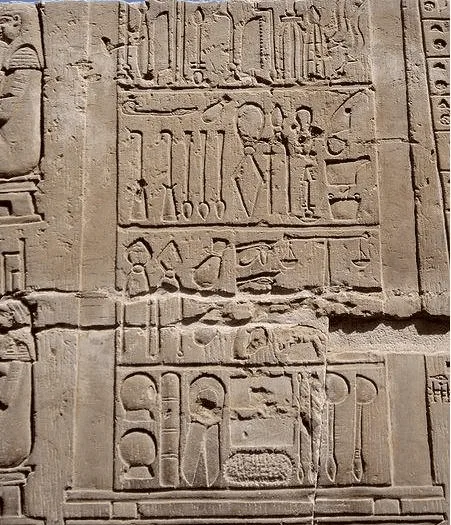
The second notable aspect is its location within the taula enclosure and the elements found around it, which point to a healing cult. As we have already mentioned, the figurine was found in the sacred zone known as the iconostasis pilaster, generally associated with the deposition of votive and sacred images. Additionally, alongside the image, there was a pile of stones that can be linked to the libation rite, common in the worship of the god of medicine, as well as 2 metal lancets similar to surgical instruments used at the time, such as those we see depicted on the hieroglyphics from Kom Ombo.
The Mystery Remains Unsolved
Both the chosen location and the elements accompanying it seem to indicate that the people who placed Imhotep's figure in this sanctuary space knew both his divine origin and his attributes associated with medicine. The mid-twentieth-century discovery of a Horus figurine in a field near Mahón could reinforce this hypothesis.
However, the real intentionality and route by which these elements reached the lives of Menorcan Talayotic people continue to pose many questions.
Direct trade with Carthage; the proximity of Punic Ibiza, a recipient of the great Phoenician tradition of exchanges with Egypt; the own experiences of slingers who could bring new cults from their expeditions; Greek commercial circuits; or perhaps some remote contact between Menorca and an Egyptian element, might explain why someone decided to dedicate a sacred space to the god-architect Imhotep on this isolated island across the Mediterranean.
Both the Horus figurine and the Imhotep statuette remain on display at the Museu de Menorca. From their showcases, they remind us that the ancient Mediterranean was a more complex, rich, and interconnected period than we might have imagined.
Bibliography
Flaquer Fábregues, J. (1953). Alayor (Menorca) Torre d’En Gaumés: Excavaciones de 1943. Madrid.
Flinders Petrie, W. M. (1998). The Religion of the Egyptians. Barcelona: Ediciones Abraxas.
Grimalt, F. (2020). Sobre els talaiots. Manacor: Món de Llibres Edicions.
Hurry, J. B. (1926). Imhotep the Egyptian god of medicine. Chicago: Ares Publishers.
Riudavets, I., & Ferrer, A. (2021). The Talayotic Culture of Menorca: An Island Between the Bronze Age and Iron Age. Madrid: Dilema.
Rosselló Bordoy, G., Sánchez-Cuenca, R., & De Montaner Alonso, P. (1974). Imhotep son of Ptah. Mayurqa, 12. (Separata). Palma de Mallorca.


Comments