

Victoria Alicia Isabel Julia María, known as Princess Alice of Battenberg, was born at Windsor Castle on February 25, 1885. She was a great-granddaughter of Queen Victoria of the United Kingdom because her mother, Princess Victoria of Hesse, was the eldest daughter of Grand Duchess Alice of Hesse and granddaughter of Queen Victoria. Her father was Prince Louis of Battenberg, who became Marquess of Milford Haven after renouncing his German title during World War I. Alice had three siblings: Louise, future queen of Sweden; George, Royal Navy captain and second Marquess of Milford Haven; and Louis, first Count Mountbatten of Burma, nicknamed Dickie by the family (Vickers, 2002, pp. 2-18). Since childhood, Alice had speech difficulties and was soon diagnosed with congenital deafness (Vickers, 2002, pp. 25-26).
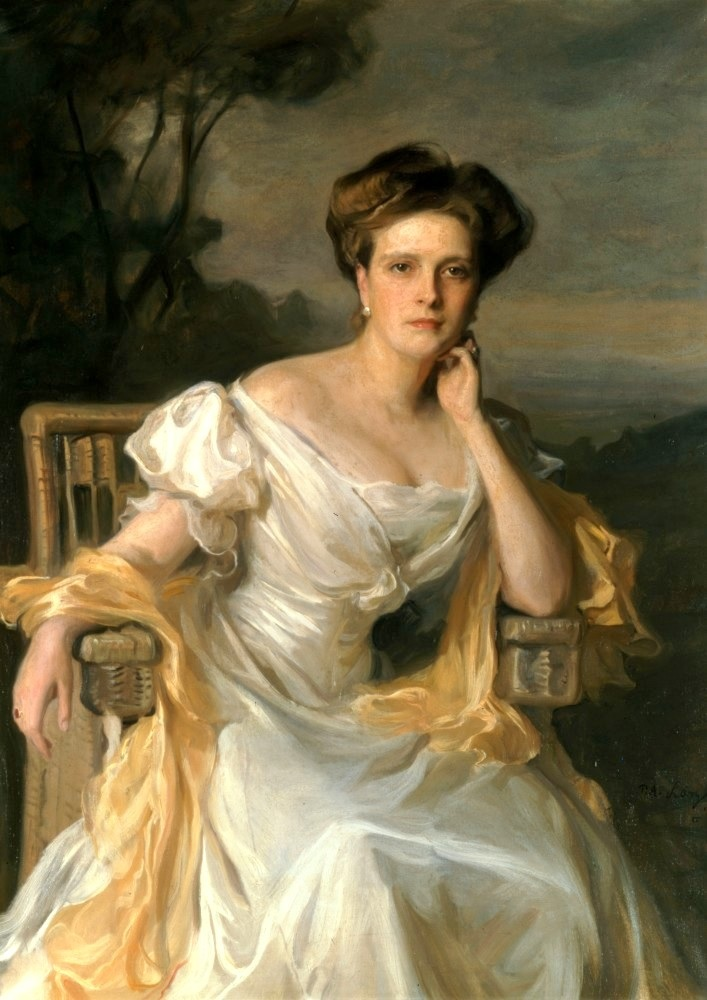
With the help of her mother, she learned to read lips and thanks to her determination managed to speak English, German, French, and Greek. She would learn this last language after becoming engaged to Prince Andrew of Greece and Denmark. The marriage took place in 1903 in Darmstadt, just a year after they met during the coronation of King Edward VII. This union united the royal houses of the United Kingdom, Germany, Denmark, Russia, and Greece, and Alice became Princess Andrew, adopting her husband's name. They had five children, one of whom would become the future husband of Queen Elizabeth II, Prince Philip of Edinburgh. After their marriage, the princess got involved in charitable causes while her husband continued his military career. Following a visit to Russia in 1908 for a royal wedding, she discussed with her aunt, Grand Duchess Isabel Feodorovna, the possibility of founding a religious order of nurses (Vickers, 2002, pp. 55-84). The grand duchess became a nun after her husband was assassinated and sold all her possessions to open a convent for helping those in need. However, she would be murdered along with other members of her family by the Bolsheviks in 1918 (Nelipa, 2010, pp. 269-270). This idea inspired Alice to live a more religious life.
In 1922, after years of wars and coups, the family of Princess Alice and Prince Andrew of Greece went into exile, evacuated by the British royal family upon hearing Alice's pleas for help as she feared her husband would be killed. The entire family moved to France but their marriage began to deteriorate due to the prince’s frustration at being sidelined from his military career and accused of treason. Despite being an exiled family living off charity from relatives, Princess Alice continued helping Greek refugees. However, her mental health gradually declined. In 1928 she converted to Orthodox Christianity and in 1930 was diagnosed with paranoid schizophrenia by various experts after revealing that she received divine messages, had healing powers, communicated with Jesus Christ, and suffered depression (López Jimeno, 2021, pp. 39-40). Her family decided to intern her at a sanatorium for treatment. She was admitted against her will to the German clinic Kurhaus Schloss Tegel. Its director, Ernst Simmel, consulted the case with neurologist Sigmund Freud, who suggested that the patient's ovaries be exposed to high-intensity X-rays to accelerate menopause and thus eliminate her libido, as they believed her religious delusions were a result of sexual frustration (Nobus, 2020, pp. 1-2). Despite resistance and attempts to escape, she remained there for two years. However, years later she was again interned because her family feared her reintegration into society. Her mother tricked her by promising a reunion with her son Philip and forcibly admitted her to the Swiss Bellevue sanatorium in Kreuzlingen where she would stay more than two years.
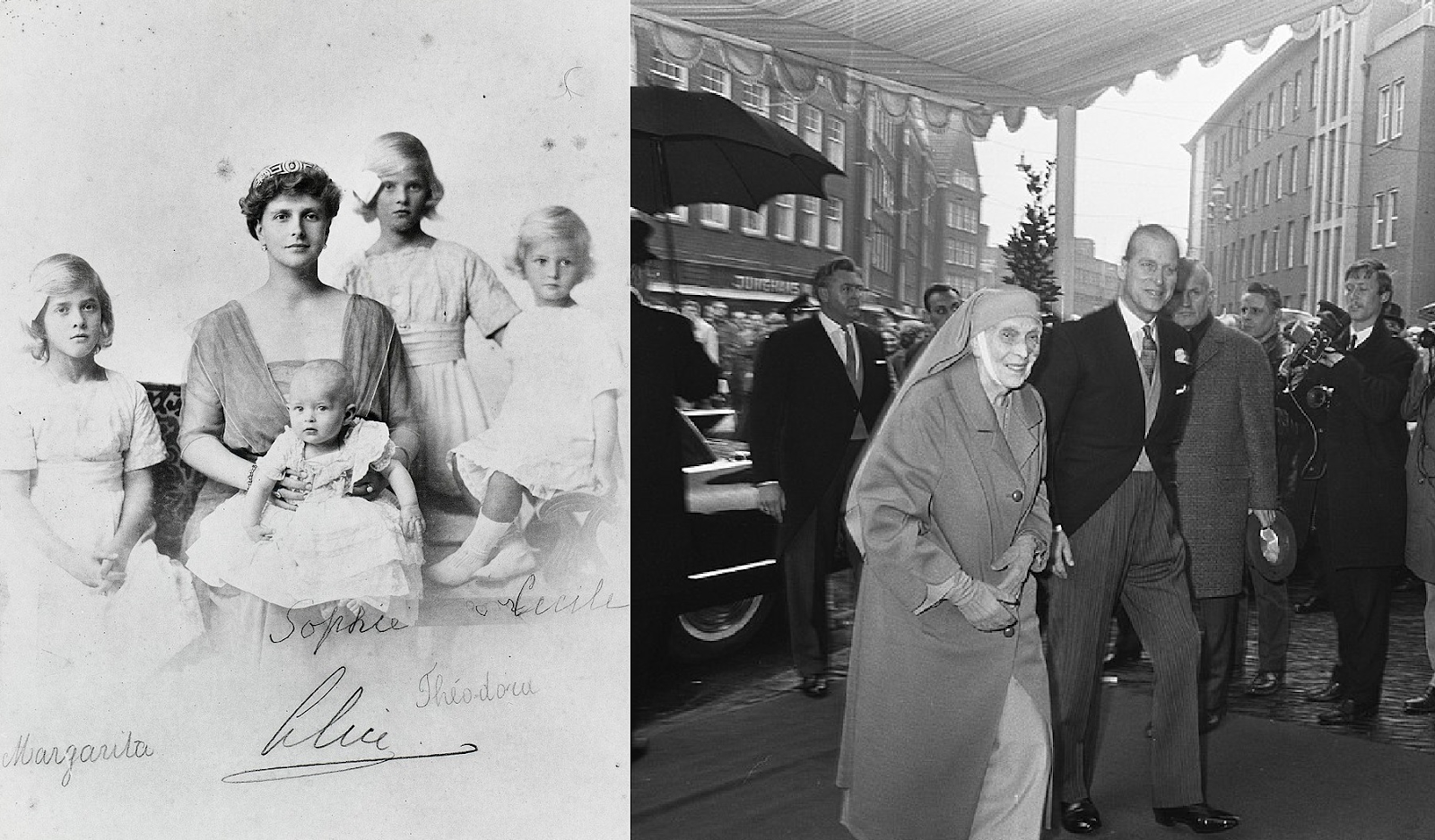
When she finally came out, her four daughters had married German princes close to Nazism, her son was studying in the UK under his brother Dickie's tutelage, and her husband had moved to Monaco with his mistress. In 1939 with the outbreak of World War II, the Germans occupied all of Greece and Princess Alice decided to help by taking in orphaned children, training nurses, organizing social dining rooms (López Jimeno, 2021, p. 45) and even hiding a Jewish family in her Athens home. For this reason, decades after her death, she was named in Jerusalem by Yad Vashem (Holocaust Memorial) as "Righteous Among the Nations" (Kelley, 1997, p. 100). During the war, she would break curfew to distribute food. Once warned that a stray bullet could hit her,she responded: “they told me you don’t hear the shot that kills you and anyway I’m deaf. So why worry about it?” (Vickers, 2002, p. 311).
During her life, Princess Alice only attended one of her son's weddings, that of Philip to the future Queen Elizabeth II of the United Kingdom in 1947. The bride’s mother considered Princess Alice: "pleasant but odd... very odd indeed," eccentric and overly religious (Kelley, 1997, p. 100). After her son's marriage with the Windsors, she continued to have contact with them, attending events and family vacations (López Jimeno, 2021, pp. 40-42). In 1949, in a property outside Athens, she founded an Orthodox monastic order called the Christian Brotherhood of Martha and Mary, which aimed to help orphans and elderly people. Her mother, the Marchioness of Milford Haven, undervalued her efforts and said: “What can one say about a nun who smokes and plays basketball?” (Rey y Cabieses, 2015, p. 2). Decades later, in 1967, the coup d'état of the colonels in Greece made Alice return to Britain at her son Philip's request due to potential danger. She settled at Buckingham Palace but before leaving Greece she donated her mansion to the Greek Red Cross for it to become a home for the elderly, which still stands today (López Jimeno, 2021, pp. 40-42). Finally, in 1969, Princess Alice died at the age of 84 in Buckingham. She had no material possessions as she gave away everything she owned. Her last wish was that her remains rest in the Convent of Saint Mary Magdalene on the Mount of Olives (Jerusalem), near her aunt's grave, Grand Duchess Isabel Feodorovna. Her daughter Sofia suggested that this place would be too far to visit her tomb, to which Alice replied: “Nonsense, there’s a perfectly good bus service!” In 1988 her remains were finally transferred to the crypt beneath Saint Mary Magdalene's Church (Vickers, 2002, p. 396).
In conclusion, Princess Alice embodied a break from the standards imposed on royal women. Despite being undervalued due to her health issues and complex family situation, she lived a life serving those in need. Therefore, her legacy does not consist of her titles or being the grandmother of today's King of the United Kingdom but rather in her good deeds and defense of religious ideas.

Bibliography
Kelley, K. (1997). The Windsors: A Photographic Portrait of the British Royal Family. Plaza & Janés.
Vickers, H. (2002). Alice: Princess Andrew of Greece. St. Martin’s Griffin.
Nelipa, M.. (2010). Murder of Grigorii Rasputin: A Conspiracy that Brought Down the Russian Empire. Gilbert’s Books.
Nobus, D. (2020). The Madness of Princess Alice: Sigmund Freud, Ernst Simmel and Alice of Battenberg at Kurhaus Schloß Tegel. Brunel University.
López Jimeno, M. A. (2021). Alicia de Battenberg , The Crown (Netflix) y la historia contemporánea de Grecia. Metakinema Revista de Cine e Historia, 25.
Rey y Cabieses, A. M. (16 July 2015). Alicia de Battenberg , the nun mother-in-law of Queen Elizabeth II. Real Academia Matritense de Heráldica y Genealogía. http://www.ramhg.es/images/stories/pdf/casas-reales-y-soberanas-articulos/alicia%20de%20battenberg.pdf



_en_zijn_moeder_bij_de_kerk,_Bestanddeelnr_919-0424.jpg)

Comments