

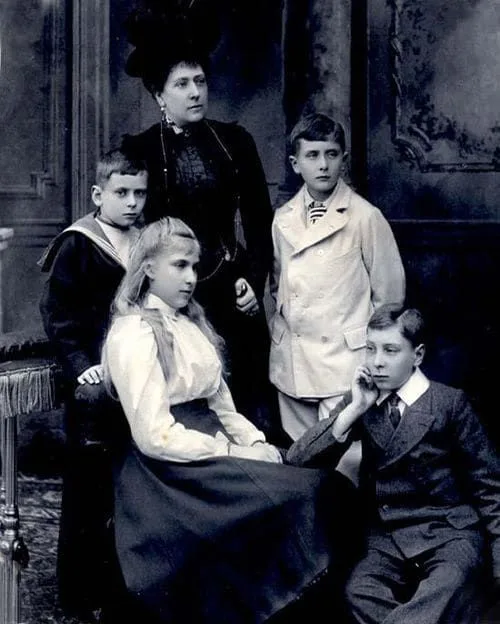
Victoria Eugenie Julia Ena of Battenberg, born on October 24, 1887, in Balmoral Castle, Aberdeenshire, Scotland. She was the daughter of Prince Henry of Battenberg (1858-1896) and Princess Beatrice of the United Kingdom (1857-1944), the youngest daughter of Queen Victoria (1819-1901) (Noel, 1986, pp. 13-16). She was named Victoria in honor of her maternal grandmother; Eugenie, after her godmother, Empress Eugénie de Montijo; Julia, in honor of her paternal grandmother; and lastly, Ena, an ancient Scottish Celtic name by which she was known to her family. It marked the first royal birth in Scotland since King Charles I in 1600 (Fisas, 1989, p. 240). Additionally, it was the first baby born at Balmoral and she was baptized in this castle while Queen Victoria held her throughout the ceremony. Victoria Eugenie would be the second of four siblings: Alexander (1886-1960), Leopoldo (1889-1922), and Maurice (1891-1914) (Noel, 1986, pp. 13-17).
Her birth was not easy; Queen Victoria described it in her diary: «after a terribly long time the child appeared to our great joy and relief, a large and beautiful girl but who had almost died at birth» (Noel, 1986, p.15). That night, a huge bonfire was lit on one of the peaks surrounding Balmoral Castle, Craig Gowan, as a sign of triumph for this happy event. Victoria Eugenie's childhood passed alongside her siblings, parents and grandmother in an atmosphere of constant royal court life with ministers, courtiers, and officials (Noel, 1986, pp. 15-19).
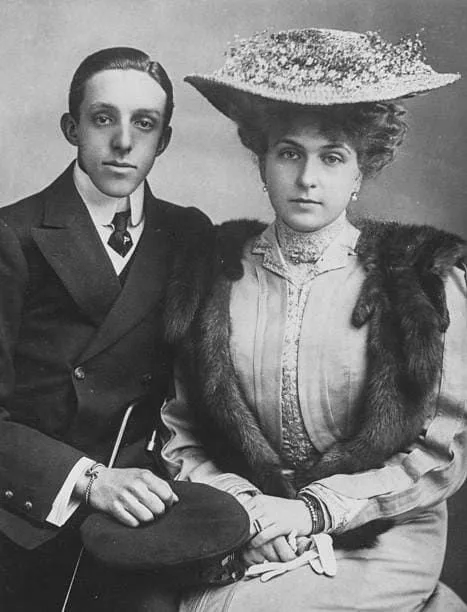
In 1905, Alfonso XIII of Spain (1886-1956) began his journey to find a suitable wife for the future queen of Spain. He was twenty years old and once said: «I will marry a princess that I like and no one else. I want to love my wife» (Noel, 1986, p. 55). The king had set his sights on the young British princess, Patricia of Connaught. However, during his visit to England, his proposal was rejected by this princess. Nevertheless, his affections quickly turned to her cousin, Victoria Eugenie. At a dinner at Buckingham Palace, he noticed the beautiful young woman and asked: «Who is that girl with almost white hair?» Victoria Eugenie believed he had mistaken her for an albino and blushed in embarrassment (Gómez Santos, 1964, p. 39). The young Spanish king approached to speak with her after the dinner. After his visit to England, he began courting the young princess Victoria Eugenie (Noel, 1986, pp. 58-67). For the future queen of Spain, the young monarch seemed: «very thin, very southern, very cheerful, very charming. He was not handsome then, although he improved greatly in this regard later» (Noel, 1986, p. 68).
The wedding took place on May 31, 1906, at the Church of Jerónimos, Madrid. The days leading up to the wedding saw anonymous messages threatening an attack during the royal wedding (Gómez Santos, 1964, pp. 113-122). These threats were carried out. After the wedding ceremony, the royal procession's carriages headed towards the palace. As they passed by Calle Mayor 88, anarchist Mateo Morral threw a bomb inside a bouquet of flowers causing over one hundred injuries and twenty-three deaths (Noel, 1986, pp. 109-119).
Victoria Eugenie and Alfonso XIII had seven children: Alfonso, Prince of Asturias (1907-1938); Jaime, Duke of Segovia (1908-1975); Beatriz (1909-2002); Fernando (1910); María Cristina (1911-1996); Juan, Count of Barcelona (1913-1993), and Gonzalo (1914-1934). Alfonso XIII was informed that his descendants might carry the disease hemophilia but ignored these warnings as he assured this misfortune would not appear in his family. It did: Alfonso, Prince of Asturias, and Gonzalo suffered from it. On the other hand, Jaime was born deaf. Additionally, Queen Victoria Eugenie silently endured her husband's continuous infidelities (Calderón Berrocal, 2013, pp. 127-130).
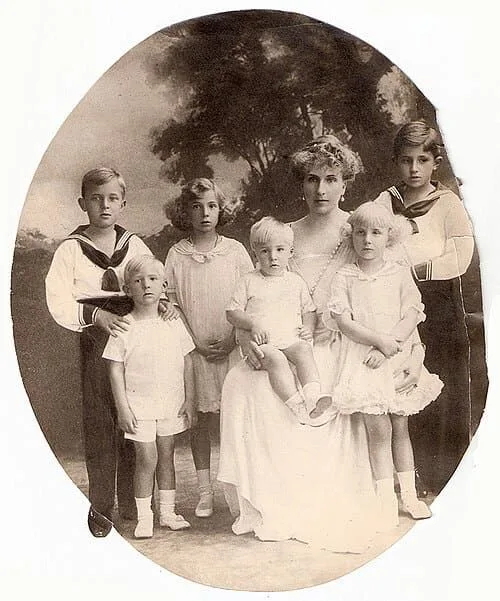
b) Queen of Spain, Victoria Eugenie, with her six children. Source. License: Public Domain.
The queen began to focus her life on helping and improving the conditions of the sick and needy. The level of medical care was, for the most part, very low. Even worse were the levels of nursing staff who belonged to religious orders with an archaic approach to medicine. The queen visited the poorest neighborhoods in Madrid, creating and promoting various charitable organizations: a Spanish branch of the Red Cross, a league against cancer, another against tuberculosis, the Institute for the Rehabilitation of Invalids, and crèches, among many others (Fisas, 1989, p. 251). The formation of the Red Cross society in 1916 under the personal direction of the queen was a milestone as from that moment on, the entire medical system began to improve. The work she did during World War I with the Red Cross helped her cope with the loneliness and sense of isolation she felt at the Spanish court and in her marriage (Noel, 1986, pp. 172-177).
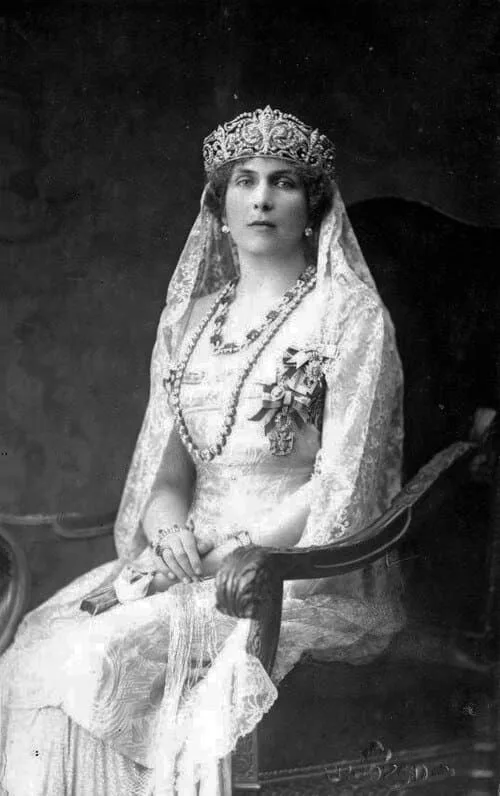
In 1931, after years of turmoil, the monarchy left Spain. Victoria Eugenie left Spain alone with five of her children as Alfonso had already departed (Noel, 1986, p. 249). During exile, the king and queen separated. From 1948 onwards, Victoria Eugenie settled permanently in Vieille Fontaine Palace in Lausanne (Switzerland). It was here that she celebrated her grandson Juan Carlos de Borbón's engagement to Princess Sofia of Greece. She returned to Spain in 1968 after thirty-seven years in exile to be godmother at the baptism of her great-grandson, the current King Felipe VI. Upon returning to Spain, the queen believed Spain had forgotten her exclaiming: «So many years have passed... Surely no one remembers me now!» (Calderón Berrocal, 2013, p. 166). She was admired for her beauty but criticized for her coldness (Fisas, 1989, p. 250). However, Spain had not forgotten her and she was received with great enthusiasm (Calderón Berrocal, 2013, 166). In the words of Infanta Margarita: «We adored her. She knew all of us as well as the palm of her hand. She treated us all equally. She preferred to speak to us in Spanish and not English... on occasion we felt more inclined to open our hearts to her than to our parents... she loved our visits» (Noel, 1986, p. 297).
Being with her fourteen grandchildren was the greatest interest of the queen's life since the 1940s. She hoped they would find a future full of promise, unlike her disappointing life (Noel, 1986, pp. 298-299). In her final years, she recalled the deaths of her sons Alfonso and Gonzalo, exclaiming: «The burdens of state, the difficulty of living with a king whose faults were so extreme, were nothing compared to my pain at losing two children. Love rarely dies suddenly, especially maternal love» (Noel, 1986, p. 299).
On April 15, 1969, she died in Lausanne. Her son Juan covered his mother's body with the mantle of Our Lady of Pilar, patroness of Spain. She was embalmed and buried in a blue robe that her granddaughter Infanta Pilar had given to her. Her head was covered by a white lace mantilla (Noel, 1986, p. 330). Her remains were transferred to Spain in 1985 where they rest at the Monastery of San Lorenzo de El Escorial alongside those of her children and Alfonso XIII (Calderón Berrocal, 2013, pp. 160-171).
In conclusion, the young Princess Victoria Eugenie of Battenberg became Queen of Spain out of love, with a reign marked by sadness from a marriage to an absent and unfaithful husband, rigidity within the Spanish court, and the loss of her children. She dedicated her time to charity and her family in exile, believing she would be a forgotten queen.
Bibliography
Noel, G. (1986). Victoria Eugenie: Queen of Spain. Javier Vergara Editor.
Gómez Santos, M. (1964). The Queen Victoria Eugenia Up Close. Afrodísio Aguado.
Calderón Berrocal, Mª del Carmen. (2013). Notes on Victoria Eugenie of Battenberg, Queen of Spain. Tabularium, 1(10), 109-179.
Fisas, C. (1989). The Stories of the Queens of Spain (House of Bourbon). Planeta.
Obregón, A. (April 19, 1969). Queen Victoria in Portugal. ABC, https://www.march.es/es/coleccion/archivo-linz-transicion-espanola/ficha/reina-victoria-portugal–linz.R-49133


Comments